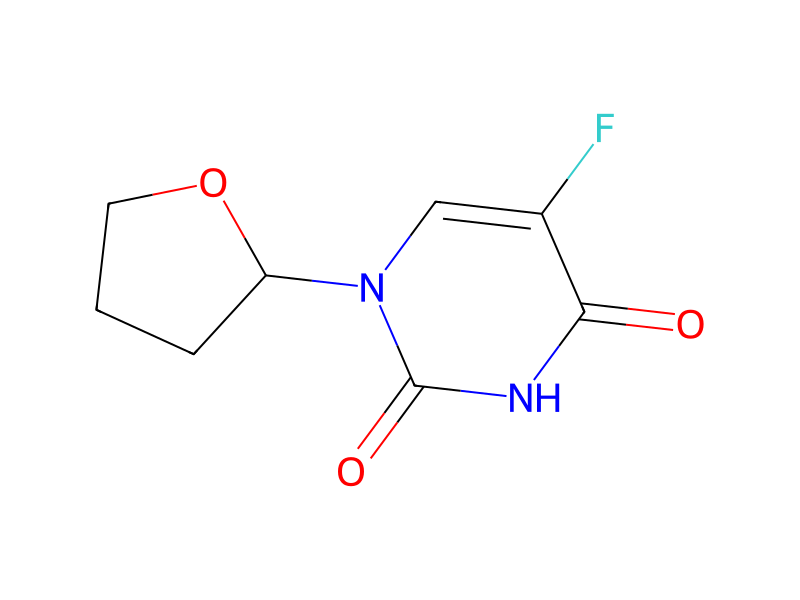
Tegafur
Completing data — refresh the page later to see the latest
Basic information
- CAS
17902-23-7- Standard SMILES
O=c1[nH]c(=O)n(C2CCCO2)cc1F- InChIKey
WFWLQNSHRPWKFK-UHFFFAOYSA-N- Molecular formula
- C8H9FN2O3
- Average molar mass
- 200.17 g/mol
- Monoisotopic mass
- 200.05972037
Overview
Tegafur is an organohalogen compound and a member of pyrimidines.
Names & identifiers
- Preferred name
- Tegafur
- IUPAC
- 5-fluoro-1-(oxolan-2-yl)pyrimidine-2,4-dione
- English name
- Tegafur
- Molecular formula
- C8H9FN2O3
- Molecular weight
- 200.17
Names & synonyms
tegafur17902-23-7FtorafurFutrafulSinoflurolFentalNeberkCitofurLamarLifrilCoparoginFurafluor
Show more names
1-(Tetrahydro-2-furanyl)-5-fluorouracilafurFluaid
FurofutranNitobanilExonalFulfeelTefsiel CRiolFlorafurFT-207
Database identifiers
- CAS
17902-23-7、37076-68-9、82294-77-7- PubChem CID
- 5386
- DTXSID
DTXSID001009966- ChEMBL
CHEMBL20883- ChEBI
CHEBI:32188- UNII
- 1548R74NSZ
- EC Number
- 241-846-2
- Nikkaji
- J4.543H
Properties
Computed structural propertiesFilling in
- XLogP
- -0.3
- Topological polar surface area
- 58.6 Ų
- Hydrogen bond donors
- 1
- Hydrogen bond acceptors
- 4
- Rotatable bonds
- 1
- Heavy atoms
- 14
- Formal charge
- 0
- Complexity
- 316
Experimental & physicochemical properties
DrugsPharmaceuticals -> Antineoplastic and immunomodulating agents -> Antineoplastic agents
LogP-0.27
Solubility
Partly miscible
29.9 [ug/mL] (The mean of the results at pH 7.4)
Melting Point339.8-343.4
Physicochemical properties
- Melting point
- 171 · 171-173 °C(lit.)
- Density
- 1.3222 · 1.3222 (estimate)
- storage temp.
- room temp
- solubility
- 50 mg/mL · DMSO: >50mg/mL
- form
- Very Fine Crystalline Powder
- pka
- 7.63 · 7.63±0.10(Predicted)
- color
- white to off-white
- Merck
- 14 · 14,9112
- InChI
Safety & regulation
Safety information is for reference only and does not replace the supplier’s Safety Data Sheet (SDS), applicable regulations, or professional assessment.
GHS classification
GHS Classification
Danger
H301 (95.1%): Toxic if swallowed [Danger Acute toxicity, oral]
P261, P262, P264, P270, P271, P280, P301+P316, P302+P352, P304+P340, P316, P321, P330, P361+P364, P403+P233, P405, and P501 (click each P-code to see the statement)
Aggregated GHS information provided per 41 reports by companies from 4 notifications to the ECHA C&L Inventory. Each notification may be associated with multiple companies.
Hazard information
Other Safety InformationIMAP assessments - 2,4(1H,3H)-Pyrimidinedione, 5-fluoro-1-(tetrahydro-2-furanyl)-: Environment tier I assessment
Hazard Classes and CategoriesAcute Tox. 3 (95.1%)
Safety data
- wgk
- 3
- tsca
- TSCA listed
- rtecs
- YR0450000
- ridadr
- UN 2811 6.1/PG 2
- hs_code
- 29349990
- Toxicity
- LD50 in mice (mg/kg): 900 orally (3 days) (Yasumoto); 750 i.p. (FR 1574684), also reported as 1150 i.p. (Smart)
- risk_code
- 23/24/25
- Signal word
- Danger
- Symbol(GHS)
- GHS06
- hazard_code
- T
- safety_code
- 22-36/37/39-45
- hazard_class
- 6.1
- Storage Class
- 6.1C - Combustible acute toxic Cat.3toxic compounds or compounds which causing chronic effects
Chemistry & industry
Pharmacology
ATC Code
L01BC53
L - Antineoplastic and immunomodulating agents
QL - Antineoplastic and immunomodulating agents
Protein BindingTegafur is 52.3% bound to serum proteins and 5-FU is 18.4% protein bound.
Pharmacodynamics
Tegafur is an antineoplastic agent that belongs in the class of pyrimidine analogues. It interferes with the 2'-deoxythymidylate (DTMP) synthesis in the pyrimidine pathway, resulting in inhibition of DNA synthesis. In a phase III trial investigating the clinical efficacy of S-1 (tegafur/gimeracil/oteracil) in patients with advanced or recurrent gastric cancer, treatment resulted in a high response rate and was associated with a longer overall survival and longer progression-free survival rate when used in combination with cisplatin. In a meta analysis, triple combination therapy consisting of tegafur, gimeracil and oteracil showed longer survival times and well tolerance in patients with advanced gastric cancer. Tegafur and its active metabolites are potent myleosuppressive agents.
Mechanism of Action
The transformation of 2'-deoxyurindylate (dUMP) to 2'-deoxythymidylate (dTMP) is essential in driving the synthesis of DNA and purines in cells. Thymidylate synthase catalyzes the conversion of dUMP to dTMP, which is a precursor of thymidine triphosphate (TTP), one of the four deoxyribonucleotides required for DNA synthesis. After administration into the body, tegafur is converted into the active antineoplastic metabolite, fluorouracil (5-FU). In tumour cells, 5-FU undergoes phosphorylation to form the active anabolites, including 5-fluorodeoxyuridine monophosphate (FdUMP). FdUMP and reduced folate are bound to thymidylate synthase leading to formation of a ternary complex which inhibits DNA synthesis. In addition, 5-fluorouridine-triphosphate (FUTP) is incorporated into RNA causing disruption of RNA functions.
Biological Half-LifeThe elimination half life of tegafur is approximately 11 hours.
Metabolism/Metabolites
Hepatic CYP2A6 is the predominant enzyme that mediates 5-hydroxylation of tegafur to generate 5'-hydroxytegafur. This metabolite is unstable and undergoes spontaneous degradation to form 5-FU, which is an active antineoplastic agent that exerts a pharmacological action on tumours. 5-FU is rapidly metabolised by the liver enzyme dihydropyrimidine dehydrogenase (DPD).
Related reactions
50 records

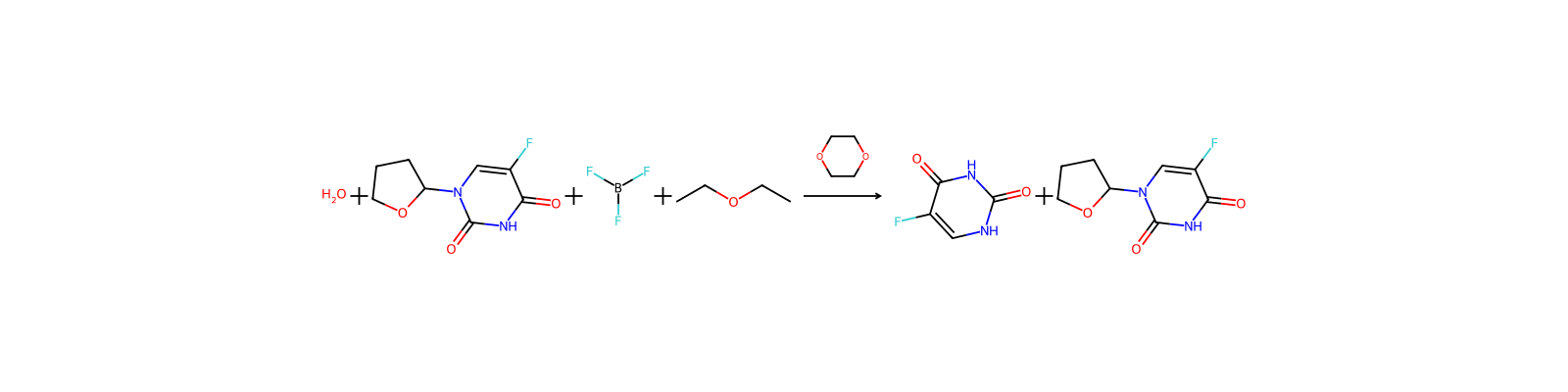
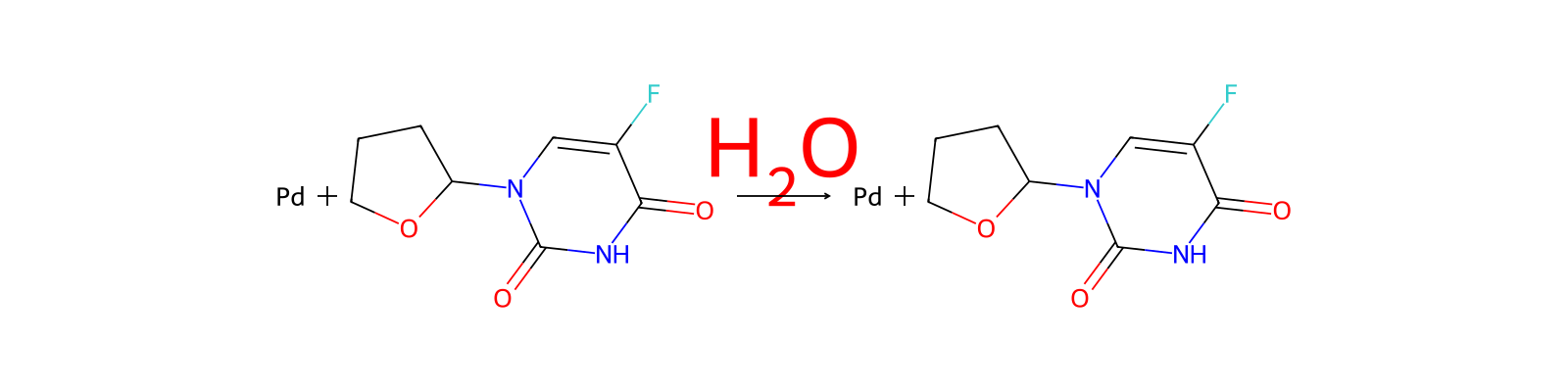


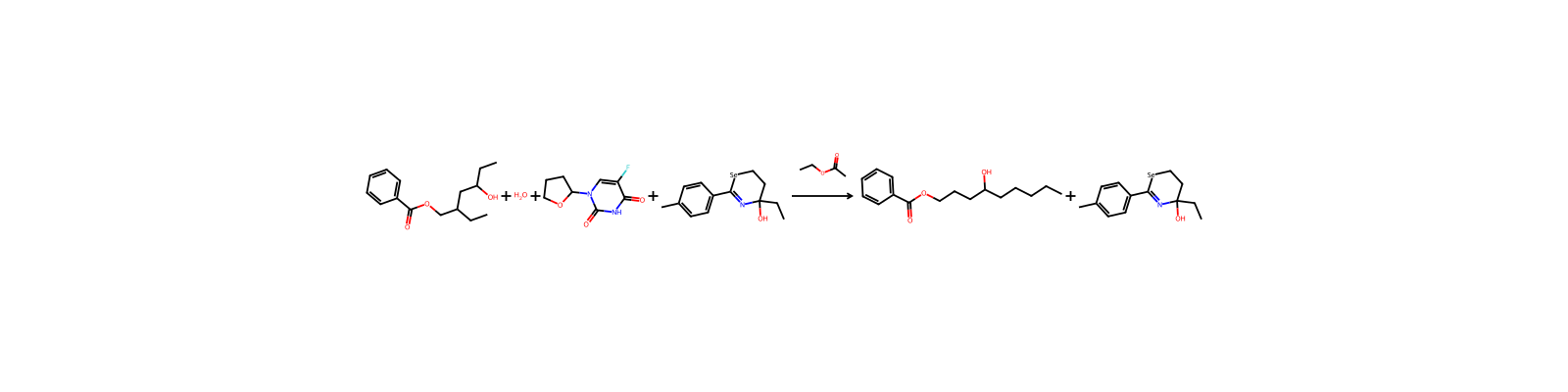
Compound notes
Loading…