HomeMCPWorkbenchSkills
HomeWorkbenchNotificationsMe
llms.txt · MCP GuidePrivacy Policy · Terms of Service · Supportv1.8.0
  1. Home
  2. /Compound

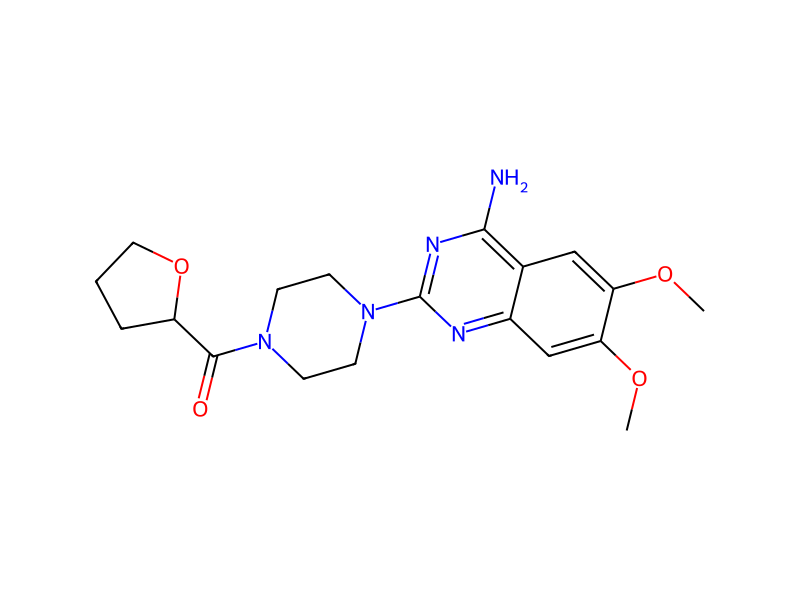
Terazosin

HCID 5401
New noteNew reactionRequest quotes
Print preview
Basic informationOverviewNames & identifiersPropertiesSafety & regulationChemistry & industryRelated reactionsCompound notes
Substructure searchFind similar structures

Basic information

CAS
63590-64-7
Standard SMILES
COc1cc2nc(N3CCN(C(=O)C4CCCO4)CC3)nc(N)c2cc1OC
InChIKey
VCKUSRYTPJJLNI-UHFFFAOYSA-N
Molecular formula
C19H25N5O4
Average molar mass
387.4 g/mol
Monoisotopic mass
387.1906543

Overview

Terazosin is a member of furans, a member of piperazines, a member of quinazolines and a primary amino compound. It has a role as an antineoplastic agent, an antihypertensive agent and an alpha-adrenergic antagonist.

Names & identifiers

Preferred name
Terazosin
IUPAC
[4-(4-amino-6,7-dimethoxyquinazolin-2-yl)piperazin-1-yl]-(oxolan-2-yl)methanone
English name
Terazosin
Molecular formula
C19H25N5O4
Molecular weight
387.43

Names & synonyms

terazosin63590-64-7TerazosineFosfomicTerazosinaBlavinFlumarcTerazosinumTerazosabbHytrinexVicard1-(4-Amino-6,7-dimethoxy-2-quinazolinyl)-4-((tetrahydro-2-furanyl)carbonyl)piperazine
Show more names
TERAZOSIN HCLUrodieHYTRINerazosinarbonyl)-CID 663211Vasomet:VicardHytrin:Hytrinex
8L5014XET7CHEBI:9445DTXSID3023639Piperazine, 1-(4-amino-6,7-dimethoxy-2-quinazolinyl)-4-((tetrahydro-2-furanyl)carbonyl)-6,7-dimethoxy-2-(4-((oxolan-2-yl)carbonyl)piperazin-1-yl)quinazolin-4-amine6,7-dimethoxy-2-(4-(oxolane-2-carbonyl)piperazin-1-yl)-3,4-dihydroquinazolin-4-imine6,7-dimethoxy-2-[4-(oxolane-2-carbonyl)piperazin-1-yl]-3,4-dihydroquinazolin-4-imine6,7-dimethoxy-2-{4-[(oxolan-2-yl)carbonyl]piperazin-1-yl}quinazolin-4-amine

Database identifiers

CAS
63590-64-7
PubChem CID
5401
DTXSID
DTXSID3023639
ChEMBL
CHEMBL611

Properties

Computed structural properties

XLogP
1.4
Topological polar surface area
103 Ų
Hydrogen bond donors
1
Hydrogen bond acceptors
8
Rotatable bonds
4
Heavy atoms
28
Formal charge
0
Complexity
544

Experimental & physicochemical properties

Drugs · 2 items

Pharmaceuticals

Pharmaceuticals -> Antihypertensives

LogP · 2 items

1

1.14

Solubility1.50e+00 g/L
Human Drugs · 2 items

Breast Feeding; Lactation; Milk, Human; Adrenergic alpha-Antagonists; Antihypertensive Agents

Pharmaceuticals

Melting Point · 2 items

271-274

273 °C

Physical DescriptionSolid
Collision Cross Section194.24 Ų [M+H]+ [CCS Type: TW; Method: calibrated with polyalanine and drug standards]

Physicochemical properties

Melting point
281 · 281-283°C
Boiling point
664.5 · 664.5±65.0 °C(Predicted)

Safety & regulation

Safety information is for reference only and does not replace the supplier’s Safety Data Sheet (SDS), applicable regulations, or professional assessment.

GHS classification

GHS Classification · 5 items

This chemical does not meet GHS hazard criteria for 2.3% (1 of 44) of reports.

Warning

H302 (97.7%): Harmful if swallowed [Warning Acute toxicity, oral]

P264, P270, P301+P317, P330, and P501 (click each P-code to see the statement)

Aggregated GHS information provided per 44 reports by companies from 3 notifications to the ECHA C&L Inventory.

Hazard information

Regulatory InformationREACH registered substance: 6,7-dimethoxy-2-[4-(oxolane-2-carbonyl)piperazin-1-yl]quinazolin-4-amine (EC: 613-265-8)
Hazard Classes and CategoriesAcute Tox. 4 (97.7%)

Toxicology

Treatment · 1 item

Should overdosage of Terazosin lead to hypotension, support of the cardiovascular system is of first importance. Restoration of blood pressure and normalization of heart rate may be accomplished by keeping the patient in the supine position. If this measure is inadequate, shock should first be treated with volume expanders. If necessary, vasopressors should then be used and renal function should be monitored and supported as needed. Laboratory data indicate that Terazosin is highly protein bound; therefore, dialysis may not be of benefit. (L1712)

Health EffectsHypotension, palpitations, postural hypotension, syncope, peripheral edema, weight gain, dyspnea, nasal congestion/rhinitis, impotence.
Hepatotoxicity · 1 item

Terazosin has been associated with a low rate of serum aminotransferase elevations that in controlled trials was no higher than with placebo therapy. These elevations were transient and did not require dose modification. Instances of serum enzyme elevations, but no instances of clinically apparent acute liver injury with jaundice due to terazosin, have been published. Furthermore, product labels do not include discussion of hepatic toxicity. Cholestatic hepatitis and jaundice have been reported with other alpha-adrenergic blockers. Thus, acute symptomatic liver injury due to terazosin must be exceedingly rare if it occurs at all.

Chemistry & industry

Pharmacology

ATC Code · 2 items

G04CA03

G - Genito urinary system and sex hormones

Protein Binding90-94%.
PharmacodynamicsTerazosin is a quinazoline derivative alpha-1-selective adrenergic blocker.
Mechanism of Action · 1 item

Terazosin is selective for alpha-1-adrenoceptors but not their individual subtypes. Inhibition of these alpha-1-adrenoceptors results in relaxation of smooth muscle in blood vessels and the prostate, lowering blood pressure and improving urinary flow. Smooth muscle cells accounts for roughly 40% of the volume of the prostate and so their relaxation reduces pressure on the urethra. It has also been shown that catecholamines induce factors responsible for mitogenesis and alpha-1-adrenergic receptor blockers inhibit this effect. A final long term mechanism of terazosin and other alpha-1-adrenergic receptor blockers is the induction of apoptosis of prostate cells. Treatment with terazosin enhances the expression of transforming growth factor beta-1 (TGF-beta1), which upregulates p27kip1, and the caspase cascade.

Biological Half-LifeTerazosin has a mean half life 12 hours though this can be as high as 14 hours in patients over 70 years and as low as 11.4 hours in patients 20 to 39 years old.
Metabolism/Metabolites · 2 items

The majority of terazosin is hepatically metabolized. The metabolites recovered include 6-O-demethyl terazosin, 7-O-methyl terazosin, a piperozine derivative, and a diamine derivative.

Hepatic. One of the four metabolites identified (piperazine derivative of terazosin) has antihypertensive activity. Route of Elimination: Approximately 10% of an orally administered dose is excreted as parent drug in the urine and approximately 20% is excreted in the feces. Half Life: 12 hours

FDA Pharmacological Classification · 6 items

8L5014XET7

TERAZOSIN

Mechanisms of Action [MoA] - Adrenergic alpha-Antagonists

Related reactions

24 records
New reaction record
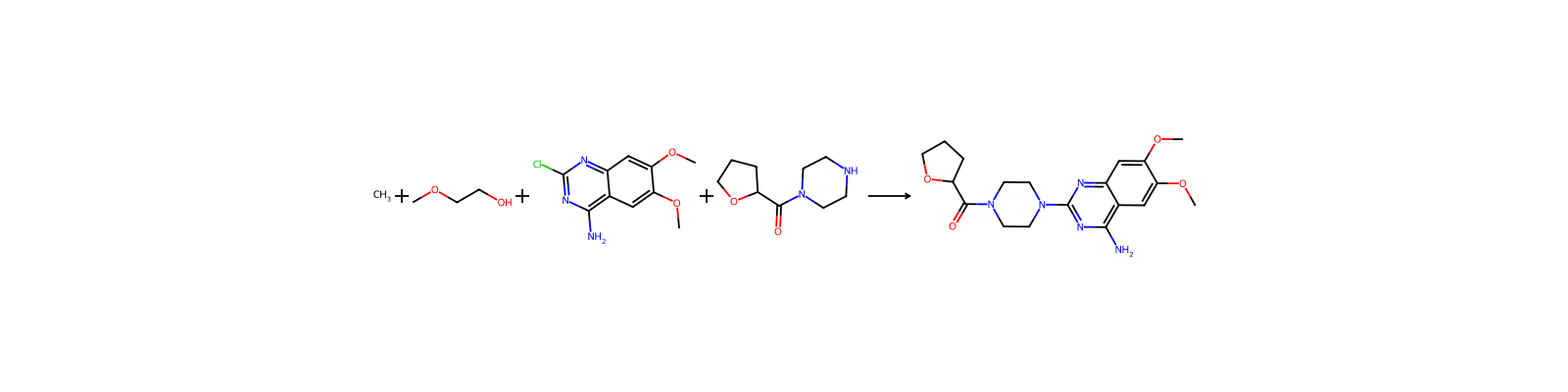
HRID 35998 reaction equation
HRID 35998As reactantuspto-grants-1995_05
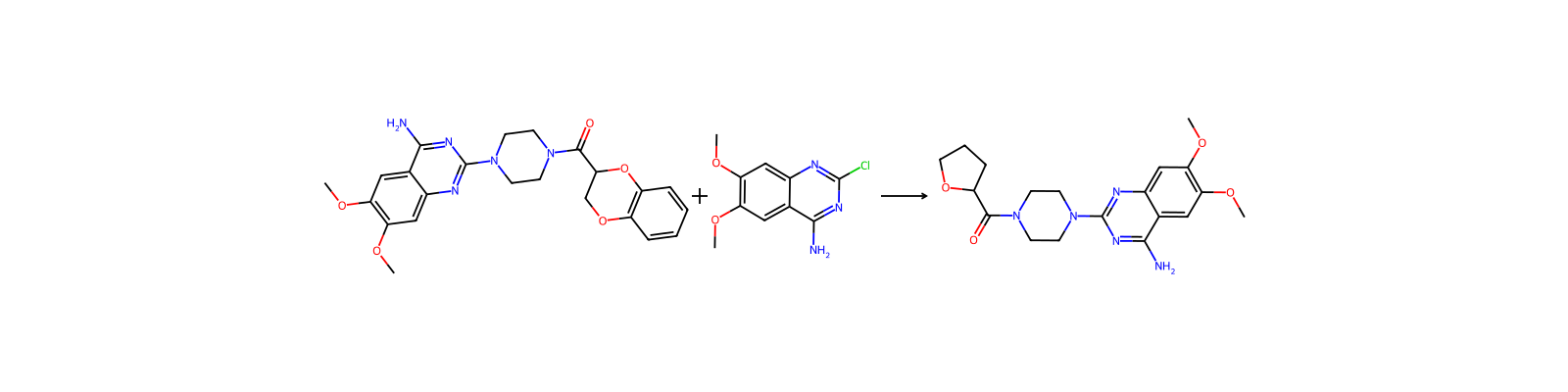
HRID 103285 reaction equation
HRID 103285As productAs reactantTraining data from https://doi.org/10.1039/C8SC04228D (2/10)
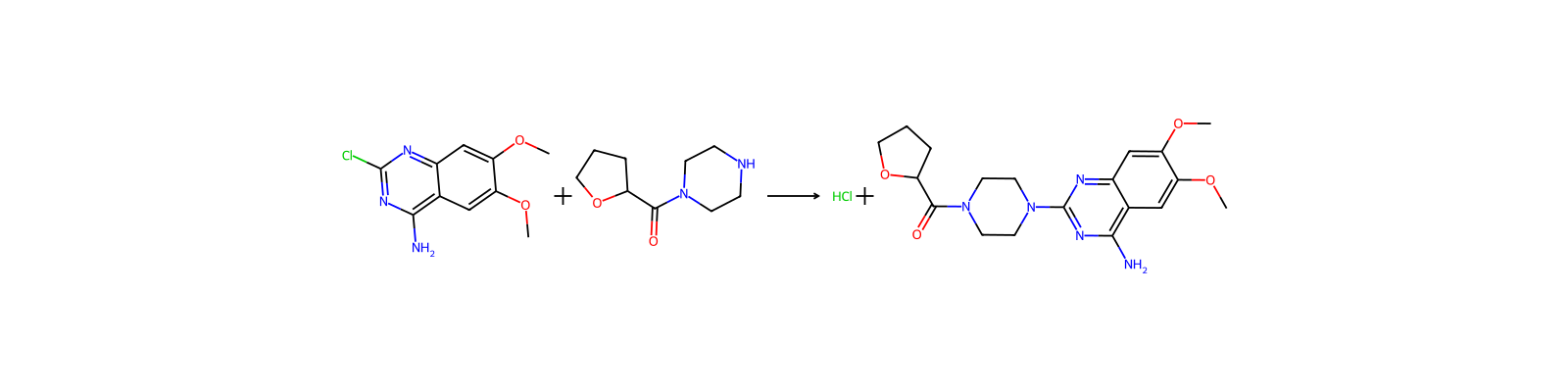
HRID 113451 reaction equation
HRID 113451As productTraining data from https://doi.org/10.1039/C8SC04228D (2/10)
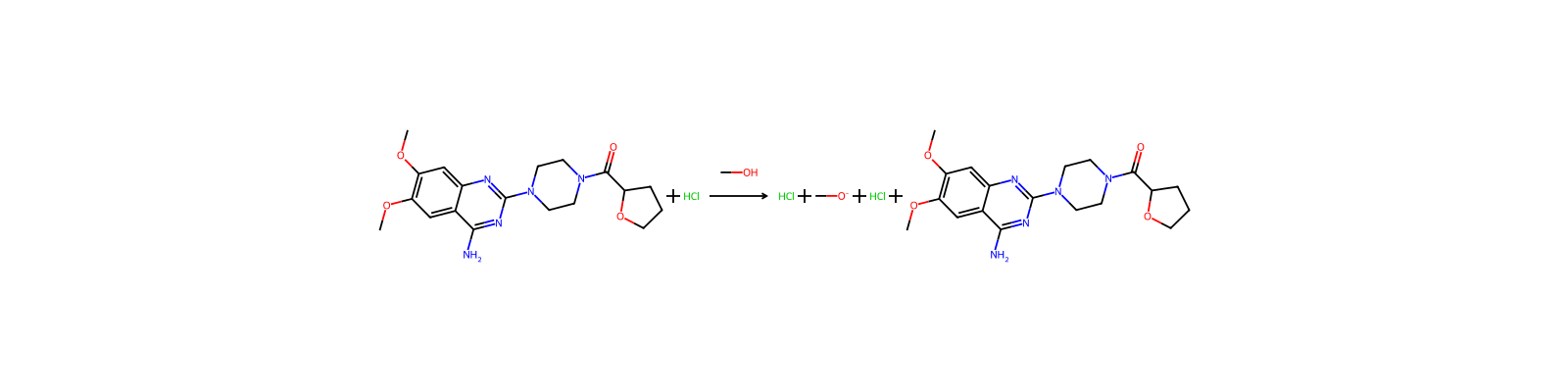
HRID 117851 reaction equation
HRID 117851As productTraining data from https://doi.org/10.1039/C8SC04228D (2/10)
HRID 202205 reaction equation
HRID 202205As productTraining data from https://doi.org/10.1039/C8SC04228D (6/10)
HRID 428379 reaction equation
HRID 428379As productuspto-grants-2001_11
HRID 619669 reaction equation
HRID 619669As productuspto-grants-1999_09
HRID 957030 reaction equation
HRID 957030As productValidation data from https://doi.org/10.1039/C8SC04228D
Page 1 of 3

Compound notes

Loading…

On this pageBasic informationOverviewNames & identifiersPropertiesSafety & regulationChemistry & industryRelated reactionsCompound notes
More actions
New noteNew reactionRequest quotes
ChEBI
CHEBI:9445
UNII
8L5014XET7
EC Number
613-265-8
Nikkaji
J19.669J
Density
1.332 · 1.332±0.06 g/cm3(Predicted)
storage temp.
-20 °C · -20°C Freezer
solubility
2 O: · H2O: 25 mg/mL
form
powder
pka
pKa (0.1N NaOH): 7.1(at 25℃)
color
white to off-white
Water Solubility
30.6 mg/L · 30.6mg/L(22.5 ºC)
BCS Class
1 · 1/3
InChIKey
VCKUSRYTPJJLNI-UHFFFAOYSA-N
CAS DataBase Reference
63590 · 63590-64-7(CAS DataBase Reference)
NCI Dictionary of Cancer Terms
Hytrin
FDA UNII
8 L5014XET7 · 8L5014XET7
ATC code
4 CA03 · G04CA03
Comptox DTXSID
3023639 · DTXSID3023639
Protein binding
90 · 90-94%
Excreted unchanged in urine
10 % · 10%
Volume of distribution
0.5 · 0.5-0.9(L/kg)
Biological half-life
9 · 9-12 / Unchanged
Symbol(GHS)
7 · GHS07
Signal word
Warning
Hazard statements
302 · H302
Precautionary statements
280 · P280-P301+P312+P330
Hazard Codes
Xn,Xi
Risk Statements
22 · 22-36/37/38
Safety Statements
26 · 26-36
WGK Germany
3 · 3
RTECS
8044925 · TK8044925
HS Code
2934999090 · 2934999090
REACH Registrations
Active
Adverse EffectsTerazosin is generally well-tolerated. Many adverse effects of terazosin are explainable due to its blockade of alpha-1 adrenergic receptors.
Exposure RoutesOral. Essentially completely absorbed in man (90% bioavailability).
Toxicity Summary · 2 items

Overdose of terazosin may lead to hypotension, and standard life-support protocols should be in place for instances of hemodynamic instability. There are no specific antidotes for terazosin toxicity. Vasopressors may be used to support physiologic blood pressure parameters in the event of terazosin overdose. Terazosin is long-acting, with an elimination half-life of approximately 12 hours, and is highly protein-bound. Elimination is via renal excretion (40%) and excretion of feces (60%).

Terazosin selectively and competitively inhibits vascular postsynaptic alpha(1)-adrenergic receptors, resulting in peripheral vasodilation and a reduction of vascular resistance and blood pressure. Unlike the nonselective alph-adrenergic blockers phenoxybenzamine and phentolamine, terazosin does not block presynaptic alpha(2)-receptors and, hence, does not cause reflex activation of norepinephrine release to produce reflex tachycardia.

Signs and SymptomsAsthenia, postural hypotension, dizziness, somnolence, nasal congestion/rhinitis.
Carcinogen ClassificationNo indication of carcinogenicity to humans (not listed by IARC).
Drug Induced Liver Injury · 5 items

Drug-Induced Liver Injury Severity and Toxicity (DILIst)

terazosin

DILI Negative

Oral

DOI:10.1016/j.drudis.2019.09.022

Effects During Pregnancy and Lactation◉ Summary of Use during Lactation
Toxicity DataLD50: 259.3mg/kg (parental-intravenous, Mouse) (A308)
EPA Human Health Benchmarks for Pharmaceuticals · 6 items

Terazosin

0.02

0.1

For hypertension, the dose may be slowly increased to achieve the desired blood pressure response. The usual recommended dose range is 1 mg to 5 mg terazosin administered once a day; however, some patients may benefit from doses as high as 20 mg per day.

Data used to generate the benchmarks include the following: Lowest Daily Dose (LDD): 1 mg/day, Lowest Therapeutic Dose (LTD): 0.01 mg/kg-day, and Screening Dose: 0.000004 mg/kg-day.

18-Aug-21

Safety data

wgk
3
rtecs
TK8044925
hs_code
2934999090
risk_code
22-36/37/38
Signal word
Warning
Symbol(GHS)
GHS07
hazard_code
Xn,Xi
safety_code
26-36
Hazard statements
H302
REACH Registrations
Active
Precautionary statements
P280-P301+P312+P330

Established Pharmacologic Class [EPC] - alpha-Adrenergic Blocker

Terazosin is an alpha-Adrenergic Blocker. The mechanism of action of terazosin is as an Adrenergic alpha-Antagonist.

TERAZOSIN

MeSH Pharmacological Classification · 2 items

Drugs that bind to and block the activation of ADRENERGIC ALPHA-1 RECEPTORS.

Drugs used in the treatment of urological conditions and diseases such as URINARY INCONTINENCE and URINARY TRACT INFECTIONS.

Absorption, Distribution and Excretion · 4 items

Approximately 90%.

Approximately 10% of the oral dose is excreted unchanged in the urine and approximately 20% is excreted in the feces. 40% of the total dose is eliminated in urine and 60% of the total dose is eliminated in the feces.

25L to 30L.

Plasma clearance is 80mL/min and renal clearance is 10mL/min.

Cellular LocationsMembrane

Uses & manufacturing

Uses · 2 items

Use (kg; approx.) in Germany (2009): >75

Terazosin is indicated for the treatment of symptomatic benign prostatic hyperplasia (BPH). There is a rapid response, with approximately 70% of patients experiencing an increase in urinary flow and improvement in symptoms of BPH when treated with terazosin. The long-term effects of terazosin on the incidence of surgery, acute urinary obstruction or other complications of BPH are yet to be determined. Terazosin tablets are also indicated for the treatment of hypertension. Terazosin tablets can be used alone or in combination with other antihypertensive agents such as diuretics or beta-adrenergic blocking agents.

Use ClassificationPharmaceuticals
Applications · 3 items

UsesAn α-1-adrenergicblocker related to prazosin.

UsesTerazosin is used for the same indications as is prazosin; however, it has the advantage of being able to be used once a day.

UsesAn a-1-adrenergicblocker related to prazosin

Upstream & downstream products

Upstream raw materials

2-Furoic acidPiperazineQuinazoline2-Furoyl chlorideTerazosin hydrochloride

Additional notes

DefinitionChEBI: Terazosin is a member of quinazolines, a member of piperazines, a member of furans and a primary amino compound. It has a role as an antineoplastic agent, an antihypertensive agent and an alpha-adrenergic antagonist.