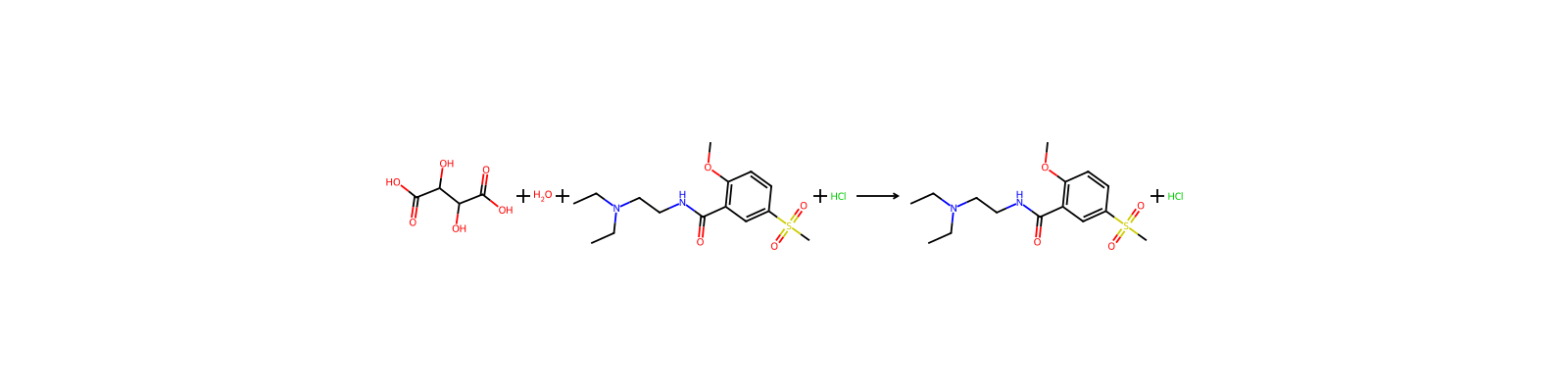
HRID 982575As reactant

51012-32-9CCN(CC)CCNC(=O)c1cc(S(C)(=O)=O)ccc1OCJTVPZMFULRWINT-UHFFFAOYSA-NN-[2-(diethylamino)ethyl]-2-methoxy-5-methylsulfonylbenzamide is a member of benzamides.
51012-32-9Pharmaceuticals
Pharmaceuticals -> Listed in ZINC15
Pharmaceuticals -> Antipsychotics
Safety information is for reference only and does not replace the supplier’s Safety Data Sheet (SDS), applicable regulations, or professional assessment.
This chemical does not meet GHS hazard criteria for 100% (5 of 5) of all reports.
Not Classified
Aggregated GHS information provided per 5 reports by companies from 1 notifications to the ECHA C&L Inventory.
Drug-Induced Liver Injury Severity and Toxicity (DILIst)
Tiapride
DILI Positive
DOI:10.1016/j.drudis.2019.09.022
N05AL03
N - Nervous system
QN - Nervous system
Tiapride has a high degree of regional selectivity for limbic areas. One study found that tiapride shows over three times as much affinity for limbic areas than striatal areas as opposed to the near equal selectivity for limbic and striatal regions shown by haloperidol. Another study in rats found tiapride's affinity for the septum, a limbic region, to be over thirty times as high as for the striatum. Efficacy at the D2 receptor is moderate, with 80 percent of receptors occupied even in the presence of excess tiapride concentrations.
Tiapride is a selective dopamine D2 and D3 receptor antagonist, offering an advantage over other neuroleptic drugs, such as haloperidol and risperidone, which bind a range of targets including four of the five known dopamine receptor subtypes (D1-4), serotonin (5-HT2A, 2C), α1- and α2-adrenergic, and histamine H1 receptors. Compared to these drugs, tiapride has a relatively moderate affinity for its target receptors, displacing 50 percent of 3H-raclopride binding at a concentration of 320 nM at D2 receptors and a concentration of 180 nM at D3 receptors.
Agents that control agitated psychotic behavior, alleviate acute psychotic states, reduce psychotic symptoms, and exert a quieting effect. They are used in SCHIZOPHRENIA; senile dementia; transient psychosis following surgery; or MYOCARDIAL INFARCTION; etc. These drugs are often referred to as neuroleptics alluding to the tendency to produce neurological side effects, but not all antipsychotics are likely to produce such effects. Many of these drugs may also be effective against nausea, emesis, and pruritus.

DTXSID0023664CHEMBL84158CHEBI:94666Drugs that bind to but do not activate DOPAMINE RECEPTORS, thereby blocking the actions of dopamine or exogenous agonists. Many drugs used in the treatment of psychotic disorders (ANTIPSYCHOTIC AGENTS) are dopamine antagonists, although their therapeutic effects may be due to long-term adjustments of the brain rather than to the acute effects of blocking dopamine receptors. Dopamine antagonists have been used for several other clinical purposes including as ANTIEMETICS, in the treatment of Tourette syndrome, and for hiccup. Dopamine receptor blockade is associated with NEUROLEPTIC MALIGNANT SYNDROME.
The bioavailability of tiapride is approximately 75 percent. It has a Tmax is 0.4-1.5 hours and Tss is 24-48 hours with 3 time daily dosing. Benzamide and its derivatives are highly water-soluble but known to cross the blood-brain barrier, necessitating carrier-mediated transport.
Urine (70% as unchanged tiapride)
Tiapride distributes rapidly and exhibits virtually no binding to plasma proteins, giving it a relatively high volume of distribution
16.6 l/h.
Usesdiuretic, antihypertensive
UsesTiapride hydrochloride is a D2DR and D3DR inhibitor; Anti-psychotic agent and alternative treatment for Tourette’s syndrome.
DefinitionChEBI: N-[2-(diethylamino)ethyl]-2-methoxy-5-methylsulfonylbenzamide is a member of benzamides.