
HRID 286915As product
Completing data — refresh the page later to see the latest

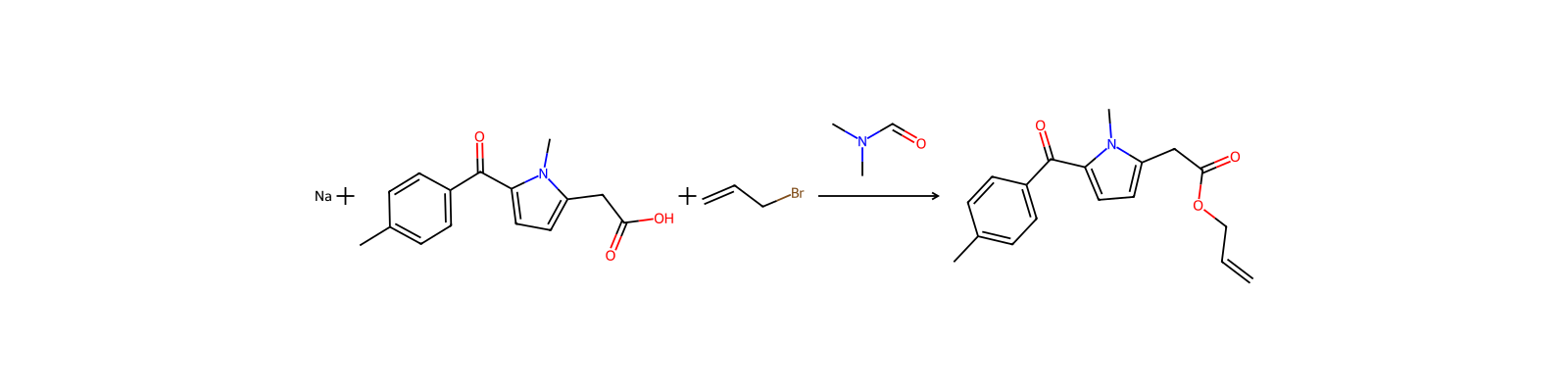
26171-23-3Cc1ccc(C(=O)c2ccc(CC(=O)O)n2C)cc1UPSPUYADGBWSHF-UHFFFAOYSA-NTolmetin is a monocarboxylic acid that is (1-methylpyrrol-2-yl)acetic acid substituted at position 5 on the pyrrole ring by a 4-methylbenzoyl group. Used in the form of its sodium salt dihydrate as a nonselective nonsteroidal anti-inflammatory drug. It has a role as a non-steroidal anti-inflammatory drug and an EC 1.14.99.1 (prostaglandin-endoperoxide synthase) inhibitor. It is a monocarboxylic acid, a member of pyrroles and an aromatic ketone. It is a conjugate acid of a tolmetin(1-).
26171-23-3DTXSID2043951CHEMBL1020CHEBI:71941DEA NFLIS-Drug Category -> Analgesics
Pharmaceuticals -> Listed in ZINC15
2.6
2.79
Breast Feeding; Lactation; Milk, Human; Analgesic Agents; Anti-inflammatory Agents, Nonsteroidal
Pharmaceuticals
155-157 °C (DECOMPOSES)
156 °C
3.5
3.5
3.5
157.42 Ų [M+H]+ [CCS Type: TW; Method: calibrated with polyalanine and drug standards]
Safety information is for reference only and does not replace the supplier’s Safety Data Sheet (SDS), applicable regulations, or professional assessment.
Danger
H301 (33.3%): Toxic if swallowed [Danger Acute toxicity, oral]
P261, P264, P264+P265, P270, P271, P280, P301+P316, P301+P317, P302+P352, P304+P340, P305+P351+P338, P319, P321, P330, P332+P317, P337+P317, P362+P364, P403+P233, P405, and P501 (click each P-code to see the statement)
Aggregated GHS information provided per 3 reports by companies from 3 notifications to the ECHA C&L Inventory. Each notification may be associated with multiple companies.
REVIEW ARTICLE INCLUDES TOLMETIN.[SIMON LS, MILLS JA; NONSTEROIDAL ANTIINFLAMMATORY DRUGS (SECOND OF TWO PARTS); N ENGL J MED 302 (22) 1237 (1980)]
TOLMETIN'S PHARMACOLOGICAL PROPERTIES & THERAPEUTIC EFFICACY IN RHEUMATIC DISEASES ARE REVIEWED.[BROGDEN RN ET AL; TOLMETIN: A REVIEW OF ITS PHARMACOLOGICAL PROPERTIES & THERAPEUTIC EFFICACY IN RHEUMATIC DISEASES; DRUGS 15(6) 429 (1978)]
THE HISTORY OF RESEARCH & DEVELOPMENT OF NONSTEROIDAL ANTI-INFLAMMATORY AGENTS, INCL TOLMETIN.[GRINGAUZ A; NONSTEROIDAL ANTI-INFLAMMATORY AGENTS--ANYTHING NEW UNDER THE SUN?; HOSP FORMUL 14(MAR) 290 (1979)]
PT RECEIVING CORTICOSTEROID OR GOLD THERAPY OBTAINED GREATER RELIEF OF SYMPTOMS WHEN TOLMETIN WAS ADDED TO THE REGIMEN, & THERE WAS EVIDENCE THAT TOLMETIN HAD A STEROID-SPARING EFFECT. /TOLMETIN SODIUM/
M - Musculo-skeletal system
M - Musculo-skeletal system
QM - Musculo-skeletal system
QM - Musculo-skeletal system
Tolmetin is a nonsteroidal anti-inflammatory agent. Studies in animals have shown tolmetin to possess anti-inflammatory, analgesic and antipyretic activity. In the rat, tolmetin prevents the development of experimentally induced polyarthritis and also decreases established inflammation. In patients with either rheumatoid arthritis or osteaoarthritis, tolmetin is as effective as aspirin and indomethacin in controlling disease activity, but the frequency of the milder gastrointestinal adverse effects and tinnitus was less than in aspirin-treated patients, and the incidence of central nervous system adverse effects was less than in indomethacin-treated patients. In patients with juvenile rheumatoid arthritis, tolmetin is as effective as aspirin in controlling disease activity, with a similar incidence of adverse reactions. tolmetin has produced additional therapeutic benefit when added to a regimen of gold salts and, to a lesser extent, with corticosteroids. Tolmetin should not be used in conjunction with salicylates since greater benefit from the combination is not likely, but the potential for adverse reactions is increased.
The mode of action of tolmetin is not known. However, studies in laboratory animals and man have demonstrated that the anti-inflammatory action of tolmetin is not due to pituitary-adrenal stimulation. Tolmetin inhibits prostaglandin synthetase in vitro and lowers the plasma level of prostaglandin E in man. This reduction in prostaglandin synthesis may be responsible for the anti-inflammatory action. Tolmetin does not appear to alter the course of the underlying disease in man.
ALTHOUGH IT DIFFERS CHEMICALLY FROM ASPIRIN & OTHER NONSTEROIDAL ANTI-INFLAMMATORY AGENTS, ITS PHARMACOLOGIC PROPERTIES ARE SIMILAR. /TOLMETIN SODIUM/
...INHIBITS PROSTAGLANDIN SYNTHETASE IN VITRO. IT ALSO HAS BEEN SHOWN TO LOWER PLASMA LEVEL OF PROSTAGLANDIN E IN MAN. HOWEVER, SIGNIFICANCE OF THESE ACTIONS IN RELATION TO CLINICAL EFFECTS IS NOT KNOWN. /TOLMETIN SODIUM/




156.7 Ų [M+H]+ [CCS Type: TW]
CONCOMITANT ADMIN OF TOLMETIN & ACETAMINOPHEN PRODUCED A GREATER IMPROVEMENT IN SYMPTOMS THAN WITH TOLMETIN ALONE, BUT FURTHER STUDIES ARE NEEDED TO SUBSTANTIATE THIS EFFECT. /TOLMETIN SODIUM/
CONCOMITANT ASPIRIN REDUCES PLASMA LEVELS OF TOLMETIN BY ABOUT 20%, BUT THE INTERACTION PROBABLY IS NOT CLINICALLY IMPORTANT. /TOLMETIN SODIUM/
IN DOGS, PROSTAGLANDIN SYNTHETASE INHIBITORS INDOMETHACIN & TOLMETIN BLOCKED FUROSEMIDE-INDUCED INCR IN RENIN SECRETION WHETHER FUROSEMIDE WAS GIVEN IV OR INTO RENAL ARTERY.
DESPITE ITS EXTENSIVE BINDING TO ALBUMIN...NO CHANGE IN PROTHROMBIN TIME WHEN WARFARIN & TOLMETIN WERE GIVEN TOGETHER.
MOST FREQUENTLY REPORTED ADVERSE REACTIONS ARE GI DISTURBANCES... EPIGASTRIC DISTRESS, INCL HEARTBURN, DYSPEPSIA, & ABDOMINAL PAIN, WAS MOST COMMON; OTHER REACTIONS INCL NAUSEA, VOMITING, & CONSTIPATION. GI BLEEDING WAS REPORTED OCCASIONALLY... IN CLINICAL STUDIES, PEPTIC ULCER OCCURRED IN APPROX 2% OF PT. /TOLMETIN SODIUM/
CNS REACTIONS REPORTED INCL HEADACHE, DIZZINESS, LIGHTHEADEDNESS, NERVOUSNESS, & DROWSINESS. ... OTHER REACTIONS OBSERVED OCCASIONALLY WERE RASH OR URTICARIA, PRURITUS, TINNITUS, & MILD EDEMA, WHICH WAS RELATED TO SODIUM RETENTION. /TOLMETIN SODIUM/
THE CASE OF A 51-YR-OLD MAN WHO DEVELOPED ANAPHYLAXIS AFTER RESTARTING ORAL THERAPY WITH TOLMETIN SODIUM FOR A PULLED GROIN MUSCLE IS PRESENTED.
A 56-YR-OLD MAN WITH RHEUMATOID ARTHRITIS, BEING TREATED WITH TOLMETIN SODIUM 1800 MG/DAY, DEVELOPED A DRUG FEVER BELIEVED TO BE DUE TO TOLMETIN SODIUM THERAPY.
For more Human Toxicity Excerpts (Complete) data for TOLMETIN (9 total), please visit the HSDB record page.
Drug-Induced Liver Injury Severity and Toxicity (DILIst)
tolmetin
DILI Positive
Oral
DOI:10.1016/j.drudis.2019.09.022
MAX ANTIINFLAMMATORY ACTIVITY OF RECTALLY ADMIN TOLMETIN WAS OBSERVED IN RATS AFTER 125 MG/KG DOSE. TOLMETIN ALSO SHOWED GREATER ACTIVITY WHEN ADMIN RECTALLY THAN ORALLY. THE LD50 OF RECTALLY ADMIN TOLMETIN WAS 743.6 MG/KG IN MALE & 843.4 MG/KG IN FEMALE RATS.
TOLMETIN (100-150 MUG/L) DOSE-DEPENDENTLY INHIBITED DNA SYNTHESIS BY MOUSE SPLEEN CELLS & HUMAN LYMPHOCYTES IN VITRO.
Essentially all of the administered dose is recovered in the urine in 24 hours either as an inactive oxidative metabolite or as conjugates of tolmetin.
URINE METABOLITES 1-METHYL-5-(4-CARBOXYBENZOYL)-1H-PYRROLE-2-ACETIC ACID & TOLMETIN GLUCURONIDE NOTED AFTER TOLMETIN SODIUM.
Tolmetin has known human metabolites that include Tolmetin glucuronide.
D8K2JPN18B
TOLMETIN
Mechanisms of Action [MoA] - Cyclooxygenase Inhibitors
Chemical Structure [CS] - Anti-Inflammatory Agents, Non-Steroidal
Established Pharmacologic Class [EPC] - Nonsteroidal Anti-inflammatory Drug
Tolmetin is a Nonsteroidal Anti-inflammatory Drug. The mechanism of action of tolmetin is as a Cyclooxygenase Inhibitor.
Anti-inflammatory agents that are non-steroidal in nature. In addition to anti-inflammatory actions, they have analgesic, antipyretic, and platelet-inhibitory actions. They act by blocking the synthesis of prostaglandins by inhibiting cyclooxygenase, which converts arachidonic acid to cyclic endoperoxides, precursors of prostaglandins. Inhibition of prostaglandin synthesis accounts for their analgesic, antipyretic, and platelet-inhibitory actions; other mechanisms may contribute to their anti-inflammatory effects.
Compounds or agents that combine with cyclooxygenase (PROSTAGLANDIN-ENDOPEROXIDE SYNTHASES) and thereby prevent its substrate-enzyme combination with arachidonic acid and the formation of eicosanoids, prostaglandins, and thromboxanes.
Rapidly and almost completely absorbed with peak plasma levels being reached within 30-60 minutes after an oral therapeutic dose.
THE DRUG IS RAPIDLY ABSORBED AFTER ORAL ADMIN, PEAK PLASMA LEVELS OCCUR IN 30 TO 60 MIN. IT IS EXCRETED LARGELY IN URINE, PRIMARILY AS CONJUGATES OR METABOLITES. ITS PLASMA HALF-LIFE IS APPROX 1 HR. /TOLMETIN SODIUM/
GI ABSORPTION IS ABOUT 90% OR GREATER...WITH PEAK LEVELS WITHIN 20-60 MIN FOR TOLMETIN... PROTEIN BINDING IS EXTENSIVE, BEING 90% OR GREATER... HEPATIC BIOTRANSFORMATION & RENAL EXCRETION WITH SOME FECAL EXCRETION OF METABOLITES ARE THE MEANS OF ELIMINATION. /TOLMETIN SODIUM/
TOLMETIN IS RAPIDLY & COMPLETELY ABSORBED FOLLOWING ORAL ADMIN TO MAN, & CONCN ACHIEVED IN PLASMA ARE NOT REDUCED BY CONCOMITANT ADMIN OF GASTRIC ANTACIDS. PEAK CONCN ARE ACHIEVED 20-60 MIN AFTER ORAL ADMIN, & T/2 IN PLASMA IS BETWEEN 1 & 3 HR.
AFTER ABSORPTION, TOLMETIN IS EXTENSIVELY (99%) BOUND TO PLASMA PROTEINS. VIRTUALLY ALL OF THE DRUG CAN BE RECOVERED IN URINE AFTER 24 HR; SOME IS UNCHANGED (17%), BUT MOST IS CONJUGATED (10%) OR OTHERWISE METABOLIZED. THE MAJOR METABOLITE TRANSFORMATION IS DECARBOXYLATION.
TOLMETIN SODIUM WAS RAPIDLY & COMPLETELY ABSORBED (PEAK TIME, 20-60 MIN) & ELIMINATED RAPIDLY FROM PLASMA WITH BIPHASIC DECAY CURVE & ELIMINATION T/2 OF APPROX 2.1 HR.
DescriptionAn antiinflammatory, analgesic, and antipyretic that is as efficacious as moderate doses of aspirin and better tolerated. Tolmetin produces a number of adverse effects including epigastric pain, dyspepsia, nausea, and vomiting. Tolmetin is approximately 99% plasma protein bound, yet does not interfere with concurrent treatment with oral hypoglycemics. Tolmetin has been found to be effective in the treatment of osteoarthritis and rheumatoid arthritis.
Usesinhibits synthesis of prostaglandins and exhibits expressed analgesic, anti-inflammatory, and fever-reducing properties. It is used for relieving weak to moderate pain in rheumatoid arthritis and osteoarthritis.
UsesTolmetine is an NSAID.
General DescriptionTolmetin sodium (Tolectin), is an arylacetic acid derivativewith a pyrrole as the aryl group. This drug is well absorbed and has a relatively short plasma half-life (1 hour). It is recommendedfor use in the management of acute and chronicRA. Its efficacy is similar to aspirin and indomethacin, butwith less frequency of the adverse effects and tinnitus associatedwith aspirin. It does not potentiate coumarin-likedrugs nor alter the blood levels of sulfonylureas or insulin.However, tolmetin, and especially its closely related drug,zomepirac (i.e., with a p-chlorobenzoyl group and an additionalmethyl group on the pyrrole ring), can produce a rarebut fatal anaphylactic reaction because of irreversible bindingof their unstable acyl glucuronides. Zomepirac waswithdrawn from market because it is eliminated only via theester-type, acyl glucuronide. It is possible that tolmetin isless toxic in this regard because it undergoes additional hepaticbenzylic hydroxylation via its p-methyl group and isexcreted as its stable ether glucuronide.
DefinitionChEBI: A monocarboxylic acid that is (1-methylpyrrol-2-yl)acetic acid substituted at position 5 on the pyrrole ring by a 4-methylbenzoyl group. Used in the form of its sodium salt dihydrate as a nonselective nonsteroidal anti-inflammatory drug.