
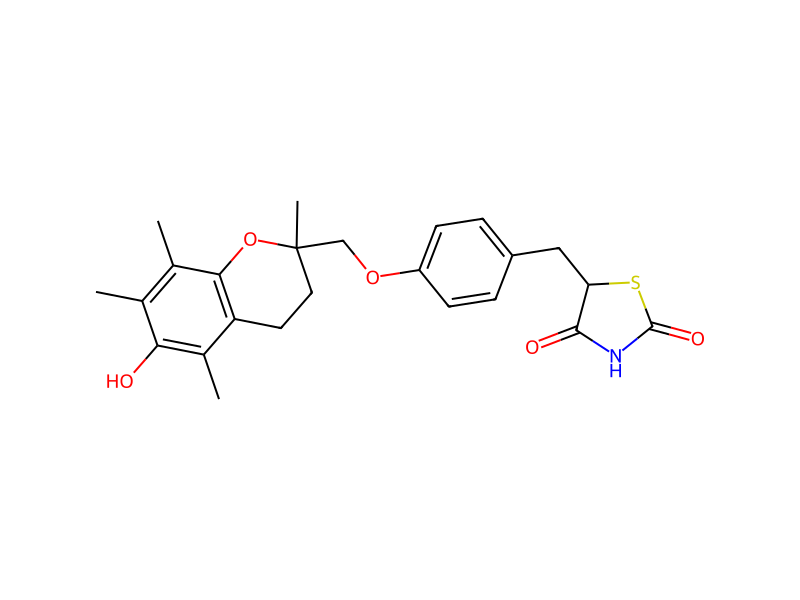
Basic information
- CAS
97322-87-7- Standard SMILES
Cc1c(C)c2c(c(C)c1O)CCC(C)(COc1ccc(CC3SC(=O)NC3=O)cc1)O2- InChIKey
GXPHKUHSUJUWKP-UHFFFAOYSA-N- Molecular formula
- C24H27NO5S
- Average molar mass
- 441.5 g/mol
- Monoisotopic mass
- 441.16099396
Overview
Troglitazone is a member of chromanes and a thiazolidinone. It has a role as a ferroptosis inhibitor, an antioxidant, a hypoglycemic agent, an antineoplastic agent, a vasodilator agent, an anticonvulsant, an anticoagulant, a platelet aggregation inhibitor and an EC 6.2.1.3 (long-chain-fatty-acid--CoA ligase) inhibitor.
Names & identifiers
- Preferred name
- Troglitazone
- IUPAC
- 5-[[4-[(6-hydroxy-2,5,7,8-tetramethyl-3,4-dihydrochromen-2-yl)methoxy]phenyl]methyl]-1,3-thiazolidine-2,4-dione
- English name
- Troglitazone
- Molecular formula
- C24H27NO5S
- Molecular weight
- 441.54
Names & synonyms
troglitazone97322-87-7RezulinRomglizonePrelayCS-045RomozinNoscaltroglitazonatroglitazonumCI-991DTXSID8023719
Show more names
ci991DepotoxAKOS 91980
GR92132XGR-92132X5-(4-(6-Hydroxy-2,5,7,8-tetramethylchroman-2-ylmethoxy)benzyl)thiazolidine-2,4-dione5-[[4-[(3,4-Dihydro-6-hydroxy-2,5,7,8-tetramethyl-2H-1-benzopyran-2-yl)methoxy]phenyl]methyl]-2,4-thiazolidinedioneCHEBI:9753I66ZZ0ZN0EDTXCID6037192,4-Thiazolidinedione, 5-((4-((3,4-dihydro-6-hydroxy-2,5,7,8-tetramethyl-2H-1-benzopyran-2-yl)methoxy)phenyl)methyl)-
Database identifiers
- CAS
97322-87-7- PubChem CID
- 5591
- DTXSID
DTXSID8023719- ChEMBL
CHEMBL408- ChEBI
CHEBI:9753- Nikkaji
- J996.467C
Properties
Computed structural properties
- XLogP
- 5.1
- Topological polar surface area
- 110 Ų
- Hydrogen bond donors
- 2
- Hydrogen bond acceptors
- 6
- Rotatable bonds
- 5
- Heavy atoms
- 31
- Formal charge
- 0
- Complexity
- 681
Experimental & physicochemical properties
Human Drugs
FDA approved drugs -> Active ingredient
FDA approved drugs -> Active ingredient
Melting Point184-186 °C
Collision Cross Section193.9 Ų [M-H]- [CCS Type: DT; Buffer gas: N2; Ionization: ESI-; Dataset: TOXCAST; Source Identifier: DTXSID8023719]
Physicochemical properties
- Melting point
- 184 · 184-186°C
- Boiling point
- 657 · 657.0±55.0 °C(Predicted)
- Density
- 1.266 · 1.266±0.06 g/cm3(Predicted)
- storage temp.
- -20 °C · Inert atmosphere,Store in freezer, under -20°C
- solubility
- 20 mg/mL · DMSO: 20 mg/mL
- form
- solid
- pka
- 6.34 · 6.34±0.50(Predicted)
- color
- white to yellow
- Stability
- 1 year · Stable for 1 year from date of purchase as supplied. Solutions in DMSO or ethanol may be stored at -20°C for up to 3 months.
Safety & regulation
Safety information is for reference only and does not replace the supplier’s Safety Data Sheet (SDS), applicable regulations, or professional assessment.
Toxicology
Hepatotoxicity
Large prospective studies showed that significant elevations in serum aminotransferase levels (equal to or greater than 3 times the upper limit of the normal range [ULN]) occurred in 1.9% of patients with diabetes treated with troglitazone for 24 to 48 weeks, compared to only 0.6% in placebo recipients. These enzyme elevations were usually asymptomatic and often resolved despite continuation of therapy. Nevertheless, elevations >10 times ULN occurred in 0.5% of patients (but in no placebo recipient) and a proportion of these developed symptoms of liver injury and jaundice. Soon after the approval of troglitazone as therapy for type 2 diabetes in the United States, cases of severe acute liver injury began to be reported, and dramatic case reports as well as small case series documented that clinically significant injury was occurring in 1:1000 to 1:10,000 recipients. The latency to onset of injury was typically 1 to 6 months and the onset was marked by fatigue, weakness, dark urine and jaundice, and an acute hepatitis-like elevation in serum enzymes (hepatocellular pattern). Allergic phenomena (rash, fever, eosinophilia) were uncommon and serum autoantibodies were not usually present. Liver biopsies showed acute inflammatory changes and variable degrees of necrosis, ranging from rare spotty necrosis to bridging hepatic necrosis and submassive or massive necrosis. At least two dozen cases of acute liver failure and death or need for liver transplantation were reported to the FDA before troglitazone was withdrawn from use in 2000.
Exposure RoutesAbsorbed rapidly. Food increases the extent of absorption by 30% to 85%.
Toxicity Summary
Troglitazone is a thiazolidinedione antidiabetic agent that lowers blood glucose by improving target cell response to insulin. It has a unique mechanism of action that is dependent on the presence of insulin for activity. Troglitazone decreases hepatic glucose output and increases insulin dependent glucose disposal in skeletal muscle. Its mechanism of action is thought to involve binding to nuclear receptors (PPAR) that regulate the transcription of a number of insulin responsive genes critical for the control of glucose and lipid metabolism. Troglitazone is a ligand to both PPAR‘± and PPAR‘_, with a highter affinity for PPAR‘_. The drug also contains an ‘±-tocopheroyl moiety, potentially giving it vitamin E-like activity. Troglitazone has been shown to reduce inflammation, and is associated with a decrase in nuclear factor kappa-B (NF-‘_B) and a concomitant increase in its inhibitor (I‘_B). NF-‘_B is an important cellular transcription regulator for the immune response. Unlike sulfonylureas, troglitazone is not an insulin secretagogue.
Chemistry & industry
Pharmacology
ATC Code
A - Alimentary tract and metabolism
QA - Alimentary tract and metabolism
Protein Binding> 99% (primarily to serum albumin)
Pharmacodynamics
Troglitazone is an oral antihyperglycemic agent which acts primarily by decreasing insulin resistance. Troglitazone is used in the management of type II diabetes (noninsulin-dependent diabetes mellitus (NIDDM) also known as adult-onset diabetes). It improves sensitivity to insulin in muscle and adipose tissue and inhibits hepatic gluconeogenesis. Troglitazone is not chemically or functionally related to either the sulfonylureas, the biguanides, or the g-glucosidase inhibitors. Troglitazone may be used concomitantly with a sulfonylurea or insulin to improve glycemic control.
Mechanism of Action
Troglitazone is a thiazolidinedione antidiabetic agent that lowers blood glucose by improving target cell response to insulin. It has a unique mechanism of action that is dependent on the presence of insulin for activity. Troglitazone decreases hepatic glucose output and increases insulin dependent glucose disposal in skeletal muscle. Its mechanism of action is thought to involve binding to nuclear receptors (PPAR) that regulate the transcription of a number of insulin responsive genes critical for the control of glucose and lipid metabolism. Troglitazone is a ligand to both PPARα and PPARγ, with a highter affinity for PPARγ. The drug also contains an α-tocopheroyl moiety, potentially giving it vitamin E-like activity. Troglitazone has been shown to reduce inflammation, and is associated with a decrase in nuclear factor kappa-B (NF-κB) and a concomitant increase in its inhibitor (IκB). Unlike sulfonylureas, troglitazone is not an insulin secretagogue.
Biological Half-Life16-34 hours
Metabolism/Metabolites
A sulfate conjugate metabolite (Metabolite 1) and a quinone metabolite (Metabolite 3) have been detected in the plasma of healthy males. A glucuronide conjugate (Metabolite 2) has been detected in the urine and also in negligible amounts in the plasma. In healthy volunteers and in patients with type 2 diabetes, the steady-state concentration of Metabolite 1 is six to seven times that of troglitazone and Metabolite 3. In in vivo drug interaction studies, troglitazone has been shown to induce cytochrome P450 CYP3A4 at clinically relevant doses.
Related reactions
20 records


Compound notes
Loading…