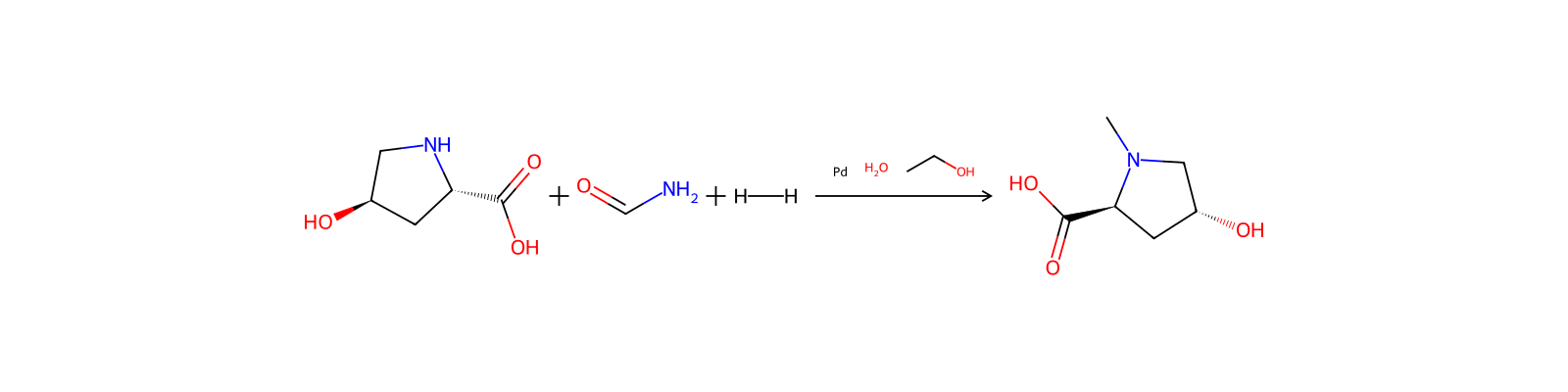
L-Hydroxyproline
Completing data — refresh the page later to see the latest

Basic information
- CAS
51-35-4- Standard SMILES
O=C(O)[C@@H]1C[C@@H](O)CN1- InChIKey
PMMYEEVYMWASQN-DMTCNVIQSA-N- Molecular formula
- C5H9NO3
- Average molar mass
- 131.13 g/mol
- Monoisotopic mass
- 131.05824315
Overview
Trans-4-hydroxy-L-proline is an optically active form of 4-hydroxyproline having L-trans-configuration. It has a role as a mouse metabolite, a plant metabolite and a human metabolite. It is a tautomer of a trans-4-hydroxy-L-proline zwitterion.
Names & identifiers
- Preferred name
- L-Hydroxyproline
- IUPAC
- (2S,4R)-4-hydroxypyrrolidine-2-carboxylic acid
- English name
- L-Hydroxyproline
- Molecular formula
- C5H9NO3
- Molecular weight
- 131.13
Names & synonyms
L-Hydroxyproline51-35-4trans-4-Hydroxy-L-prolinehydroxyprolineHyprohydroxy-L-proline(4R)-4-hydroxy-L-prolinetrans-L-HydroxyprolineL-Proline, 4-hydroxy-, (4R)-trans-Hydroxyproline4-Hydroxy-2-pyrrolidinecarboxylic aciddelta-Hydroxyproline
Show more names
Hyp(2S,4R)-4-HYDROXYPYRROLIDINE-2-CARBOXYLIC ACID4-HYDROXY-L-PROLINE4-HydroxyprolineH-HYP-OH4R-4-hydroxyproline4-HYDROXYPYRROLIDINE-2-CARBOXYLIC ACID5kg
L-Proline, 4-hydroxy-, trans-(2S,4R)-4-hydroxyprolineRMB44WO89XLUMISTORL-threo-4-hydroxyprolineNSC-46704(2S,4R)-4-hydroxy-2-pyrrolidinecarboxylic acidCHEBI:18095
Database identifiers
- CAS
51-35-4、618-28-0- PubChem CID
- 5810
- DTXSID
DTXSID10883225- ChEMBL
Properties
Computed structural propertiesFilling in
- XLogP
- -3.3
- Topological polar surface area
- 69.6 Ų
- Hydrogen bond donors
- 3
- Hydrogen bond acceptors
- 4
- Rotatable bonds
- 1
- Heavy atoms
- 9
- Formal charge
- 0
- Complexity
- 125
Experimental & physicochemical properties
Chemical ClassesBiological Agents -> Amino Acids and Derivatives
DrugsPharmaceuticals -> Listed in ZINC15
CosmeticsSkin conditioning; Surfactant; Antistatic; Hair conditioning
LogP-3.17
Food AdditivesUse unspecified -> FDA Substance added to food
Solubility
Soluble in water at 0, 25, 50, and 60 °C
361 mg/mL at 25 °C
Boiling PointDecomposes
Melting Point
274°C
274 - 275 °C
Physical Description
Solid; [Merck Index] White crystalline powder; [Alfa Aesar MSDS]
Solid
Dissociation Constants
Safety & regulation
Safety information is for reference only and does not replace the supplier’s Safety Data Sheet (SDS), applicable regulations, or professional assessment.
GHS classification
GHS Classification
This chemical does not meet GHS hazard criteria for 89.3% (25 of 28) of all reports.
Warning
H315 (10.7%): Causes skin irritation [Warning Skin corrosion/irritation]
P261, P264, P264+P265, P271, P280, P302+P352, P304+P340, P305+P351+P338, P319, P321, P332+P317, P337+P317, P362+P364, P403+P233, P405, and P501 (click each P-code to see the statement)
Aggregated GHS information provided per 28 reports by companies from 4 notifications to the ECHA C&L Inventory. Each notification may be associated with multiple companies.
Hazard information
Regulatory Information
Chemical: L-Proline, 4-hydroxy-, (4R)-
Status: Active Update: 27-04-2022 https://echa.europa.eu/registration-dossier/-/registered-dossier/21207
L-Proline, 4-hydroxy-, (4R)-: Does not have an individual approval but may be used under an appropriate group standard
Other Safety InformationIMAP assessments - L-Proline, 4-hydroxy-, trans-: Environment tier I assessment
Hazards SummaryMay cause irritation; [Alfa Aesar MSDS] See L-Proline.
Hazard Classes and CategoriesSkin Irrit. 2 (10.7%)
Toxicology
Carcinogen ClassificationNo indication of carcinogenicity to humans (not listed by IARC).
Safety data
Chemistry & industry
Pharmacology
Pharmacodynamics
Hydroxyproline as well as proline and glycine are the major components of collagen. Collagen is on one of the main building blocks of connective tissue such as skin, bone, and cartilage. Thus when these tissues are damaged, hydroxyproline is necessary for repair of the damaged area.
Tissue LocationsEpidermis
Cellular LocationsEndoplasmic reticulum
Metabolite PathwaysArginine: Glycine Amidinotransferase Deficiency (AGAT Deficiency)
Uses & manufacturing
Uses
An analog of proline and an non-essential amino acid found in collagen; [Merck Index]
This is an endogenously produced metabolite found in the human body. It is used in metabolic reactions, catabolic reactions or waste generation.
Use ClassificationCosmetics -> Skin conditioning; Surfactant; Antistatic; Hair conditioning
General Manufacturing InformationL-Proline, 4-hydroxy-, (4R)-: ACTIVE
Applications
DescriptionA non-essential amino acid. Can be isolated from gelatin. Hydroxyproline has not been reported as added to food in any of the NAS surveys.
UsesA versatile reagent for the synthesis of neuroexcitatory kainoids and antifungal echinocandins.
Useshydroxyproline is a skin-conditioning amino acid. It is a component of collagen.
UsesA natural constituent of animal structural proteins such as collagen and elastin. Several microorganisms producing proline trans-4- and cis-3-hydroxylase were discovered and these enzymes were applied to the industrial production of trans-4- and cis-3-hydroxy-L-proline.
Related reactions
448 records


Compound notes
Loading…