HomeMCPWorkbenchSkills
HomeWorkbenchNotificationsMe
llms.txt · MCP GuidePrivacy Policy · Terms of Service · Supportv1.8.3
  1. Home
  2. /Compound

Trifluoromethyluracil

HCID 5899
New reaction
Print
Basic informationOverviewNames & identifiersPropertiesSafety & regulationChemistry & industryRelated reactionsCompound notes
Substructure searchFind similar structures

Basic information

CAS
54-20-6
Standard SMILES
O=c1[nH]cc(C(F)(F)F)c(=O)[nH]1
InChIKey
LMNPKIOZMGYQIU-UHFFFAOYSA-N
Molecular formula
C5H3F3N2O2
Average molar mass
180.08 g/mol
Monoisotopic mass
180.01466183

Overview

a metabolite of trifluorothymidine in the mammalian brain tissue; structure in first source

Names & identifiers

Preferred name
Trifluoromethyluracil
IUPAC
5-(trifluoromethyl)-1H-pyrimidine-2,4-dione
English name
Trifluorothymine
Molecular formula
C5H3F3N2O2
Molecular weight
180.08

Names & synonyms

Trifluoromethyluracil5-TFMURefChem:8996125-(Trifluoromethyl)uracil54-20-6Trifluorothymine5-Trifluoromethyluracil5-(trifluoromethyl)pyrimidine-2,4(1H,3H)-dione5-(trifluoromethyl)-1H-pyrimidine-2,4-dione2,4(1H,3H)-Pyrimidinedione, 5-(trifluoromethyl)-MFCD000060245-(trifluoromethyl)-1,2,3,4-tetrahydropyrimidine-2,4-dione
Show more names
5-(trifluoroMethyl)pyriMidine-2,4-diol5-Trifluoromethyl2,4-DIHYDROXY-5-TRIFLUOROMETHYL-1H-PYRIMIDINE5-TrifluorothymineTrifluorothymine 5-
URACIL, 5-(TRIFLUOROMETHYL)-5-Trifluoromethyl-1H-pyrimidine-2,4-dione5-trifluoromethyl-uracilL 595725-0-1NSC73757NSC-737574U846R5P34ifluoromethyl)pyrimidine-2,4(1H,3H)-dione

Database identifiers

CAS
54-20-6
PubChem CID
5899
DTXSID
DTXSID40202304
ChEMBL
CHEMBL405942

Properties

Computed structural properties

XLogP
0
Topological polar surface area
58.2 Ų
Hydrogen bond donors
2
Hydrogen bond acceptors
5
Rotatable bonds
0
Heavy atoms
12
Formal charge
0
Complexity
268

Experimental & physicochemical properties

SpringerMaterials PropertiesChemical shift
LogP0.04

Physicochemical properties

Melting point
245 · 245-246 °C(lit.)
Density
1.5484 · 1.5484 (estimate)
storage temp.
-20 °C · Sealed in dry,Store in freezer, under -20°C
solubility
50 mg/mL, · methanol: soluble50mg/mL, clear
pka
6.63 · 6.63±0.10(Predicted)
form
powder to crystal
color
White to Orange to Green
Water Solubility
INSOLUBLE
BRN
612694 · 612694
InChI
InChI=1S/C5H3F3N2O2/c6-5(7,8)2-1-9-4(12)10-3(2)11/h1H,(H2,9,10,11,12)
InChIKey
LMNPKIOZMGYQIU-UHFFFAOYSA-N

Safety & regulation

Safety information is for reference only and does not replace the supplier’s Safety Data Sheet (SDS), applicable regulations, or professional assessment.

GHS classification

GHS Classification · 4 items

Danger

H301 (91.1%): Toxic if swallowed [Danger Acute toxicity, oral]

P261, P264, P264+P265, P270, P271, P280, P301+P316, P302+P352, P304+P340, P305+P351+P338, P319, P321, P330, P332+P317, P337+P317, P362+P364, P403+P233, P405, and P501 (click each P-code to see the statement)

Aggregated GHS information provided per 45 reports by companies from 8 notifications to the ECHA C&L Inventory. Each notification may be associated with multiple companies.

Hazard information

Hazard Classes and CategoriesAcute Tox. 3 (91.1%)

Safety data

wgk
3
rtecs
YR1750000
ridadr
2811
hs_code
2933599090
Toxicity
LD50 intraperitoneal in mouse: 800mg/kg
risk_code
22-36/38-40-36/37/38-25
Signal word
Danger
Symbol(GHS)
GHS06
hazard_code
Xi,T
hazard_note
Irritant
safety_code
24/25-36-26
hazard_class
6.1
Storage Class
6.1C - Combustible acute toxic Cat.3toxic compounds or compounds which causing chronic effects
packing_group
Ⅲ

Chemistry & industry

Applications

UsesTrifluorothymine is an antitumor and antiviral agent. Trifluorothymine was found in patientsтАЩ urine as a metabolite of Trifluorothymidine as cancer treatment.

Upstream & downstream products

Upstream raw materials

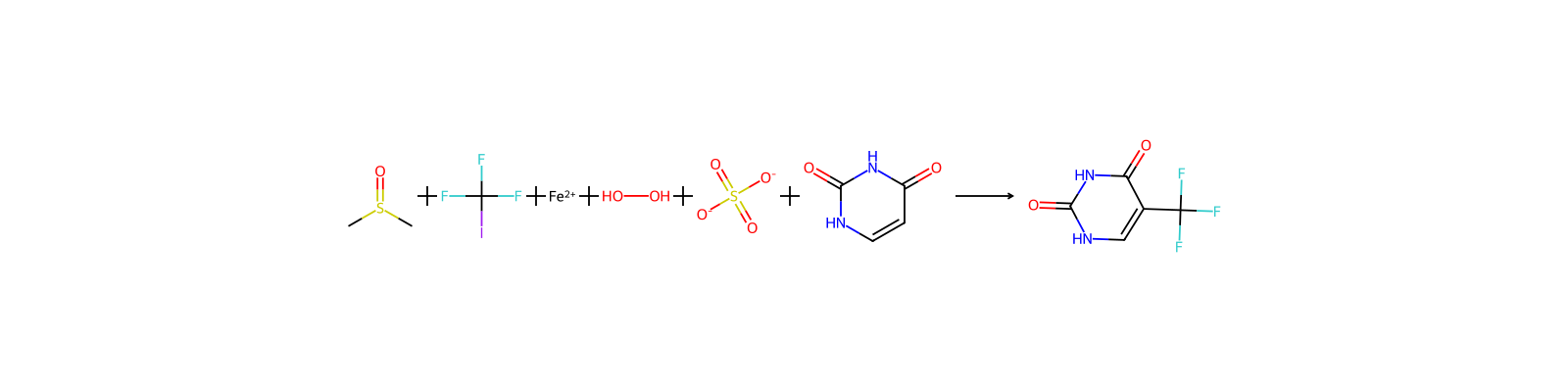
Trifluoromethyl iodideUracilIron(III) sulfate hydrateHydrogen peroxideDimethyl sulfoxide

Downstream products

PF-5622712,4(1H,3H)-Pyrimidinedione, 1-ethyl-5-(trifluoromethyl)-

Related reactions

35 records
New reaction record
HRID 12655 reaction equation
HRID 12655As reactant
HRID 18124 reaction equation
HRID 18124As reactant
HRID 109319 reaction equation
HRID 109319As product
HRID 188816 reaction equation
HRID 188816As reactant
HRID 282960 reaction equation
HRID 282960As product
HRID 301528 reaction equation
HRID 301528As product
HRID 684612 reaction equation
HRID 684612As product
HRID 700673 reaction equation
HRID 700673As reactant
PreviousPage 1 of 5

Compound notes

On this pageBasic informationOverviewNames & identifiersPropertiesSafety & regulationChemistry & industryRelated reactionsCompound notes
UNII
4U846R5P34
EC Number
200-197-5
Nikkaji
J49.057A
SMILES
C1(=O)NC=C(C(F)(F)F)C(=O)N1
CAS DataBase Reference
54 · 54-20-6(CAS DataBase Reference)
EWG's Food Scores
1 · 1
FDA UNII
4 U846R5P34 · 4U846R5P34
NIST Chemistry Reference
2 · 2,4(1H,3h)-pyrimidinedione, 5-(trifluoromethyl)-(54-20-6)
Comptox DTXSID
40202304 · DTXSID40202304
UNSPSC Code
12352100 · 12352100
NACRES
22 · NA.22
Symbol(GHS)
6 · GHS06
Signal word
Danger
Hazard statements
301 · H301-H315-H319-H335
Precautionary statements
301 · P301+P310+P330-P302+P352-P305+P351+P338
target organs
Respiratory system
Hazard Codes
Xi,T
Risk Statements
22 · 22-36/38-40-36/37/38-25
Safety Statements
24 · 24/25-36-26
RIDADR
2811 · 2811
WGK Germany
3 · 3
RTECS
1750000 · YR1750000
Hazard Note
Irritant
HazardClass
6.1 · 6.1
PackingGroup
Ⅲ
HS Code
2933599090 · 2933599090
Storage Class
6.1 C · 6.1C - Combustible acute toxic Cat.3toxic compounds or compounds which causing chronic effects
Hazard Classifications
3 OralEye · Acute Tox. 3 OralEye Irrit. 2Skin Irrit. 2STOT SE 3
Toxicity
50 intraperitoneal · LD50 intraperitoneal in mouse: 800mg/kg
target organs
Respiratory system
Hazard statements
H301-H315-H319-H335
Hazard Classifications
Acute Tox. 3 OralEye Irrit. 2Skin Irrit. 2STOT SE 3
Precautionary statements
P301+P310+P330-P302+P352-P305+P351+P338