
Hexadecyltrimethylammonium Bromide
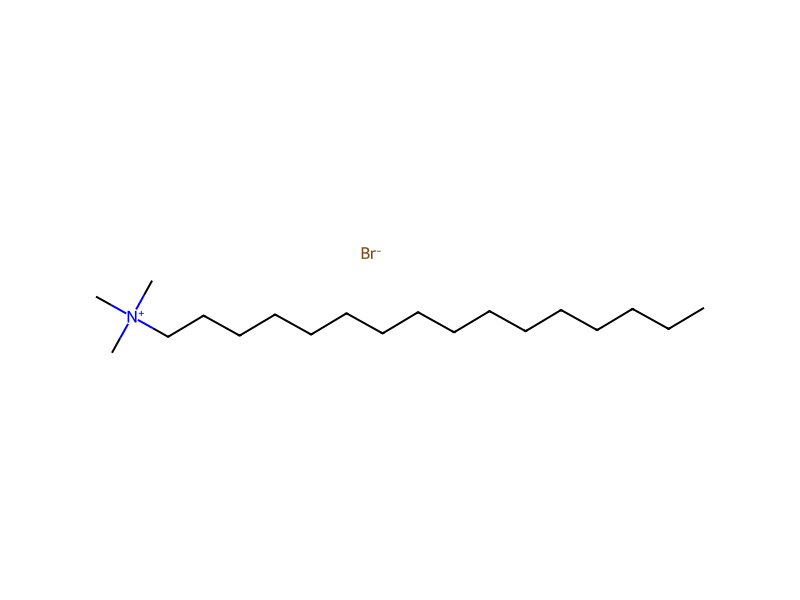
Basic information
- CAS
57-09-0- Standard SMILES
CCCCCCCCCCCCCCCC[N+](C)(C)C.[Br-]- InChIKey
CXRFDZFCGOPDTD-UHFFFAOYSA-M- Molecular formula
- C19H42N.Br
- Average molar mass
- 364.4 g/mol
Overview
Cetyltrimethylammonium bromide is the organic bromide salt that is the bromide salt of cetyltrimethylammonium; one of the components of the topical antiseptic cetrimide. It has a role as a detergent and a surfactant. It is a quaternary ammonium salt and an organic bromide salt. It contains a cetyltrimethylammonium ion.
Names & identifiers
- Preferred name
- Hexadecyltrimethylammonium Bromide
- IUPAC
- hexadecyl(trimethyl)azanium bromide
- English name
- Hexadecyl trimethyl ammonium bromide
- Molecular formula
- C19H42BrN
- Molecular weight
- 364.45
Names & synonyms
57-09-0Cetrimonium bromideCetyltrimethylammonium bromideHexadecyltrimethylammonium bromideBromatCETABCentimideCtmabAcetoquat CTABCee deeCetyl trimethyl ammonium bromideTrimethylcetylammonium bromide
Show more names
CTABHTABCTABRCTMBcetarol
Bromuro de cetrimonioN-Cetyltrimethylammonium bromideBromure de cetrimoniumCetrimonii bromidumTrimethylhexadecylammonium bromideCetrimonio bromuroN-HEXADECYLTRIMETHYLAMMONIUM BROMIDEPalmityltrimethyl ammonium bromide
Database identifiers
- CAS
57-09-0、8044-71-1- PubChem CID
- 5974
- DTXSID
DTXSID5037028- ChEMBL
CHEMBL307346- ChEBI
CHEBI:3567- UNII
- L64N7M9BWR
- EC Number
- 200-311-3
Properties
Computed structural properties
- Topological polar surface area
- 0 Ų
- Hydrogen bond donors
- 0
- Hydrogen bond acceptors
- 1
- Rotatable bonds
- 15
- Heavy atoms
- 21
- Formal charge
- 0
- Complexity
- 181
Experimental & physicochemical properties
Chemical ClassesNitrogen Compounds -> Quaternary Amines
Cosmetics
Cosmetics ingredient -> Conditioning/Emollient; Emulsifier; Fragrance; Preservative/Stabilizer
Cosmetic ingredients (Cetrimonium Bromide) -> CIR (Cosmetic Ingredient Review)
Preservative
Food Contact SubstancesFCS -> FDA Cumulative Estimated Daily Intake (CEDI)
Physical Description
Dry Powder
White powder; [MSDSonline]
Collision Cross Section197.7 Ų [M+H]+ [CCS Type: TW; Method: calibrated with polyalanine and drug standards]
Physicochemical properties
- Melting point
- 248 · 248-251 °C(lit.)
- Density
- 1.1107 · 1.1107 (rough estimate)
- bulk density
- 390 kg/m3 · 390kg/m3
- refractive index
- 1.526 · 1.5260 (estimate)
- Flash point
Safety & regulation
Safety information is for reference only and does not replace the supplier’s Safety Data Sheet (SDS), applicable regulations, or professional assessment.
GHS classification
GHS Classification
This chemical does not meet GHS hazard criteria for 0.6% (5 of 823) of reports.
Danger
H302 (97%): Harmful if swallowed [Warning Acute toxicity, oral]
P260, P261, P264, P264+P265, P270, P271, P273, P280, P301+P317, P302+P352, P304+P340, P305+P354+P338, P317, P319, P321, P330, P332+P317, P362+P364, P391, P403+P233, P405, and P501 (click each P-code to see the statement)
Aggregated GHS information provided per 823 reports by companies from 38 notifications to the ECHA C&L Inventory. Each notification may be associated with multiple companies.
Not Classified
Hazard information
Regulatory Information
Chemical: 1-Hexadecanaminium, N,N,N-trimethyl-, bromide
Hazard Traits - Hazard Trait Undefined
Regulation (EC) No 1935/2004 (amended)
1-Hexadecanaminium, N,N,N-trimethyl-, bromide (1:1) is listed on the EPA's Chemical Data Reporting (CDR) system. Manufacturers and importers of 1-Hexadecanaminium, N,N,N-trimethyl-, bromide (1:1) are required to report information about their production and use of this chemical to the EPA under the Toxic Substances Control Act (TSCA). (40 eCFR Part 711)
Status: Active Update: 30-09-2021 https://echa.europa.eu/registration-dossier/-/registered-dossier/10369
Cetrimonium bromide: Does not have an individual approval but may be used under an appropriate group standard
Other Safety InformationIMAP assessments - Cationic surfactants: Human health tier II assessment
Hazards Summary
Corrosive to skin and eyes; May cause skin sensitization; [eChemPortal: ERMA] Allergic contact dermatitis is infrequently documented; [Marks, p. 266] Quaternary ammonium compounds have curare-like properties when concentrated solutions are ingested; Affected patients may have methemoglobinemia and hemolysis and die within 1-3 hours; Elevated liver function tests were reported; Concentrated solutions can cause burns; No data on carcinogenicity or teratogenicity; [IPCS-PIMs]
Chemistry & industry
Pharmacology
MeSH Pharmacological ClassificationSubstances used on humans and other animals that destroy harmful microorganisms or inhibit their activity. They are distinguished from DISINFECTANTS, which are used on inanimate objects.
Uses & manufacturing
Uses
CIR ingredient: Cetrimonium Bromide
Quarternary ammonium compounds are used as algaecides/slimicides (swimming pools, industrial water reservoirs, and farm ponds), antiseptcis for cleaning wounds, antistatic agents for textiles, softeners for paper products, and pigment dispersers; [IPCS-PIMs]
Using Disinfectants or Biocides [Category: Clean]
Cetyl-Trimethyl-Ammonium, Cetrimonium, cetyl trimethylammonium, or hexadecyltrimethylammonium is a quaternary ammonium cation whose bromide and chloride salts are used as antiseptics.
U.S. Production2023: 4,409 lb
Industry UsesOther
Household Products
Cosmetics product ingredient: Cetrimonium bromide
Information on 9 consumer products that contain Cetrimonium bromide in the following categories is provided:
Use ClassificationCosmetics -> Preservative
General Manufacturing Information
Printing Ink Manufacturing
1-Hexadecanaminium, N,N,N-trimethyl-, bromide (1:1): ACTIVE
Applications
UsesHexadecyltrimethylammonium Bromide (CTAB) is a cationic surfactant used as a template in the synthesis of Mesoporous γ-Fe2O3.
Related reactions
83 records


Compound notes
Loading…