
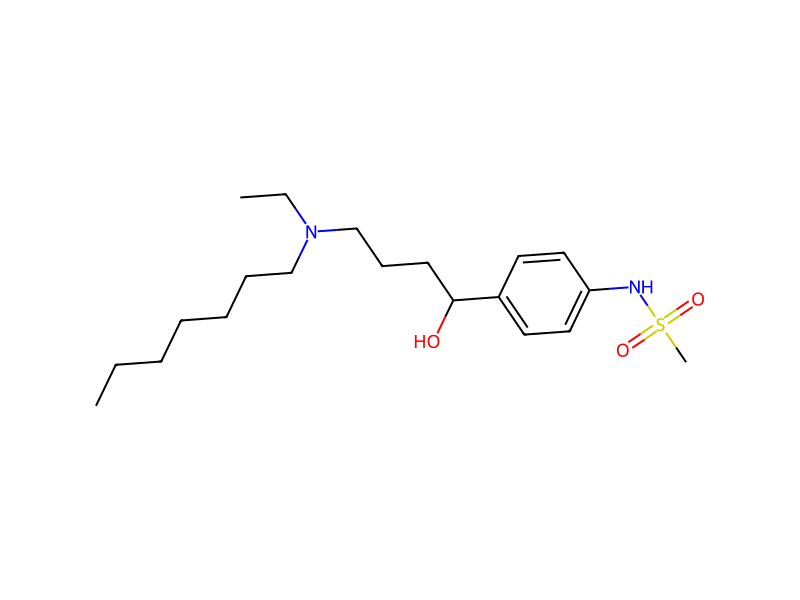
Basic information
- Standard SMILES
CCCCCCCN(CC)CCCC(O)c1ccc(NS(C)(=O)=O)cc1- InChIKey
ALOBUEHUHMBRLE-UHFFFAOYSA-N- Molecular formula
- C20H36N2O3S
- Average molar mass
- 384.6 g/mol
- Monoisotopic mass
- 384.24466401
Overview
Ibutilide is a member of benzenes and an organic amino compound.
Names & identifiers
- Preferred name
- Ibutilide
- IUPAC
- N-[4-[4-[ethyl(heptyl)amino]-1-hydroxybutyl]phenyl]methanesulfonamide
- English name
- IBUTILIDE
- Molecular formula
- C20H36N2O3S
- Molecular weight
- 384.58
Names & synonyms
Ibutilide122647-31-8IbutilidaIbutilidumn-(4-{4-[ethyl(heptyl)amino]-1-hydroxybutyl}phenyl)methanesulfonamideN-(4-(4-(ethyl(heptyl)amino)-1-hydroxybutyl)phenyl)methanesulfonamideN-[4-[4-[ethyl(heptyl)amino]-1-hydroxybutyl]phenyl]methanesulfonamide2436VX1U9BDTXSID20861271N-[4-[4-(ethylheptylamino)-1-hydroxybutyl]phenyl]methanesulfonamideN-(4-(4-(ethylheptylamino)-1-hydroxybutyl)phenyl)methanesulfonamideRefChem:56518
Show more names
CorvertU-70226EIBUTIBIDERosuvastatin-dUnii-2436vx1U9bIBUTILIDE USP/EP/BP
C01BD05DTXCID30197270Ibutilidum [INN-Latin]Ibutilida [INN-Spanish]Ibutilide (INN)CHEMBL533Ibutilide [INN:BAN]IBUTILIDE [INN]
Database identifiers
- CAS
122647-31-8、122647-32-9- PubChem CID
- 60753
- DTXSID
DTXSID20861271- ChEMBL
CHEMBL533- ChEBI
CHEBI:5856- UNII
- 2436VX1U9B
- Nikkaji
- J362.100F
Properties
Computed structural properties
- XLogP
- 4
- Topological polar surface area
- 78 Ų
- Hydrogen bond donors
- 2
- Hydrogen bond acceptors
- 5
- Rotatable bonds
- 14
- Heavy atoms
- 26
- Formal charge
- 0
- Complexity
- 442
Experimental & physicochemical properties
LogP4.6
Solubility
MW: 885.23. Crystals from acetone, mp 117-119 °C.; UV max (95% ethanol): 228, 267 nm (epsilon 16670, 894); solubility: (mg/mL): aqueous >100 (pH less than or equal to 7) /Ibutilide fumarate/
4.73e-03 g/L
Physical DescriptionSolid
Physicochemical properties
- Boiling point
- 522.4 · 522.4±60.0 °C(Predicted)
- Density
- 1.099 · 1.099±0.06 g/cm3(Predicted)
- pka
- 8.54 · 8.54±0.10(Predicted)
- form
- Oil
- color
- Colorless to light yellow
- CAS DataBase Reference
- 122647 · 122647-31-8
- FDA UNII
- 2436 VX1U9B · 2436VX1U9B
- ATC code
- 1 BD05 · C01BD05
Safety & regulation
Hazard information
FDA Requirements
The Approved Drug Products with Therapeutic Equivalence Evaluations identifies currently marketed prescription drug products, including ibutilide fumarate, approved on the basis of safety and effectiveness by FDA under sections 505 of the Federal Food, Drug, and Cosmetic Act. /Ibutilide fumarate/
Safety & protection
Storage ConditionsStore at controlled room temperature 20 deg to 25 °C (68 deg to 77 °F). Store vial in carton until used.
Disposal Methods
SRP: Expired or waste pharmaceuticals shall carefully take into consideration applicable DEA, EPA, and FDA regulations. It is not appropriate to dispose by flushing the pharmaceutical down the toilet or discarding to trash. If possible return the pharmaceutical to the manufacturer for proper disposal being careful to properly label and securely package the material. Alternatively, the waste pharmaceutical shall be labeled, securely packaged and transported by a state licensed medical waste contractor to dispose by burial in a licensed hazardous or toxic waste landfill or incinerator.
Toxicology
Interactions
Supraventricular arrhythmias may mask the cardiotoxicity associated with excessive digoxin levels. Therefore, it is advisable to be particularly cautious in patients whose plasma digoxin levels are above or suspected to be above the usual therapeutic range. Coadministration of digoxin did not have effects on either the safety or efficacy of ibutilide in the clinical trials.
The potential for proarrhythmia may increase with the administration of ibutilide fumarate injection to patients who are being treated with drugs that prolong the QT interval, such as phenothiazines, tricyclic antidepressants, tetracyclic antidepressants, and certain antihistamine drugs (H1 receptor antagonists).
Class Ia antiarrhythmic drugs (Vaughan Williams Classification), such as disopyramide, quinidine, and procainamide, and other class III drugs, such as amiodarone and sotalol, should not be given concomitantly with ibutilide fumarate injection or within 4 hours postinfusion because of their potential to prolong refractoriness. In the clinical trials, class I or other class III antiarrhythmic agents were withheld for at least 5 half-lives prior to ibutilide infusion and for 4 hours after dosing, but thereafter were allowed at the physician's discretion.
Ibutilide is a class III antiarrhythmic agent indicated for cardioversion of atrial fibrillation and atrial flutter to sinus rhythm (SR). The most serious complication of ibutilide is torsades de pointes (TdP). Magnesium has been successfully used for the treatment of TdP, but its use as a prophylactic agent for this arrhythmia has not yet been established. The present study investigated whether high dose of magnesium would increase the safety and efficacy of ibutilide administration. A total of 476 patients with atrial fibrillation or atrial flutter who were candidates for conversion to SR were divided into 2 groups. Group A consisted of 229 patients who received ibutilide to convert atrial fibrillation or atrial flutter to SR. Group B consisted of 247 patients who received an intravenous infusion of 5 g of magnesium sulfate for 1 hour followed by the administration of ibutilide. Then, another 5 g of magnesium were infused for 2 additional hours. Of the patients in groups A and B, 154 (67.3%) and 189 (76.5%), respectively, were converted to SR (p = 0.033). Ventricular arrhythmias (sustained, nonsustained ventricular tachycardia, and TdP) occurred significantly more often in group A than in group B (7.4% vs 1.2%, respectively, p = 0.002). TdP developed in 8 patients (3.5%) in group A and in none (0%) in group B (p = 0.009). The administration of magnesium (despite the high doses used) was well tolerated. In conclusion, the administration of high doses of magnesium probably makes ibutilide a much safer agent, and magnesium increased the conversion efficacy of ibutilide.
Adverse Effects
According to the Institute for Safe Medication Practices (ISMP), ibutilide carries a heightened risk of causing significant patient harm, including potentially fatal arrhythmias. Thus, clinicians must consistently assess the balance between benefits and risks when contemplating the use of this agent.
Toxicity SummaryCurrently, the antidote for ibutilide does not exist. In animal models, acute overdose has caused central nervous system (CNS) toxicity, including CNS depression, rapid gasping, and convulsions.
Human Toxicity Excerpts
/SIGNS AND SYMPTOMS/ In the registration trials with ibutilide fumarate injection, four patients were unintentionally overdosed. The largest dose was 3.4 mg administered over 15 minutes. One patient (0.025 mg/kg) developed increased ventricular ectopy and monomorphic ventricular tachycardia, another patient (0.032 mg/kg) developed AV block-3rd degree and nonsustained polymorphic VT, and two patients (0.038 and 0.020 mg/kg) had no medical event reports. Based on known pharmacology, the clinical effects of an overdosage with ibutilide could exaggerate the expected prolongation of repolarization seen at usual clinical doses. Medical events (e.g., proarrhythmia, AV block) that occur after the overdosage should be treated with measures appropriate for that condition.
/SIGNS AND SYMPTOMS/ Like other antiarrhythmic agents, ibutilide fumarate injection can induce or worsen ventricular arrhythmias in some patients. This may have potentially fatal consequences. Torsades de pointes, a polymorphic ventricular tachycardia that develops in the setting of a prolonged QT interval, may occur because of the effect Ibutilide fumarate has on cardiac repolarization, but Ibutilide fumarate can also cause polymorphic VT in the absence of excessive prolongation of the QT interval. In general, with drugs that prolong the QT interval, the risk of torsades de pointes is thought to increase progressively as the QT interval is prolonged and may be worsened with bradycardia, a varying heart rate, and hypokalemia. In clinical trials conducted in patients with atrial fibrillation and atrial flutter, those with QTc intervals >440 msec were not usually allowed to participate, and serum potassium had to be above 4.0 mEq/L. Although change in QTc was dose dependent for ibutilide, there was no clear relationship between risk of serious proarrhythmia and dose in clinical studies, possibly due to the small number of events. In clinical trials of intravenous ibutilide, patients with a history of congestive heart failure or low left ventricular ejection fraction appeared to have a higher incidence of sustained polymorphic ventricular tachycardia (VT), than those without such underlying conditions; for sustained polymorphic VT the rate was 5.4% in patients with a history of congestive heart failure and 0.8% without it. There was also a suggestion that women had a higher risk of proarrhythmia, but the sex difference was not observed in all studies and was most prominent for nonsustained ventricular tachycardia. The incidence of sustained ventricular arrhythmias was similar in male (1.8%) and female (1.5%) patients, possibly due to the small number of events. Ibutilide fumarate is not recommended in patients who have previously demonstrated polymorphic ventricular tachycardia (eg, torsades de pointes).
/CASE REPORTS/ The case of a 52-yr-old man who presented to the hospital with cardiac palpitations and who developed acute toxic renal failure after receiving 2 doses of 0.87 mg of ibutilide to restore sinus rhythm after an electrocardiogram revealed atrial flutter with fast atrioventricular conduction is presented. Concomitant therapy included allopurinol, cefpodoxime, theophylline, and lisinopril. Six days after the patient was treated with ibutilide, he was admitted to the hospital with high-grade pulmonary congestion in association with renal failure. After 4 hemodialysis sessions, his kidney function improved, and serum creatinine and creatinine clearance were within normal ranges 1 wk later.
/CASE REPORTS/ While waiting to observe the response to ibutilide fumarate by a patient with atrial fibrillation, a nurse preparing the intravenous solution inadvertently spilled the drug on the hands of a medical resident. The resident immediately wiped his hands dry with disposable paper towels. Several hours later he sensed tingling and itching over the area, and the next day two erythematous bullous lesions were present on the dorsal surfaces of both hands. A single application of topical steroid was applied to the affected areas. The lesions were kept clean and dry, and healed completely in approximately 10 days. This is an unusual allergic reaction due to contact with ibutilide fumarate.
/CASE REPORTS/ Ibutilide is a novel class III antiarrhythmic agent used for the termination of atrial flutter and atrial fibrillation. It mainly affects membrane potassium currents (IKr) and prolongs the cardiac action potential. This effect is reflected as QT-interval prolongation in the ECG. Drugs that affect IKr-currents are known to cause malignant ventricular arrhythmia. ... Three patients with heart failure where ibutilide triggered malignant ventricular arrhythmias (sustained torsades de pointes) /were reported/. All patients experienced dramatic hemodynamic deterioration. One patient died because of sustained arrhythmia. ... Ibutilide is contraindicated in patients with heart failure and should be used with caution in patients with ischaemic heart disease or previous myocardial infarction. Ibutilide-induced ventricular arrhythmias may be particularly difficult to treat in patients with heart failure.
Drug Induced Liver Injury
Drug-Induced Liver Injury Severity and Toxicity (DILIst)
ibutilide
DILI Negative
Intravenous
DOI:10.1016/j.drudis.2019.09.022
Non-Human Toxicity Excerpts
/LABORATORY ANIMALS: Acute Exposure/ Acute overdose in animals results in CNS toxicity; notably, CNS depression, rapid gasping breathing, and convulsions. The intravenous median lethal dose in the rat was more than 50 mg/kg which is, on a mg/sq m basis, at least 250 times the maximum recommended human dose.
/LABORATORY ANIMALS: Developmental or Reproductive Toxicity/ In two Segment II Teratology studies, timed-pregnant Crl:CD[BR] (Sprague-Dawley) rats were treated orally (gastric intubation) on days 6-15 of gestation with ibutilide fumarate (ibutilide), a class III antiarrhythmic that has been shown to increase the refractory period and action potential duration of myocardial cells. In the first study, ibutilide does of 20, 40, and 80 mg/kg/ day were tested. Although maternal toxicity was equivocal in the 80 mg/kg/day group, all 23 rats that conceived had entirely resorbed litters when the animals were killed on day 20 of gestation. Similarly, 12 of 24 litters were completely resorbed in the 40 mg/kg/day group, with an 87.7% postimplantational loss. Of the surviving fetuses in this group, 48.6% had at least one malformation. The incidences of malformed pharynx and malformed palate, along with adactyly, were statistically significantly higher in this group than in the control group. In addition, a significant (P < 0.05) increase in total malformations (5.7% of the fetuses), relative to the controls (0.8%), was found for the 20 mg/kg/day group. Since a no observed adverse effect level (NOAEL) was not found, a second teratology study was performed. In this study, the ibutilide doses were 5, 10, and 20 mg/kg/day. The 20 mg/kg/day dose was again teratogenic with 9.2% of the fetuses malformed, as compared to a control value of 1.0%. Also, the incidences of scoliosis and interventricular septal defect were statistically significantly higher in this group. Although statistically significant differences were not detected, scoliosis was also found in the 10 mg/kg/day group (3 fetuses in 2 litters), along with a significant dose-response trend for this malformation. As the result, the NOAEL for ibutilide teratogenicity in rats was set at 5 mg/kg/day. This dose is 4 times the proposed maximum clinical dose (two 1 mg doses, each infused over 10 minutes, or 0.033 mg/kg for a 60 kg person), when corrected for 2.6% oral bioavailability in the rat at a dose of 10 mg/kg, as determined in separate studies.
Populations at Special Risk
... Ibutilide is contraindicated in patients with heart failure and should be used with caution in patients with ischaemic heart disease or previous myocardial infarction. Ibutilide-induced ventricular arrhythmias may be particularly difficult to treat in patients with heart failure.
Women have a higher incidence of torsades de pointes than men, but it is not known if the risk of drug-induced torsades de pointes varies during the menstrual cycle. ... A volunteer sample of 58 healthy adults (38 men and 20 women) aged 21 to 40 years /were given/ a low dose of ibutilide (0.003 mg/kg), infused intravenously for 10 minutes. Subjects were monitored for 120 minutes. Women received the intervention on 3 separate occasions to correspond with menstrual cycle phases, which were verified by using hormonal assays. QT interval, recorded from electrocardiogram at timed intervals during and after ibutilide infusion and standardized for variations in heart rate (QTc). Maximum (mean (SD)) millisecond increase in QTc after ibutilide infusion was greater for women during menses (63 (13)) and the ovulatory phase (59 (17)) compared with women during the luteal phase (53 (14)) and compared with men (46 (16); P =0.002 vs menses and P =0.007 vs ovulation). Progesterone (r = -0.40) and progesterone-to-estradiol ratio (r = -0.41), but not estradiol (r = 0.14) or testosterone (r = 0.09), were inversely correlated with ibutilide-induced QT prolongation. Menstrual cycle and sex differences exist in QTc responses to ibutilide, with the greatest increase in QTc corresponding to the first half of the menstrual cycle.
Antidote and Emergency Treatment
/SRP:/ Immediate first aid: Ensure that adequate decontamination has been carried out. If patient is not breathing, start artificial respiration, preferably with a demand valve resuscitator, bag-valve-mask device, or pocket mask, as trained. Perform CPR if necessary. Immediately flush contaminated eyes with gently flowing water. Do not induce vomiting. If vomiting occurs, lean patient forward or place on the left side (head-down position, if possible) to maintain an open airway and prevent aspiration. Keep patient quiet and maintain normal body temperature. Obtain medical attention. /Poisons A and B/
/SRP:/ Basic treatment: Establish a patent airway (oropharyngeal or nasopharyngeal airway, if needed). Suction if necessary. Watch for signs of respiratory insufficiency and assist ventilations if needed. Administer oxygen by nonrebreather mask at 10 to 15 L/min. Monitor for pulmonary edema and treat if necessary ... . Monitor for shock and treat if necessary ... . Anticipate seizures and treat if necessary ... . For eye contamination, flush eyes immediately with water. Irrigate each eye continuously with 0.9% saline (NS) during transport ... . Do not use emetics. For ingestion, rinse mouth and administer 5 mL/kg up to 200 mL of water for dilution if the patient can swallow, has a strong gag reflex, and does not drool ... . Cover skin burns with dry sterile dressings after decontamination ... . /Poisons A and B/
/SRP:/ Advanced treatment: Consider orotracheal or nasotracheal intubation for airway control in the patient who is unconscious, has severe pulmonary edema, or is in severe respiratory distress. Positive-pressure ventilation techniques with a bag valve mask device may be beneficial. Consider drug therapy for pulmonary edema ... . Consider administering a beta agonist such as albuterol for severe bronchospasm ... . Monitor cardiac rhythm and treat arrhythmias as necessary ... . Start IV administration of D5W /SRP: "To keep open", minimal flow rate/. Use 0.9% saline (NS) or lactated Ringer's if signs of hypovolemia are present. For hypotension with signs of hypovolemia, administer fluid cautiously. Watch for signs of fluid overload ... . Treat seizures with diazepam or lorazepam ... . Use proparacaine hydrochloride to assist eye irrigation ... . /Poisons A and B/
Regulatory information
FDA Requirements
The Approved Drug Products with Therapeutic Equivalence Evaluations identifies currently marketed prescription drug products, including ibutilide fumarate, approved on the basis of safety and effectiveness by FDA under sections 505 of the Federal Food, Drug, and Cosmetic Act. /Ibutilide fumarate/
Chemistry & industry
Pharmacology
ATC Code
C - Cardiovascular system
QC - Cardiovascular system
Protein Binding40%
Pharmacodynamics
Ibutilide prolongs the action potential duration and increases both atrial and ventricular refractoriness in vivo, i.e., class III electrophysiologic effects. Voltage clamp studies indicate that ibutilide, at nanomolar concentrations, delays repolarization by activation of a slow, inward current (predominantly sodium), rather than by blocking outward potassium currents, which is the mechanism by which most other class III antiarrhythmics act.
Mechanism of Action
Ibutilide is a 'pure' class III antiarrhythmic drug, used intravenously against atrial flutter and fibrillation. At a cellular level it exerts two main actions: induction of a persistent Na+ current sensitive to dihydropyridine Ca<sup>2+</sup> channel blockers and potent inhibition of the cardiac rapid delayed rectifier K<sup>+</sup> current, by binding within potassium channel pores. In other words, Ibutilide binds to and alters the activity of hERG potassium channels, delayed inward rectifier potassium (IKr) channels and L-type (dihydropyridine sensitive) calcium channels
Ibutilide is a 'pure' class III antiarrhythmic drug, used intravenously against atrial flutter and fibrillation. At a cellular level it exerts two main actions: induction of a persistent Na+ current sensitive to dihydropyridine Ca2+ channel blockers and potent inhibition of the cardiac rapid delayed rectifier K+ current, by binding within the channel pore cavity upon channel gating. Ibutilide has been shown to terminate atrial flutter and fibrillation in animal studies, with some risk of ventricular pro-arrhythmia. Experimental models of hypertrophy/heart failure show altered sensitivity to ibutilide, with increased dispersion of repolarization and incidence of pro-arrhythmia. Patient trials show that ibutilide is effective at terminating atrial arrhythmias when given alone, and that it can increase effectiveness and reduce energy requirements of electrical cardioversion. The risk to patients of polymorphic ventricular tachycardia necessitates careful patient selection and monitoring during and after treatment.
Ibutilide injection prolongs action potential duration in isolated adult cardiac myocytes and increases both atrial and ventricular refractoriness in vivo, i.e., class III electrophysiologic effects. Voltage clamp studies indicate that ibutilide fumarate injection, at nanomolar concentrations, delays repolarization by activation of a slow, inward current (predominantly sodium), rather than by blocking outward potassium currents, which is the mechanism by which most other class III antiarrhythmics act. These effects lead to prolongation of atrial and ventricular action potential duration and refractoriness, the predominant electrophysiologic properties of ibutilide fumarate injection in humans that are thought to be the basis for its antiarrhythmic effect.
Ibutilide fumarate is a new class III intravenous antiarrhythmic agent indicated for the acute termination of atrial fibrillation and flutter. Ibutilide prolongs repolarization in the atria and ventricle by enhancing the inward depolarizing, slow sodium current, a unique mechanism of action for a class III agent. Atrial refractoriness is prolonged with no evidence of reverse use dependence. Ibutilide may also block the delayed rectifier current, but this does not appear to be clinically relevant. In vitro and at high doses, ibutilide may shorten action potential duration, although this effect has not been noted clinically. Ibutilide can cause torsades de pointes in a rabbit model of proarrhythmia dependent on the formation of early afterdepolarizations. However, it causes less proarrhythmia than sotalol, dofetilide, or sematilide in this model. The pharmacokinetics of ibutilide are linear, its extravascular distribution is rapid and extensive, while its systemic clearance is high (elimination half-life 3-6 hours). Eight metabolites are formed by the liver, only one of which is slightly active. QT prolongation is dose dependent, is maximal at the end of the infusion, and returns to baseline within 2-4 hours following infusion. The pharmacokinetic and electrophysiologic characteristics of ibutilide are complementary in that any risk of proarrhythmia is made manageable by a short half-life. Almost all reported cases of drug-induced torsades de pointes ventricular tachycardia associated with ibutilide have occurred within 40 minutes of starting the infusion. Nevertheless, clinicians using ibutilide can further reduce the chance of torsades de pointes by being very familiar with the criteria for patient selection, and by being prepared to treat it should it occur. When used with full knowledge of its potential risks, ibutilide is a very effective intravenous agent for the acute termination of atrial fibrillation and flutter and is likely to become a significant treatment option for these arrhythmias.
Biological Half-Life
6 hours (ranges from 2-12 hours)
The elimination half-life averages about 6 hours (range from 2 to 12 hours).
Sixteen adult patients with atrial fibrillation or atrial flutter requiring conversion to normal sinus rhythm: six patients who had New York Heart Association (NYHA) class II or III heart failure due to left ventricular dysfunction (mean +/- SD left ventricular ejection fraction (LVEF) 30 +/- 9%); 10 patients who did not have left ventricular dysfunction (mean +/- SD LVEF 54 +/- 5% in six of these 10 patients) served as controls. All patients received a single dose of ibutilide 1.0 mg administered intravenously over 10 minutes. ... No significant differences were noted between the heart failure and normal left ventricular function groups in the following parameters: ... half-life (12.5 +/- 10.7 vs 12.4 +/- 8.6 hrs, p=0.99).
Metabolism/Metabolites
Primarily hepatic. Eight metabolites of ibutilide were detected in metabolic profiling of urine. These metabolites are thought to be formed primarily by o-oxidation followed by sequential b-oxidation of the heptyl side chain of ibutilide. Of the eight metabolites, only the o-hydroxy metabolite possesses class III electrophysiologic properties similar to that of ibutilide in an in vitro isolated rabbit myocardium model.
Eight metabolites of ibutilide were detected in metabolic profiling of urine. These metabolites are thought to be formed primarily by omega-oxidation followed by sequential beta-oxidation of the heptyl side chain of ibutilide. Of the eight metabolites, only the omega-hydroxy metabolite possesses class III electrophysiologic properties similar to that of ibutilide in an in vitro isolated rabbit myocardium model. The plasma concentrations of this active metabolite, however, are less than 10% of that of ibutilide.
FDA Pharmacological Classification
2436VX1U9B
IBUTILIDE
Established Pharmacologic Class [EPC] - Antiarrhythmic
Ibutilide is an Antiarrhythmic.
MeSH Pharmacological Classification
Agents used for the treatment or prevention of cardiac arrhythmias. They may affect the polarization-repolarization phase of the action potential, its excitability or refractoriness, or impulse conduction or membrane responsiveness within cardiac fibers. Anti-arrhythmia agents are often classed into four main groups according to their mechanism of action: sodium channel blockade, beta-adrenergic blockade, repolarization prolongation, or calcium channel blockade.
Absorption, Distribution and Excretion
Rapid after intravenous injection
In healthy male volunteers, about 82% of a 0.01 mg/kg dose of [14C] ibutilide fumarate was excreted in the urine (about 7% of the dose as unchanged ibutilide) and the remainder (about 19%) was recovered in the feces.
11 L/kg
29 mL/min/kg
Sixteen adult patients with atrial fibrillation or atrial flutter requiring conversion to normal sinus rhythm: six patients who had New York Heart Association (NYHA) class II or III heart failure due to left ventricular dysfunction (mean +/- SD left ventricular ejection fraction (LVEF) 30 +/- 9%); 10 patients who did not have left ventricular dysfunction (mean +/- SD LVEF 54 +/- 5% in six of these 10 patients) served as controls. All patients received a single dose of ibutilide 1.0 mg administered intravenously over 10 minutes. Blood samples were obtained through an indwelling catheter in the contralateral arm before ibutilide administration, at the end of the infusion, and at 5, 15, 30, 45 minutes and 1, 1.5, 2, 3, 4, 6, 8, 10, 12, 24, and 48 hours after the infusion. Serum ibutilide concentrations were determined by using high-performance liquid chromatography and mass spectrometry. No significant differences were noted between the heart failure and normal left ventricular function groups in the following parameters: maximum serum ibutilide concentration (median (interquartile range) 3.8 (2.3-5.7) vs 5.8 (3.1-14.4) ug/L, p=0.31), area under the serum concentration-time curve from time zero extrapolated to infinity (mean +/- SD 11.0 +/- 9.4 vs 13.2 +/- 10.6 ug*hr/L, p=0.88), steady-state volume of distribution (1380 +/- 334 vs 1390 +/- 964 L, p=0.99), systemic clearance (129 +/- 60 vs 125 +/- 81 L/hr, p=0.92), or half-life (12.5 +/- 10.7 vs 12.4 +/- 8.6 hrs, p=0.99). The pharmacokinetics of ibutilide do not appear to be altered in patients with NYHA class II or III heart failure due to left ventricular systolic dysfunction.
In healthy male volunteers, about 82% of a 0.01 mg/kg dose of (14)C ibutilide fumarate was excreted in the urine (about 7% of the dose as unchanged ibutilide) and the remainder (about 19%) was recovered in the feces.
Cellular LocationsCytoplasm
Metabolite PathwaysIbutilide Action Pathway
Uses & manufacturing
UsesMEDICATION
Methods of Manufacturing
The synthesis starts with a Friedel-Crafts acylation of methanesulfonanilide with succinic anhydride in presence of AlCl3 yielding 4-[(methylsulfonyl)amino]-gamma-oxobenzenebutanoic acid, which is treated with N-ethylheptylamine and dicyclohexylcarbodiimide (DCC) in DMF to give the corresponding amide. Reduction with LiAlH4 in THF in the last step provides the desired drug substance.
Formulations/PreparationsParenteral: Injection, for IV infusion: 1 mg (0.1 mg/mL), Covert (Pfizer). /Ibutilide fumarate/
Applications
UsesCardiac depressant (anti-arrhythmic).
General DescriptionIbutilide, N-{4-[4-(ethylheptylamino)-1-hydroxybutyl]phenyl}methanesulfonamide (Corvert), aclass III antiarrhythmic belonging to the methanesulfonanilideclass of agents, is indicated for rapid conversion ofatrial fibrillation or atrial flutter to normal sinus rhythm.Unlike dofetilide, it is not highly specific for the delayedrectifier potassium currents (Ikr) and does have some affinityfor sodium channels.
Upstream & downstream products
Upstream raw materials
Suppliers17 total
陕西缔都医药有限责任公司029-81124775 17791530730 · [email protected]
United Life Science020-82099279 18988941402 · [email protected]
銳迪國際科技有限公司18024082417 · [email protected]
上海尺水药物研究有限公司[email protected] 13564957716 · [email protected]
深圳振强药物研发有限公司0755-66853366 13670046396 · [email protected]
常州翔龙医药科技有限公司18915873328 18915873328 · [email protected]
上海拓目化工有限公司13391076197 · [email protected]
陕西缔都医药化工有限公司+86-29-81139210 +86-17392587031 · [email protected]
上海陶术生物科技股份有限公司13564774135 · [email protected]
杭州洁汉化工有限公司+86-571-86217390; +8618058761490 · [email protected]
career henan chemical co+86-0371-86658258 · [email protected]
成都圣美凯生物科技有限公司028-85157043 15882256948 · [email protected]
爱诗伦生物科技(上海)有限公司021-50676523 18019098996 · [email protected]
TargetMol中国(陶术生物)4008200310 15002144251 · [email protected]
济南光尘医药科技有限公司18563726319 · [email protected]
重庆卡兰医药有限公司[email protected]
武汉万鉴生物科技有限公司13277087647 · [email protected]
Additional notes
DefinitionChEBI: Ibutilide is an organic amino compound and a member of benzenes.
Related reactions
1 records
Linked notes
Loading…