1-(4-Isopropylphenyl)-1-methylethyl hydroperoxide
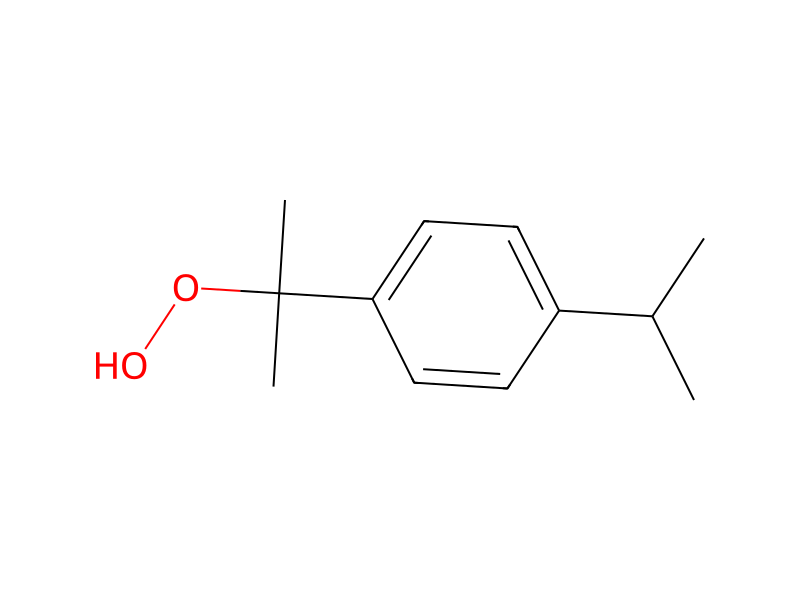
Basic information
- CAS
98-49-7- Standard SMILES
CC(C)c1ccc(C(C)(C)OO)cc1- InChIKey
HWCBEGMIBCYKST-UHFFFAOYSA-N- Molecular formula
- C12H18O2
- Average molar mass
- 194.27 g/mol
- Monoisotopic mass
- 194.13067981
Names & identifiers
- Preferred name
- 1-(4-Isopropylphenyl)-1-methylethyl hydroperoxide
- IUPAC
- 1-(2-hydroperoxypropan-2-yl)-4-propan-2-ylbenzene
- English name
- 1-(4-isopropylphenyl)-1-methylethyl hydroperoxide
- Molecular formula
- C12H18O2
- Molecular weight
- 194.27
Names & synonyms
1-(4-Isopropylphenyl)-1-methylethyl hydroperoxideHydroperoxide, 1-methyl-1-[4-(1-methylethyl)phenyl]ethyl1-Methyl-1-[4-(1-methylethyl)phenyl]ethyl hydroperoxideHydroperoxide, 1-methyl-1-(4-(1-methylethyl)phenyl)ethyl1-Methyl-1-(4-(1-methylethyl)phenyl)ethyl hydroperoxideRefChem:425699202-673-898-49-71-(2-hydroperoxypropan-2-yl)-4-propan-2-ylbenzenep-Diisorpopylbenzene hydroperoxideEINECS 202-673-8SCHEMBL374893
Show more names
Phenylhdrazine-P-sulfonic acidp-Dipropylbenzene hydroperoxidep-Diisopropylbenzene hydroperoxide1-(2-hydroperoxypropan-2-yl)-4-propan-2-yl-benzene1-(1-hydroperoxy-1-methyl-ethyl)-4-isopropyl-benzeneHydroperoxide,1-methyl-1-[4-(1-methylethyl)phenyl]ethylHydroperoxide, 1-methyl-1-[4-(1-methylethyl) phenyl]ethyl
2-[4-(PROPAN-2-YL)PHENYL]PROPANE-2-PEROXOLSCHEMBL10435261DTXSID30893285HWCBEGMIBCYKST-UHFFFAOYSA-NNS00004867
Database identifiers
- CAS
98-49-7- PubChem CID
- 60989
- DTXSID
DTXSID30893285- EC Number
- 202-673-8
- Nikkaji
- J4.953K
Properties
Computed structural properties
- XLogP
- 2.8
- Topological polar surface area
- 29.5 Ų
- Hydrogen bond donors
- 1
- Hydrogen bond acceptors
- 2
- Rotatable bonds
- 3
- Heavy atoms
- 14
- Formal charge
- 0
- Complexity
- 167
Experimental & physicochemical properties
Physical DescriptionLiquid
Physicochemical properties
- Melting point
- 33.5 °C · 33.5 °C
- Boiling point
- 290.73 °C · 290.73°C (rough estimate)
- Density
- 1.001 · 1.0010 (rough estimate)
- refractive index
- 1.5128 · 1.5128 (estimate)
- pka
- 12.24 · 12.24±0.30(Predicted)
- EPA Substance Registry System
- 1 · Hydroperoxide, 1-methyl-1-[4-(1-methylethyl)phenyl]ethyl (98-49-7)
- Symbol(GHS)
- 2 · GHS02,GHS05
- Signal word
- Danger
- Hazard statements
- 242 · H242-H314
- Precautionary statements
- 260 · P260-P264-P280-P301+P330+P331-P303+P361+P353-P363-P304+P340-P310-P321-P305+P351+P338-P405-P501-P210-P220-P234-P280-P370+P378-P403+P235-P411-P420-P501
- TSCA
- TSCA listed
Safety & regulation
Safety information is for reference only and does not replace the supplier’s Safety Data Sheet (SDS), applicable regulations, or professional assessment.
GHS classification
GHS Classification
Danger
H242 (100%): Heating may cause a fire [Danger Self-reactive substances and mixtures; Organic peroxides]
P210, P234, P235, P240, P260, P264, P264+P265, P280, P301+P330+P331, P302+P361+P354, P304+P340, P305+P354+P338, P316, P317, P321, P363, P370+P378, P403, P405, P410, P411, P420, and P501 (click each P-code to see the statement)
The GHS information provided by 1 company from 1 notification to the ECHA C&L Inventory.
Hazard information
Regulatory Information
Chemical: Hydroperoxide, 1-methyl-1-[4-(1-methylethyl)phenyl]ethyl
Hydroperoxide, 1-methyl-1-[4-(1-methylethyl)phenyl]ethyl is listed on the EPA's Chemical Data Reporting (CDR) system. Manufacturers and importers of Hydroperoxide, 1-methyl-1-[4-(1-methylethyl)phenyl]ethyl are required to report information about their production and use of this chemical to the EPA under the Toxic Substances Control Act (TSCA). (40 eCFR Part 711)
Hazard Classes and CategoriesOrg. Perox. F (100%)
Safety data
- tsca
- TSCA listed
- Signal word
- Danger
- Symbol(GHS)
- GHS02,GHS05
- Hazard statements
- H242-H314
- Precautionary statements
- P260-P264-P280-P301+P330+P331-P303+P361+P353-P363-P304+P340-P310-P321-P305+P351+P338-P405-P501-P210-P220-P234-P280-P370+P378-P403+P235-P411-P420-P501
Chemistry & industry
Uses & manufacturing
U.S. Production2023: 75,000 - <500,000 lb
Industry UsesNot Known or Reasonably Ascertainable
General Manufacturing Information
All Other Basic Organic Chemical Manufacturing
Hydroperoxide, 1-methyl-1-[4-(1-methylethyl)phenyl]ethyl: ACTIVE
Applications
Uses1-(4-Isopropylphenyl)-1-methylethyl hydroperoxide can be used as an initiator for styrene-butadiene rubber polymerization, its initiation speed is 30-50% faster than cumene hydrogen peroxide, but slower than tricumene hydrogen peroxide and tert-butyl cumene hydrogen peroxide. It can also be used as initiator for other polymers. This product can cause burns when it comes into contact with the skin.
Upstream & downstream products
Upstream raw materials
Suppliers
Loading…
Open inquiries
Loading…
Related reactions
0 records
No reaction records under the current filter.
Compound notes
Loading…