
Trisodium 3,3',3''-phosphinetriyltris(benzene-1-sulphonate)
Completing data — refresh the page later to see the latest
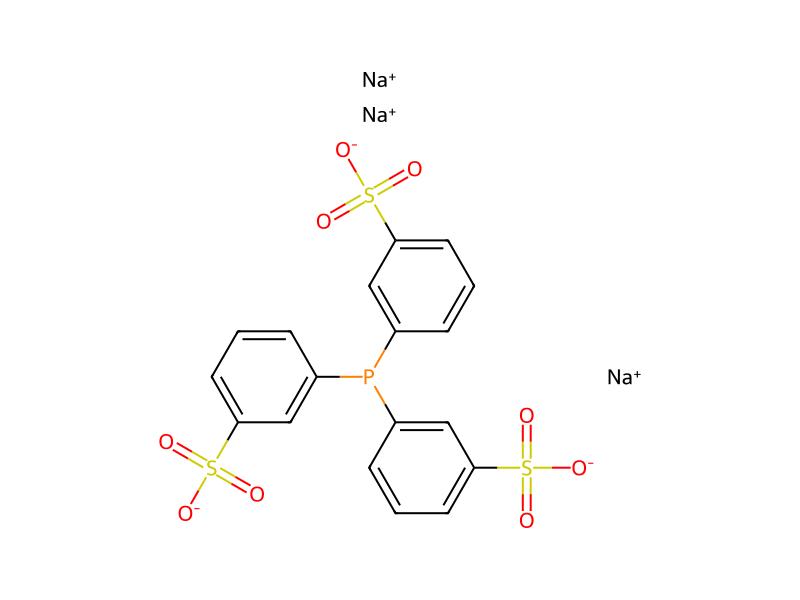
Basic information
- CAS
63995-70-0- Standard SMILES
O=S(=O)([O-])c1cccc(P(c2cccc(S(=O)(=O)[O-])c2)c2cccc(S(=O)(=O)[O-])c2)c1.[Na+].[Na+].[Na+]- InChIKey
MYAJTCUQMQREFZ-UHFFFAOYSA-K- Molecular formula
- C18H12Na3O9PS3
- Average molar mass
- 568.4 g/mol
- Monoisotopic mass
- 567.90741443
Overview
See other relationships...
Names & identifiers
- Preferred name
- Trisodium 3,3',3''-phosphinetriyltris(benzene-1-sulphonate)
- IUPAC
- trisodium;3-bis(3-sulfonatophenyl)phosphanylbenzenesulfonate
- English name
- Triphenylphosphine-3,3',3''-trisulfonic acid trisodium salt
- Molecular formula
- C18H16NaO9PS3
- Molecular weight
- 526.46
Names & synonyms
EINECS 264-596-6Trisodium 3,3',3''-phosphinetriyltris(benzene-1-sulphonate)Benzenesulfonic acid, 3,3',3''-phosphinidynetris-, sodium salt (1:3)RefChem:900480264-596-663995-70-0Sodium 3,3',3''-phosphinetriyltribenzenesulfonateTriphenylphosphine-3,3',3''-trisulfonic acid trisodium saltTPPTSTris(3-sulfophenyl)phosphine trisodium saltMFCD00145472WUE9W42Q27
Show more names
Sodium 3,3',3''-phosphanetriyltribenzenesulfonateTRIS(3-SULFONATOPHENYL)PHOSPHINE HYDRATE SODIUM SALTTRIS(3TPPTS-Na10% oxide)Triphenylphosphine-3,3TRISODIUM TRIPHENYLPHOSPHINE-3 3' 3''-T&TRI(M-SULFOPHENYL)PHOSPHINE, SODIUM SALTTRIS(3-SULFONATOPHENYL) PHOSPHINE HYDRATE
trisodium;3-bis(3-sulfonatophenyl)phosphanylbenzenesulfonatetris-(3-Sulfornatophenyl)-phosphine 4-hydrate sodium salttris(3-sulfonatophenyl)phosphine sodium saltTris(3-sulfophenyl)phosphine Trisodium (~85%)Triphenylphosphine-m-trisulfonic acid trisodium saltTriphenylphosphine-3,3',3''-trisulfonic acid trisodium salttrisodium 3-[bis(3-sulfonatophenyl)phosphino]benzenesulfonateCS-W008416
Properties
Computed structural propertiesFilling in
- Topological polar surface area
- 197 Ų
- Hydrogen bond donors
- 0
- Hydrogen bond acceptors
- 9
- Rotatable bonds
- 3
- Heavy atoms
- 34
- Formal charge
- 0
- Complexity
- 768
Physicochemical properties
- Melting point
- 300 °C · >300°C
- storage temp.
- Inert atmosphere,Room Temperature
- solubility
- DMSO (Slightly), Water (Slightly)
- form
- Powder
- color
- white to off-white
- Water Solubility
- Soluble in water.
- BRN
- 3584807 · 3584807
- Stability
- Hygroscopic
- InChIKey
- CWBHBKSVWBUDKB-UHFFFAOYSA-N
- SMILES
- P(C1C=CC=C(S(O)(=O)=O)C=1)(C1C=CC=C(S(O)(=O)=O)C=1)C1C=CC=C(S(O)(=O)=O)C=1.[NaH]
- FDA UNII
- 9 W42Q27 · WUE9W42Q27
- UNSPSC Code
- 12352107 · 12352107
- NACRES
- 22 · NA.22
- Symbol(GHS)
- 7 · GHS07
- Signal word
- Warning
- Hazard statements
- 315 · H315-H319-H335
- Precautionary statements
Safety & regulation
Safety information is for reference only and does not replace the supplier’s Safety Data Sheet (SDS), applicable regulations, or professional assessment.
GHS classification
GHS Classification
This chemical does not meet GHS hazard criteria for 2.1% (1 of 47) of reports.
Warning
H315 (97.9%): Causes skin irritation [Warning Skin corrosion/irritation]
P261, P264, P264+P265, P271, P280, P302+P352, P304+P340, P305+P351+P338, P319, P321, P332+P317, P337+P317, P362+P364, P403+P233, P405, and P501 (click each P-code to see the statement)
Aggregated GHS information provided per 47 reports by companies from 6 notifications to the ECHA C&L Inventory. Each notification may be associated with multiple companies.
Hazard information
Hazard Classes and CategoriesSkin Irrit. 2 (97.9%)
Safety data
- F
- 10
- wgk
- 1
- hs_code
- 29319090
- risk_code
- 36/37/38
- Signal word
- Warning
- Symbol(GHS)
- GHS07
- hazard_code
- Xi
- safety_code
- 26
- Storage Class
- 11 - Combustible Solids
- target organs
- Respiratory system
- Hazard statements
- H315-H319-H335
- Hazard Classifications
- Eye Irrit. 2Skin Irrit. 2STOT SE 3
- Precautionary statements
- P261-P264-P271-P280-P302+P352-P305+P351+P338
Chemistry & industry
Applications
UsesTris(3-sulfophenyl)phosphine Trisodium Salt (Triphenylphosphine-3,3',3''-trisulfonic acid trisodium salt) is a reagent used in organic synthesis such as benzothiazole-based cycloplatinated chromophores.
Preparation methods
PreparationTriphenylphosphine-3,3',3''-trisulfonic acid trisodium salt (TPPTS) is synthesized by sulfonation of triphenylphosphine with oleum (i.e., concentrated H2SO4 and SO3). Various parameters (triphenylphosphine/oleum ratio,wt % of SO3, time, temperature, and agitation speed) have been studied and modified to suppress the formation of by-products such as phosphines with a low degree of sulfonation and phosphine oxides. One particularly attractive method employs orthoboric acid B(OH)3, concentrated H2SO4, and a controlled SO3 concentration and cleanly affords either disulfonated ligand (TPPDS) or TPPTS with negligible oxidation and no by-products.
Upstream & downstream products
Upstream raw materials
Related reactions
68 records





Compound notes
Loading…