
HRID 2578As reactant
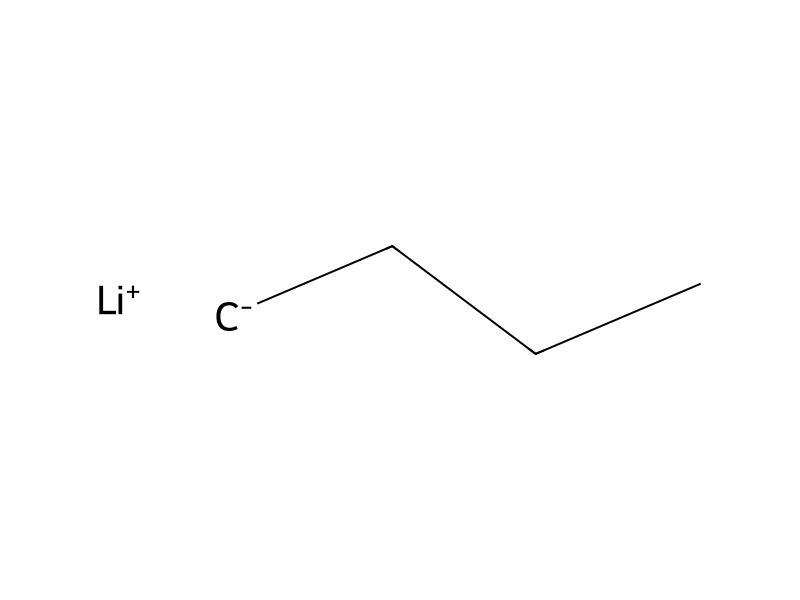
109-72-8[CH2-]CCC.[Li+]DLEDOFVPSDKWEF-UHFFFAOYSA-NButyllithium is an alkyllithium compound.
109-72-8DTXSID1026821CHEBI:51469Safety information is for reference only and does not replace the supplier’s Safety Data Sheet (SDS), applicable regulations, or professional assessment.
CSL00127
Perfluorethyllithium + Phosphorus Trichloride,Phosphorus + N-BUTYLLITHIUM + CHLOROPENTAFLUOROETHANE
Avoid temperatures below -90 C
Substitution
Several times in our laboratory, we have experienced a violent decomposition of the ethereal C2F5Cl/n-BuLi solution after the addition of just a few drops of (R)nPCl3=n. In each of these cases, the metal-halogen exchange temperature was maintained below -90 C. We believe that this problem is due to a buildup of starting reagents at low temperatures.
C&EN
UsesN-Butyllithium solution is mostly used as a pharmaceutical intermediate to synthesize anionic polymerization initiator. It is also used to produce rubber (such as integral rubber SIBR, which is the most versatile diene rubber to date), fragrance, liquid crystal materials, and other industries. It is a chemical product intermediate, linking agent, alkylating agent, and polymerization catalyst. As a catalyst, N-Butyllithium is widely used as a pharmaceutical intermediate, liquid crystal monomer, and pesticide production catalyst. N-Butyllithium is also widely used in organic syntheses, especially in growing carbon chains, and it is a staple laboratory product in reactions such as: 1) Metallization reaction: R-H + n-Butyl-Li → R-Li + Butane, in which the produced lithium alkyl can react with many substances. 2) Direct metallization: the aromatic compound that connects the substitute reacts with N-Butyllithium, and lithium metal can be attached to the aromatic compound. 3) Nucleophilic addition and substitution reaction. 4) Halogen-metal replacement.
Usesn-Butyllithium is used as a polymerization initiator in the production of elastomers like polybutadiene and styrene- butadiene- styrene. As a strong base, it is utilized in the synthesis of organic compounds. It undergoes thermal decomposition to prepare 1-butene.
Usesn-Butyllithium is a strong nucleophile in the synthetic organic chemistry. It is also used as an initiator in the polymerization process.
PreparationIndustrially, n-butyllithium is produced by the reaction of n-butyl chloride with lithium metal dispersion in various hydrocarbon solvents. Hexane is the most commonly used solvent. Up to one-half of the lithium is replaced with sodium in order to lower the cost of the butyllithium and increase the reactivity of the dispersion. The reaction is carried out below the boiling point of the solvent.The laboratory procedure is essentially the same except that pentane and diethyl ether are two of the more popular solvents. The preparation runs smoothly in ether at lower temperatures but the product must either be used immediately or kept refrigerated due to the rapid cleavage of ether by n-butyllithium.
DefinitionChEBI: Butyllithium is an alkyllithium compound.


