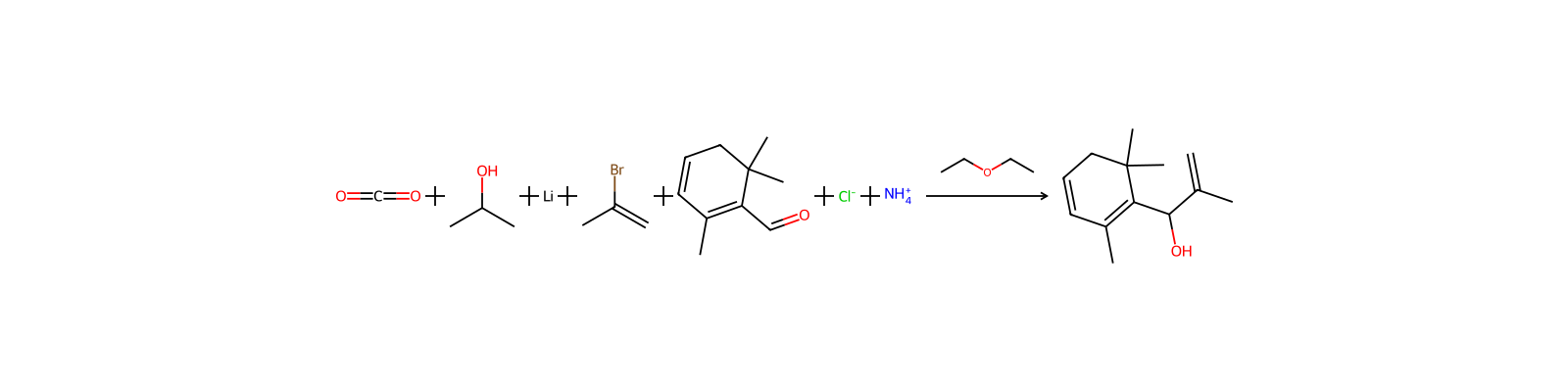
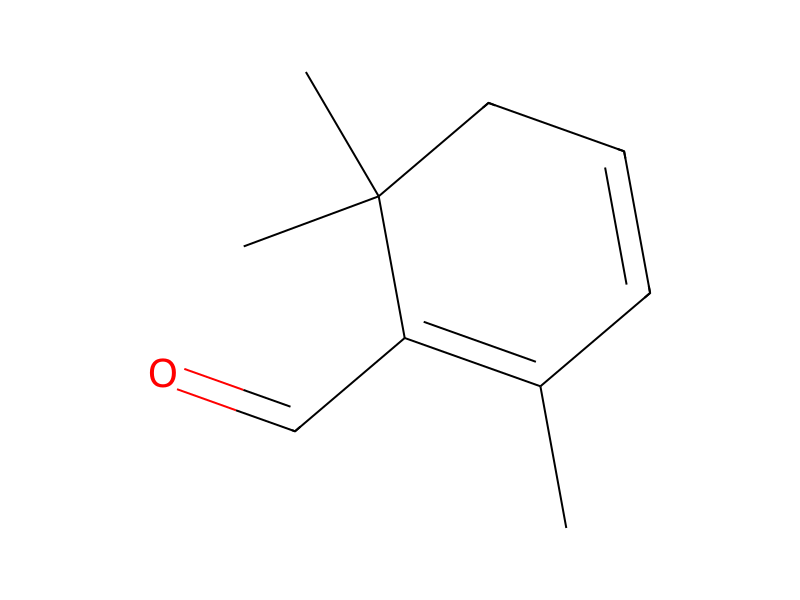
Safranal
Basic information
- CAS
116-26-7- Standard SMILES
CC1=C(C=O)C(C)(C)CC=C1- InChIKey
SGAWOGXMMPSZPB-UHFFFAOYSA-N- Molecular formula
- C10H14O
- Average molar mass
- 150.22 g/mol
- Monoisotopic mass
- 150.10446507
Overview
Safranal is a monoterpenoid formally derived from beta-cyclocitral by dehydrogenation. It is the major volatile component of saffron responsible for the characteristic aroma of saffron. It has a role as an antineoplastic agent, a radical scavenger, a neuroprotective agent, an anti-inflammatory agent, a nephroprotective agent and a plant metabolite. It is functionally related to a beta-cyclocitral.
Names & identifiers
- Preferred name
- Safranal
- IUPAC
- 2,6,6-trimethylcyclohexa-1,3-diene-1-carbaldehyde
- English name
- SAFRANAL
- Molecular formula
- C10H14O
- Molecular weight
- 150.22
Names & synonyms
Safranal116-26-72,3-Dihydro-2,2,6-trimethylbenzaldehyde2,6,6-trimethylcyclohexa-1,3-diene-1-carbaldehyde1,3-CYCLOHEXADIENE-1-CARBOXALDEHYDE, 2,6,6-TRIMETHYL-2,6,6-trimethyl-1,3-cyclohexadiene-1-carboxaldehydeDehydro-beta-cyclocitral2,6,6-Trimethyl-1,3-cyclohexadienal(2,6,6-Trimethylcyclohexa-1,3-dienyl)methanalFEMA No. 3389DTXSID70493981,1,3-Trimethyl-2-formylcyclohexa-2,4-diene
Show more names
FEMA 33892,3-Dihydro-2,2,6-trimethylbenzalhydeSAFRANAL 88+%Safranal (>80%)
2,6,6-Trimethylcyclohexa-1,3-dienyl methanalCHEBI:531694393FR07EADTXCID4029357RefChem:884355204-133-72,6,6-trimethylcyclohexa-1,3-dienecarbaldehydeMFCD00209531
Database identifiers
- CAS
116-26-7- PubChem CID
- 61041
- DTXSID
DTXSID7049398
Properties
Computed structural properties
- XLogP
- 2.1
- Topological polar surface area
- 17.1 Ų
- Hydrogen bond donors
- 0
- Hydrogen bond acceptors
- 1
- Rotatable bonds
- 1
- Heavy atoms
- 11
- Formal charge
- 0
- Complexity
- 231
Experimental & physicochemical properties
Fragrances
Fragrance substance (2,6,6-Trimethylcyclohex-1,3-dienyl methanal) -> IFRA amendment 49
Fragrance Ingredient (2,6,6-Trimethylcyclohexa-1,3-dienyl methanal) -> IFRA transparency List
Food AdditivesFLAVORING AGENT OR ADJUVANT -> FDA Substance added to food
Density0.968-0.980 (20 °C)
Flavoring AgentsEU Flavoring substances
Solubility
Insoluble in water; soluble in oils
Miscible at room temperature (in ethanol)
Boiling Point
70.00 °C. @ 1.00 mm Hg
70 °C (1 mm Hg);
Melting Point< 25 °C
Refractive Index1.525-1.533
Physical Description
Solid
Pale yellowish oily liquid; powerful, sweet green-floral and somewh/ tobacco-herbaceous odour.
Safety & regulation
Safety information is for reference only and does not replace the supplier’s Safety Data Sheet (SDS), applicable regulations, or professional assessment.
GHS classification
GHS Classification
Warning
H302 (80.4%): Harmful if swallowed [Warning Acute toxicity, oral]
P261, P264, P264+P265, P270, P272, P273, P280, P301+P317, P302+P352, P305+P351+P338, P321, P330, P332+P317, P333+P317, P337+P317, P362+P364, and P501 (click each P-code to see the statement)
Aggregated GHS information provided per 1700 reports by companies from 11 notifications to the ECHA C&L Inventory. Each notification may be associated with multiple companies.
Hazard information
Regulatory Information
Chemical: 1,3-Cyclohexadiene-1-carboxaldehyde, 2,6,6-trimethyl-
Commission Regulation (EC) No 1565/2000 (Repealed by Com. Implementing Reg. (EU) No 872/2012)
Status: Active Update: 01-12-2021 https://echa.europa.eu/registration-dossier/-/registered-dossier/17302
1,3-Cyclohexadiene-1-carboxaldehyde, 2,6,6-trimethyl-: Does not have an individual approval but may be used under an appropriate group standard
Other Safety InformationIMAP assessments - 1,3-Cyclohexadiene-1-carboxaldehyde, 2,6,6-trimethyl-: Environment tier I assessment
Hazard Classes and CategoriesAcute Tox. 4 (80.4%)
Safety data
- PPE
- Eyeshields, Gloves, type ABEK (EN14387) respirator filter
- wgk
- 3
- tsca
- TSCA listed
- risk_code
- 36/37/38
- Signal word
- Warning
- Symbol(GHS)
- GHS07,GHS09
Chemistry & industry
Pharmacology
Cellular LocationsExtracellular
Uses & manufacturing
IFRA Fragrance Standards
2,6,6-Trimethylcyclohex-1,3-dienyl methanal
2,6,6-Trimethylcyclohexa-1,3-diene-1-carbaldehyde; 2,6,6-Trimethyl-1,3-cyclohexadienal; 2,6,6-Trimethyl-1,3-cyclohexadien-1-carboxaldehyde; 1,1,3-Trimethyl-2-formylcyclohexa-2,4-diene; Dehydro-β-cyclocitral; Safranal (commercial name)
IFRA_STD_082.pdf
49
IFRA 51st Amendment - Guidance for the use of IFRA Standards
Restriction: This material should be used only in the limited quantity as stated in the Standard
Use Classification
Fragrance Ingredients
Flavouring Agent -> FLAVOURING_AGENT -> JECFA Functional Classes
Flavoring Agents -> JECFA Flavorings Index
Flavouring Agent -> FLAVOURING_AGENT -> JECFA Functional Classes
Flavouring Agent -> FLAVOURING_AGENT -> JECFA Functional Classes
Flavouring Agent -> FLAVOURING_AGENT -> JECFA Functional Classes
General Manufacturing Information1,3-Cyclohexadiene-1-carboxaldehyde, 2,6,6-trimethyl-: ACTIVE
Restriction Limits in the Finished Product (%)
0.0022 [Products applied to the lips]
0.00066 [Products applied to the axillae]
0.013 [Products applied to the face/body using fingertips]
0.012 [Products related to fine fragrances]
0.0032 [Products applied to the body using the hands (palms), primarily leave-on (Body lotion)]
0.0032 [Products applied to the face using the hands (palms), primarily leave-on (Face moisturizer)]
Applications
Occurring naturally as a glucoside (picrocrocin) in saffron. Also reported found in grapefruit juice, saffron, black tea, green tea, microbial fermented tea, Bourbon vanilla, lemon balm, grapefruit juice, maté and sweet grass oil.
Related reactions
14 records


Compound notes
Loading…