
HomeMCPWorkbenchSkills
HomeWorkbenchNotificationsMe
llms.txt · MCP GuidePrivacy Policy · Terms of Service · Supportv1.8.3
  1. Home
  2. /Compound

Sodium Molybdate

HCID 61424
New reaction
Print
Basic informationOverviewNames & identifiersPropertiesSafety & regulationChemistry & industryRelated reactionsCompound notes
Substructure searchFind similar structures

Basic information

CAS
13466-16-5
Standard SMILES
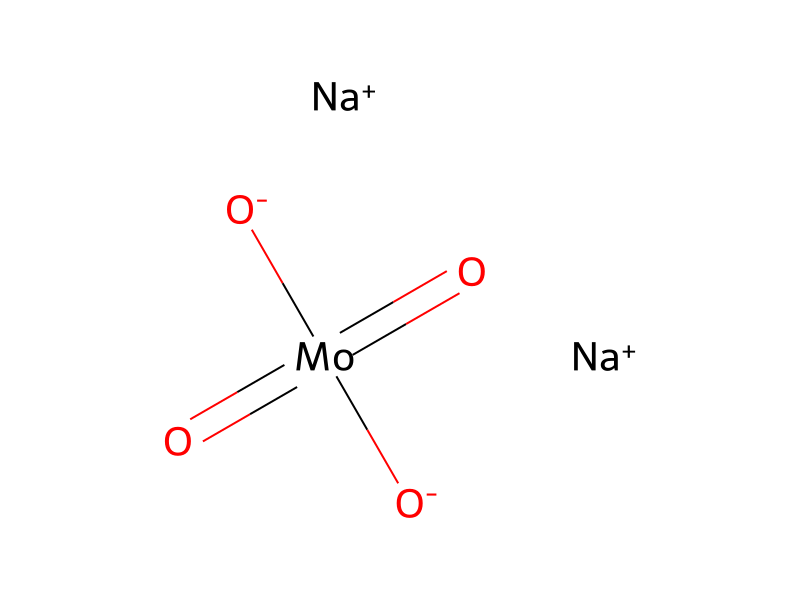
[Na+].[Na+].[O]=[Mo](=[O])([O-])[O-]
InChIKey
TVXXNOYZHKPKGW-UHFFFAOYSA-N
Molecular formula
MoO4.2Na
Average molar mass
205.93 g/mol
Monoisotopic mass
207.864601

Overview

Sodium molybdate (anhydrous) is an inorganic sodium salt having molybdate as the counterion. It has a role as a NMR chemical shift reference compound and a poison. It contains a molybdate.

Names & identifiers

Preferred name
Sodium Molybdate
IUPAC
disodium;dioxido(dioxo)molybdenum
English name
Sodium molybdate
Molecular formula
MoNa2O4
Molecular weight
205.91714

Names & synonyms

Sodium molybdateDisodium molybdateSodium molybdate(VI)Natriummolybdatsodium molybdenum oxideMolybdic acid, disodium saltNa2MoO4sodium molybdate (anhydrous)Anhydric sodium molybdateMolybdate (MoO42-), disodium, (T-4)-Molybdenum (as sodium)948QAQ08I1
Show more names
molybdicAnhydrous sodium molybdateSodium molybdatdisodiummolybdateSodiumMolybdateGrSodamidemolybdate
CHEBI:75215NSC-77389RefChem:887699231-551-77631-95-0Molybdate disodiumNatriummolybdat [German]Sodium molybdate (VAN)

Database identifiers

CAS
13466-16-5、7631-95-0
PubChem CID
61424
ChEBI
CHEBI:75215
UNII
948QAQ08I1
EC Number
231-551-7

Properties

Computed structural properties

Topological polar surface area
80.3 Ų
Hydrogen bond donors
0
Hydrogen bond acceptors
4
Rotatable bonds
0
Heavy atoms
7
Formal charge
0
Complexity
62.2

Experimental & physicochemical properties

Chemical ClassesMetals -> Metals, Inorganic Compounds
Density · 2 items

3.78 g/cm³

~3.5 @25 °C

SolubilitySolubility in water, g/100ml at 100 °C: 84
Melting Point · 2 items

687 °C

686 °C

Physical Description · 3 items

Large Crystals; Dry Powder; Liquid; Liquid; Other Solid

White solid; [ICSC] Colorless crystalline solid; [Sigma-Aldrich MSDS]

WHITE POWDER.

Physicochemical properties

Melting point
687 °C · 687 °C (lit.)
Density
3.78 g/mL · 3.78 g/mL at 25 °C (lit.)
refractive index
1.714 · 1.714
storage temp.
4 °C, · Store at 4°C, protect from light, stored under nitrogen
solubility
20.6 mg/mL · insoluble in EtOH; insoluble in DMSO; ≥20.6 mg/mL in H2O

Safety & regulation

Safety information is for reference only and does not replace the supplier’s Safety Data Sheet (SDS), applicable regulations, or professional assessment.

GHS classification

GHS Classification · 6 items

This chemical does not meet GHS hazard criteria for 64.5% (493 of 764) of all reports.

Warning

H315 (33.1%): Causes skin irritation [Warning Skin corrosion/irritation]

P261, P264, P264+P265, P271, P280, P302+P352, P304+P340, P305+P351+P338, P317, P319, P321, P332+P317, P337+P317, P362+P364, P403+P233, P405, and P501 (click each P-code to see the statement)

Aggregated GHS information provided per 764 reports by companies from 13 notifications to the ECHA C&L Inventory. Each notification may be associated with multiple companies.

Danger

Hazard information

Regulatory Information · 4 items

Chemical: Molybdic acid (H2MoO4), disodium salt

Molybdate (MoO42-), sodium (1:2), (T-4)- is listed on the EPA's Chemical Data Reporting (CDR) system. Manufacturers and importers of Molybdate (MoO42-), sodium (1:2), (T-4)- are required to report information about their production and use of this chemical to the EPA under the Toxic Substances Control Act (TSCA). (40 eCFR Part 711)

REACH registered substance: Disodium molybdate (EC: 231-551-7)

Sodium molybdate: Non hazardous

Other Safety InformationIMAP assessments - Molybdic acid (H2MoO4), disodium salt: Human health tier I assessment
Fire HazardsCombustible under specific conditions. Risk of fire and explosion on contact with magnesium.
Hazards Summary · 1 item

No developmental toxicity reported in 1972 study of hamsters; Molybdenum accumulation in reproductive tissues and histopathological testicular changes observed in male rats exposed to high doses for 60 days; [REPROTOX] Oral LD50 (rat) = 250 mg/kg also reported; Causes fatty liver degeneration, and changes in renal tubules in oral lethal-dose studies of dogs, guinea pigs, and rats; Causes abnormal liver function tests, kidney changes, weight loss, normocytic anemia, and other musculoskeletal changes in oral studies of rats; [RTECS] Aerosol causes eye and respiratory tract irritation; Chronic exposure may have effects on the respiratory tract; Possible human carcinogen; [ICSC] A skin and strong eye irritant; Toxic by inhalation; [Sigma-Aldrich MSDS] See Molybdenum.

Chemistry & industry

Uses & manufacturing

Uses · 2 items

Used to make pigments; Also used as a corrosion inhibitor, bath additive for finishing metals, reagent for alkaloids, and micronutrient; [Merck Index] Permitted for use as an inert ingredient in non-food pesticide products; [EPA]

Electroplating [Category: Plate]

U.S. Production2023: 7,000,000 - <8,500,000 lb
Consumer UsesOther
Industry UsesPigment
Household ProductsInformation on 65 consumer products that contain Sodium molybdate in the following categories is provided:
General Manufacturing Information · 2 items

Utilities

Molybdate (MoO42-), sodium (1:2), (T-4)-: ACTIVE

Applications · 4 items

UsesReagent in analytical chemistry, paint pigment, production of molybdated toners and lakes, metal finishing, brightening agent for zinc plating, corro- sion inhibitor, catalyst in dye and pigment produc- tion, additive for fertilizers and feeds, micronutri- ent.

UsesSodium Molybdate is used in method for preparing fermentation medium with reduced color and viscosity.

UsesSodium molybdate (Na2MO4) may be used as an electrolyte additive, for use in electrochemical capacitors. Addition of Na2MO4 as an electrolyte additive may result in enhanced capacitance, corrosion prevention and stabilized performance.It may also be used as a catalyst during the manufacture of paints and dyes.

General DescriptionSodium molybdate has corrosion resistant properties. On heating, it undergoes degradation and releases Na2O fumes.

Preparation methods

Related reactions

21 records
New reaction record
HRID 19448 reaction equation
HRID 19448As reactant
HRID 259176 reaction equation
HRID 259176As catalyst
HRID 326035 reaction equation
HRID 326035As reactant
HRID 436463 reaction equation
HRID 436463As catalyst
HRID 437259 reaction equation
HRID 437259As catalyst
HRID 505949 reaction equation
HRID 505949As catalyst
HRID 523433 reaction equation
HRID 523433As reactant
HRID 597421 reaction equation
HRID 597421As catalyst
PreviousPage 1 of 3

Compound notes

On this pageBasic informationOverviewNames & identifiersPropertiesSafety & regulationChemistry & industryRelated reactionsCompound notes
form
Powder
Specific Gravity
3.28 · 3.28
color
White
Odor
odorless
Water Solubility
It is soluble in water.
Specific Heat Capacity
0.69 J/ · Cp(crystal): 0.69 J/(g·K), at 25℃
Sensitive
Hygroscopic
Merck
14 · 14,8645
Exposure limits
0.5 mg/m3NIOSH: · ACGIH: TWA 0.5 mg/m3NIOSH: IDLH 1000 mg/m3
Stability
Stable. Incompatible with strong oxidizing agents.
Cosmetics Ingredients Functions
ANTICORROSIVE
InChI
1S/Mo.2Na.4O/q;2*+1;;;2*-1
InChIKey
TVXXNOYZHKPKGW-UHFFFAOYSA-N
SMILES
[Na+].[Na+].[O-][Mo]([O-])(=O)=O
CAS DataBase Reference
7631 · 7631-95-0(CAS DataBase Reference)
EWG's Food Scores
1 · 1
FDA UNII
948 QAQ08I1 · 948QAQ08I1
NIST Chemistry Reference
sodium molybdate(VI)(7631-95-0)
EPA Substance Registry System
Disodium molybdate (7631-95-0)
UNSPSC Code
12352302 · 12352302
NACRES
55 · NA.55
Symbol(GHS)
7 · GHS07
Signal word
Warning
Hazard statements
303 · H303-H332
Precautionary statements
261 · P261-P271-P304+P340-P312a
Hazard Codes
Xi
Risk Statements
36 · 36/37/38
Safety Statements
26 · 26-36
WGK Germany
1 · 1
RTECS
5075000 · QA5075000
TSCA
TSCA listed
Storage Class
13 · 13 - Non Combustible Solids
REACH Registrations
Active
Chemical DangersDecomposes on heating. This produces toxic fumes including sodium oxide. Reacts violently with halogens. This generates fire and explosion hazard.
Hazard Classes and Categories · 2 items

Skin Irrit. 2 (33.1%)

Acute toxicity (Oral) - Category 3

Safety & protection

Fire FightingIn case of fire in the surroundings, use appropriate extinguishing media.
First Aid Measures · 4 items

Fresh air, rest. Refer for medical attention.

Remove contaminated clothes. Rinse and then wash skin with water and soap.

First rinse with plenty of water for several minutes (remove contact lenses if easily possible), then refer for medical attention.

Give one or two glasses of water to drink. Refer for medical attention .

Safe StorageSeparated from strong oxidants and halogens.
Spillage DisposalSweep spilled substance into covered containers. Personal protection: particulate filter respirator adapted to the airborne concentration of the substance.
Eye PreventionWear safety goggles or eye protection in combination with breathing protection if powder.
Fire PreventionNO open flames.
Inhalation RiskA harmful concentration of airborne particles can be reached quickly when dispersed.
Skin PreventionProtective gloves.
Exposure PreventionAVOID ALL CONTACT!
Ingestion PreventionDo not eat, drink, or smoke during work.
Inhalation PreventionUse local exhaust or breathing protection.
Threshold Limit Values (TLV) · 2 items

0.5 [mg/m3], as Mo, respirable fraction

(as Mo, respirable fraction): 0.5 mg/m

Toxicology

Adverse EffectsOccupational hepatotoxin - Secondary hepatotoxins: the potential for toxic effect in the occupational setting is based on cases of poisoning by human ingestion or animal experimentation.
Exposure RoutesThe substance can be absorbed into the body by inhalation.
Signs and Symptoms · 4 items

Cough. Sore throat.

Redness.

Redness.

Abdominal pain. Nausea. Vomiting. Diarrhoea.

ICSC Environmental DataEnvironmental effects from the substance have not been investigated adequately.
Toxicity DataLC50 (rat) > 2,080 mg/m3/4hr

Safety data

wgk
1
tsca
TSCA listed
rtecs
QA5075000
risk_code
36/37/38
Signal word
Warning
Symbol(GHS)
GHS07
hazard_code
Xi
safety_code
26-36
Storage Class
13 - Non Combustible Solids
Hazard statements
H303-H332
REACH Registrations
Active
Precautionary statements
P261-P271-P304+P340-P312a

PreparationSodium molybdate dihydrate, which is obtained by evaporating an aqueous solution of molybdenum trioxide and sodium hydroxide, can be converted to the anhydrous form by heating at 100 °C.

Upstream & downstream products

Upstream raw materials

Ammonium molybdateMolybdenum trioxideSodium hydroxide

Downstream products

Molybdate red 207Pigment Fast Rose TonerMolybdate Red 107Pigment Violet 3CI NO 77605

Additional notes

DefinitionChEBI: Sodium molybdate (anhydrous) is an inorganic sodium salt having molybdate as the counterion. It has a role as a poison and a NMR chemical shift reference compound. It contains a molybdate.