HomeMCPWorkbenchSkills
HomeWorkbenchNotificationsMe
llms.txt · MCP GuidePrivacy Policy · Terms of Service · Supportv1.8.0
  1. Home
  2. /Compound

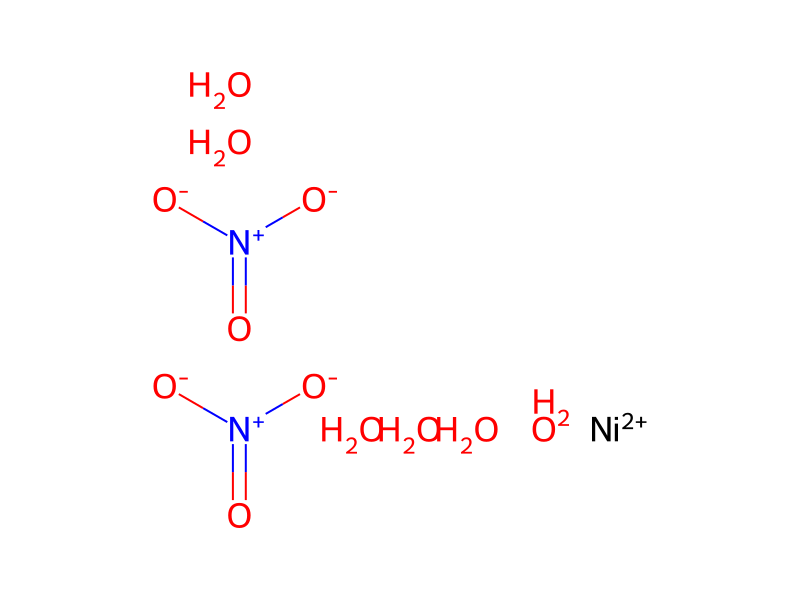
Nickel nitrate hexahydrate
HCID 61630
New noteNew reactionRequest quotes
Print preview
Basic informationNames & identifiersPropertiesSafety & regulationChemistry & industryRelated reactionsCompound notes
Substructure searchFind similar structures

Basic information

CAS
13478-00-7
Standard SMILES
O.O.O.O.O.O.O=[N+]([O-])[O-].O=[N+]([O-])[O-].[Ni+2]
InChIKey
AOPCKOPZYFFEDA-UHFFFAOYSA-N
Molecular formula
H12N2NiO12
Average molar mass
290.8 g/mol
Monoisotopic mass
289.97436672

Names & identifiers

Preferred name
Nickel nitrate hexahydrate
IUPAC
nickel(2+);dinitrate;hexahydrate
English name
Nickel(II) nitrate hexahydrate
Molecular formula
H12N2NiO12
Molecular weight
290.79

Names & synonyms

13478-00-7Nickel nitrate hexahydrateNickel(II) nitrate hexahydrateNickel dinitrate hexahydrateNickelous nitrate hexahydrateNickel(2+) dinitrate hexahydrateNickel(2+) nitrate, hexahydrateXBT61WLT1JNitric acid, nickel(2+) salt, hexahydrateNickel(II) nitrate, hexahydrate (1:2:6)DTXSID70158941RefChem:165673
Show more names
NICKEL NITRATENICKEL(II) NITRATENICKEL(II) NITRATE 6-HYDRATENitric acid nickel(II) salt hexahydrateNickel (II) nitrate hexahydrate≥ 97% (Titration)NickelNitrateArNickelousnitrate,NNickel Nitrate (Ous)
DTXCID4081432603-868-4nickel (II) nitrate hexahydrateMFCD00149805H12N2NiO12Ni(NO3)2.6H2Onickel(2+);dinitrate;hexahydrateNitric acid (dinitrate hexahydrate)

Database identifiers

CAS
13478-00-7
PubChem CID
61630
DTXSID
DTXSID70158941
UNII
XBT61WLT1J
EC Number
603-868-4

Properties

Computed structural properties

Topological polar surface area
132 Ų
Hydrogen bond donors
6
Hydrogen bond acceptors
12
Rotatable bonds
0
Heavy atoms
15
Formal charge
0
Complexity
18.8

Experimental & physicochemical properties

Chemical Classes · 2 items

Metals -> Nickel Compounds, Inorganic

Carcinogens

Density2.05 @25 °C
Boiling Point136.7 °C @760 [mm Hg]
Physical DescriptionGreen, deliquescent crystals; [Merck Index] Water soluble; [ACGIH]

Physicochemical properties

Melting point
56 °C · 56 °C(lit.)
Boiling point
137 °C · 137 °C
Density
2.05 g/mL · 2.05 g/mL at 25 °C(lit.)
bulk density
800 kg/m3 · 800kg/m3
Flash point
137 °C · 137°C
storage temp.
5 °C · Store at +5°C to +30°C.
solubility
940 g/l · 940g/l
form
flakes
color
Green to blue

Safety & regulation

Safety information is for reference only and does not replace the supplier’s Safety Data Sheet (SDS), applicable regulations, or professional assessment.

GHS classification

GHS Classification · 6 items

Danger

H272 (99.5%): May intensify fire; oxidizer [Danger Oxidizing liquids; Oxidizing solids]

P203, P210, P220, P233, P260, P261, P264, P264+P265, P270, P271, P272, P273, P280, P284, P301+P317, P302+P352, P304+P340, P305+P354+P338, P317, P318, P319, P321, P330, P332+P317, P333+P317, P342+P316, P362+P364, P370+P378, P391, P403, P405, and P501 (click each P-code to see the statement)

Aggregated GHS information provided per 219 reports by companies from 11 notifications to the ECHA C&L Inventory. Each notification may be associated with multiple companies.

Danger

H302: Harmful if swallowed [Warning Acute toxicity, oral]

Hazard information

Regulatory Information · 3 items

Chemical: Nitric acid, nickel(2+) salt, hexahydrate

Nickel (II) nitrate, hexahydrate: Does not have an individual approval but may be used under an appropriate group standard

The New Jersey Worker and Community Right to Know Act requires public and private employers to provide information about hazardous substances at their workplaces. (N.J.S.A. 34:5A-1 et. seq.)

Other Safety InformationIMAP assessments - Water soluble nickel(2+) salts: Environment tier II assessment
Hazards SummarySee NITRATES and NITRITES. See Nickel and linked occupational diseases.
Hazard Classes and Categories · 3 items

Ox. Sol. 2 (99.5%)

Acute toxicity - category 4

Carcinogens

Safety & protection

Chemistry & industry

Uses & manufacturing

Uses · 3 items

Used in nickel plating and to make brown ceramic colors; [Merck Index] Used to make nickel catalysts; [Hawley] Also used in nickel-cadmium battery manufacturing; [Ullmann]

Battery Manufacturing [Category: Industry]

Ceramics making [Category: Hobbies]

Applications · 5 items

DescriptionNickel (II) nitrate hexahydrate is the hexahydrate form of the nickel (II) nitrate. Nickel nitrate (chemical formula: Ni(NO3)2) is manufactured by the reaction of nickel oxide with nitric acid. The nickel (II) nitrate hexahydrate can be used as a precursor during the manufacturing of other nickel salts and supported nickel catalysts. For example, it is the precursor for the manufacturing of nickel sulfide-reduced graphene oxide (RGO) composite powders. It can also be used for the manufacturing of nickel and nickel oxide nanocrystals impregnated O-MWCNTs which is useful in semiconductor industries. Moreover, it can also be used in electroplating and as a mordent in textile dyeing. Finally, it can be used to improve the cycling stability and rate capability o Li2MnO2.

DescriptionNickel (II) nitrate hexahydrate appears as green crystals and substantially soluble in water. It is stable, a strong oxidiser, and incompatible with reducing agents. It has wide industrial applications in nickel plating as catalysts and is indirectly associated with other industries of nickel alloy manufacturers, nickel miners, smelters and refiners, nickel platers, and exposure to alloys, for example, in coinage.

UsesNickel plating, manufacturing of ceramic colorsNickel(II) nitrate hexahydrate is used as a precursor in the manufacturing of other nickel salts and supported nickel catalysts. It finds use as a catalyst in organic synthesis. Further it is used in electroplating and as a mordent in textile dyeing. It is a precursor for preparing nickel sulfide-reduced graphene oxide (RGO) composite powders with high initial capacities and good cycling performance. It can be employed in the preparation of nickel and nickel oxide nanocrystals impregnated O-MWCNTs (oxygen-functionalized multi-walled carbon nanotubes) with potential applications in semiconductor industries. It finds use in improving cycling stability ad rate capability of Li2MnO3.

Related reactions

6 records
New reaction record
HRID 1005252 reaction equation
HRID 1005252As reactantuspto-grants-2000_04
HRID 1050885 reaction equation
HRID 1050885As reactantuspto-grants-2016_07
HRID 1050886 reaction equation
HRID 1050886As reactantuspto-grants-2016_07
HRID 1050887 reaction equation
HRID 1050887As reactantuspto-grants-2016_07
HRID 1050888 reaction equation
HRID 1050888As reactantuspto-grants-2016_07
HRID 1602076 reaction equation
HRID 1602076As catalystuspto-grants-1999_11

Compound notes

Loading…

On this pageBasic informationNames & identifiersPropertiesSafety & regulationChemistry & industryRelated reactionsCompound notes
More actions
New noteNew reactionRequest quotes
Specific Gravity
2.05 · 2.05
PH
5 · 5 (50g/l, H2O, 20℃)
Water Solubility
238.5 g/100 · 238.5 g/100 mL (20 ºC)
Sensitive
Hygroscopic
Merck
14 · 14,6513
Exposure limits
0.1 mg/m3NIOSH: · ACGIH: TWA 0.1 mg/m3NIOSH: IDLH 10 mg/m3; TWA 0.015 mg/m3
Stability
Stable. Strong oxidizer. Incompatible with reducing agents.
InChI
1S/2NO3.Ni.6H2O/c2*2-1(3)4;;;;;;;/h;;;6*1H2/q2*-1;+2;;;;;;
InChIKey
AOPCKOPZYFFEDA-UHFFFAOYSA-N
SMILES
O.O.O.O.O.O.[Ni++].[O-][N+]([O-])=O.[O-][N+]([O-])=O
CAS DataBase Reference
13478 · 13478-00-7(CAS DataBase Reference)
FDA UNII
61 WLT1J · XBT61WLT1J
UNSPSC Code
12352302 · 12352302
NACRES
55 · NA.55
Symbol(GHS)
3 · GHS03,GHS05,GHS07,GHS08,GHS09
Signal word
Danger
Hazard statements
272 · H272-H302+H332-H315-H317-H318-H334-H341-H350-H360-H372-H410
Precautionary statements
201 · P201-P210-P273-P280-P305+P351+P338+P310-P308+P313
Hazard Codes
O,T,Xi,Xn,N
Risk Statements
45 · 45-8-22-43-40-68-50/53-48/23-42/43-41-38-20/22-61-49
Safety Statements
53 · 53-17-36/37-45-61-60
RIDADR
2725 · UN 2725 5.1/PG 3
WGK Germany
3 · 3
RTECS
7300000 · QR7300000
TSCA
Yes
HS Code
2834 · 2834 29 20
HazardClass
5.1 · 5.1
PackingGroup
III
Storage Class
5.1 B · 5.1B - Oxidizing hazardous materials
Hazard Classifications
4 InhalationAcute · Acute Tox. 4 InhalationAcute Tox. 4 OralAquatic Acute 1Aquatic Chronic 1Carc. 1AEye Dam. 1Muta. 2Ox. Sol. 2Repr. 1BResp. Sens. 1Skin Irrit. 2Skin Sens. 1STOT RE 1 Inhalation
Toxicity
50 orally · LD50 orally in Rabbit: 1620 mg/kg
Limited Quantities
5 L · 5 L (1.3 gallons) (liquid) or 5.0 kg (11 lbs) (solid)
Excepted Quantities
Max Inner Pack (30g or 30ml) and Max Outer Pack (1Kg or 1L)
Threshold Limit Values (TLV)
0.1 [mg/m3], inhalable fraction, as Ni
Permissible Exposure Limit (PEL)1.0 [mg/m3], as Ni
Protective Action Criteria (PAC) · 3 items

1.5 [mg/m3]

53 [mg/m3]

320 [mg/m3]

Immediately Dangerous to Life or Health (IDLH)10.0 [mg/m3], as Ni

Toxicology

Adverse EffectsSkin Sensitizer - An agent that can induce an allergic reaction in the skin.

Safety data

wgk
3
tsca
Yes
rtecs
QR7300000
ridadr
UN 2725 5.1/PG 3
hs_code
2834 29 20
Toxicity
LD50 orally in Rabbit: 1620 mg/kg
risk_code
45-8-22-43-40-68-50/53-48/23-42/43-41-38-20/22-61-49
Signal word
Danger
Symbol(GHS)
GHS03,GHS05,GHS07,GHS08,GHS09
hazard_code
O,T,Xi,Xn,N
safety_code
53-17-36/37-45-61-60
hazard_class
5.1
Storage Class
5.1B - Oxidizing hazardous materials
packing_group
III
Hazard statements
H272-H302+H332-H315-H317-H318-H334-H341-H350-H360-H372-H410
Limited Quantities
5 L (1.3 gallons) (liquid) or 5.0 kg (11 lbs) (solid)
Excepted Quantities
Max Inner Pack (30g or 30ml) and Max Outer Pack (1Kg or 1L)
Hazard Classifications
Acute Tox. 4 InhalationAcute Tox. 4 OralAquatic Acute 1Aquatic Chronic 1Carc. 1AEye Dam. 1Muta. 2Ox. Sol. 2Repr. 1BResp. Sens. 1Skin Irrit. 2Skin Sens. 1STOT RE 1 Inhalation
Precautionary statements
P201-P210-P273-P280-P305+P351+P338+P310-P308+P313

UsesNickel(II) nitrate hexahydrate may be used as a precursor for the synthesis of [Ni1/3Co1/3Mn1/3]O2 powders, Ni(II) oxide aerogels and crystalline nickel complexes, [Ni(C6H7N3O)2(NO3)2] and [Ni(C6H7N3O)3](NO3)2·H2O.

General DescriptionNickel(II) nitrate hexahydrate (Ni(NO3)2.6H2O) is a hydrated nickel(II) salt. Its thermal degradation has been investigated by thermogravimetric methods under quasi-isothermal conditions.

Preparation methods · 2 items

PreparationNickel nitrate hexahydrate may be prepared by several methods based on the reaction of dilute nitric acid on nickel powder, nickel oxide or nickel carbonate. The reaction is exothermic and requires controlled cooling during production. The hexahydrate can be dehydrated to anhydrous salt by treatment with fuming nitric acid.

PreparationEmerald green crystals of the hexahydrate Ni(N03)26H20 crystallize from aqueous solutions at room temperature. These are isomorphous with the corresponding cobalt(II) salt containing the regular octahedral [Ni(H20)6]2+ ions with Ni-O distances = 2.03 A. The tetrahydrate crystallize above 54° and the dihydrate above 85.4°. The pale green anhydrous nitrate can be obtained by dehydration of the hydrate with dinitrogen pentoxide in fuming nitric acid or by the liquid phase reaction of dinitrogen tetroxide with nickel carbonyl [the gas phase reaction gives the nitrite Ni(N02)2] Ni(CO)4+2N2O4 -* Ni(N03)2+2NO+4CO The first product of this latter rather violent reaction is the adduct Ni(NO3)2N2O4 from which the nitrogen tetroxide is removed by heating in vacuo. It can also be prepared by the reaction of dinitrogen tetroxide-ethyl acetate mixtures with nickel(II) chloride. The infrared spectrum shows it to be a typical covalent nitrate. It is involatile and decomposes upon heating in nitrogen to give the nitrite Ni(NO2)2 above 260°.

Upstream & downstream products

Upstream raw materials

Nickle chlorideNickel plateNickel carbonateBarium nitrateChroMiuM hydroxideNickel(II) hydroxideNickelCATION STANDARD - SODIUMNitric acidNitrating acid mixture,spentNICKEL (II) PHOSPHATESodium carbonate