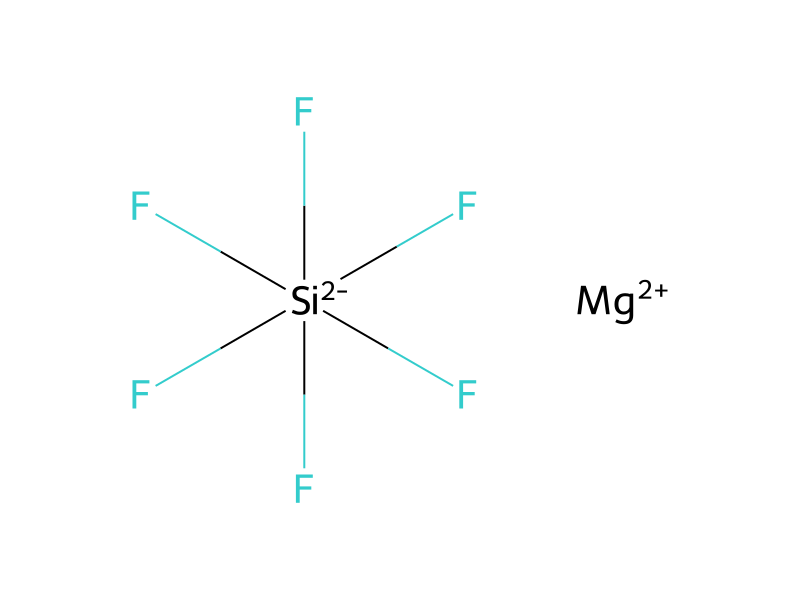
Basic information
- CAS
16949-65-8- Standard SMILES
F[Si-2](F)(F)(F)(F)F.[Mg+2]- InChIKey
INWUJAAIUAAHJA-UHFFFAOYSA-N- Molecular formula
- F6Si.Mg
- Average molar mass
- 166.38 g/mol
- Monoisotopic mass
- 165.95238755
Overview
Magnesium fluorosilicate is a crystalline solid. Decomposes at 120 °C. Contact may cause slight irritation to skin, eyes, and mucous membranes. May be slightly toxic by ingestion. Used to make other chemicals.
Names & identifiers
- Preferred name
- Magnesium hexafluorosilicate
- IUPAC
- magnesium hexafluorosilicon(2-)
- English name
- Magnesium fluosilicate
- Molecular formula
- F6MgSi
- Molecular weight
- 166.38
Names & synonyms
Show more names
Database identifiers
- CAS
16949-65-8、18972-56-0- PubChem CID
- 61861
- DTXSID
DTXSID70884950- UNII
- H37V80D2JS
- EC Number
- 241-022-2、606-187-0
Properties
Computed structural properties
- Topological polar surface area
- 0 Ų
- Hydrogen bond donors
- 0
- Hydrogen bond acceptors
- 7
- Rotatable bonds
- 0
- Heavy atoms
- 8
- Formal charge
- 0
- Complexity
- 62.7
Experimental & physicochemical properties
Physical Description
Magnesium fluorosilicate is a crystalline solid. Decomposes at 120 °C. Contact may cause slight irritation to skin, eyes, and mucous membranes. May be slightly toxic by ingestion. Used to make other chemicals.
Dry Powder
Solid; [CAMEO] White powder; [Gelest MSDS]
Physicochemical properties
- Melting point
- 120 °C · 120°C
- Boiling point
- 120 °C · >120°C
- Density
- 1.788 · 1.788
- vapor pressure
- 0.001 Pa · 0.001Pa at 25℃
- form
- Powder
- Specific Gravity
- 1.788 · 1.788
- Water Solubility
- 498.4 g/L · 498.4g/L at 18.3℃
- Hydrolytic Sensitivity
- 2 · 2: reacts with aqueous acid
- Cosmetics Ingredients Functions
- ANTIPLAQUEORAL CARE
- InChI
- InChI=1S/F6Si.Mg.6H2O/c1-7(2,3,4,5)6;;;;;;;/h;;6*1H2/q-2;+2;;;;;;
- InChIKey
- ZYDDCPHMRLLEEV-UHFFFAOYSA-N
- SMILES
- [Si-2](F)(F)(F)(F)(F)F.O.O.O.O.O.O.[Mg+2]
- LogP
- 0 at · 0 at 25℃
- CAS DataBase Reference
- 16949 · 16949-65-8(CAS DataBase Reference)
- FDA UNII
- 37 V80D2JS · H37V80D2JS
- EPA Substance Registry System
- Magnesium fluosilicate (16949-65-8)
- Symbol(GHS)
- 6 · GHS06
- Signal word
- Danger
- Hazard statements
- 301 · H301
- Precautionary statements
- 264 · P264-P270-P301+P310-P330-P405-P501
- Hazard Codes
- T
- Risk Statements
- 25 · 25
- Safety Statements
- 24 · 24/25-45
- RIDADR
- 2853 · UN 2853
- TSCA
- TSCA listed
- HazardClass
- 6.1 · 6.1
- PackingGroup
- III
- Toxicity
- 200 orally, · LD in guinea pigs (mg/kg): 200 orally, 400 s.c. (Waldbott)
- REACH Registrations
- Active
Safety & regulation
GHS classification
GHS Classification
Danger
H301: Toxic if swallowed [Danger Acute toxicity, oral]
P264, P270, P301+P316, P321, P330, P405, and P501 (click each P-code to see the statement)
Danger
H301 (100%): Toxic if swallowed [Danger Acute toxicity, oral]
P261, P264, P264+P265, P270, P271, P280, P301+P316, P304+P340, P305+P354+P338, P317, P321, P330, P405, and P501 (click each P-code to see the statement)
Hazard information
Regulatory Information
Chemical: Silicate(2-), hexafluoro-, magnesium (1:1)
Silicate(2-), hexafluoro-, magnesium (1:1) is listed on the EPA's Chemical Data Reporting (CDR) system. Manufacturers and importers of Silicate(2-), hexafluoro-, magnesium (1:1) are required to report information about their production and use of this chemical to the EPA under the Toxic Substances Control Act (TSCA). (40 eCFR Part 711)
REACH registered substance: Magnesium hexafluorosilicate (EC: 241-022-2)
Magnesium hexafluorosilicate: Does not have an individual approval but may be used under an appropriate group standard
Magnesium fluorosilicate: Does not have an individual approval but may be used under an appropriate group standard
Fire Hazards
Excerpt from ERG Guide 151 [Substances - Toxic (Non-Combustible)]:
· Non-combustible, substance itself does not burn but may decompose upon heating to produce corrosive and/or toxic fumes.
Health Hazards
Excerpt from ERG Guide 151 [Substances - Toxic (Non-Combustible)]:
· Highly toxic, may be fatal if inhaled, ingested or absorbed through skin.
Hazards Summary
Toxic by ingestion; May cause serious eye injury [Classifications by the EC] Not a skin irritant in rabbits (80% aqueous solution); Hematological and clinical chemistry changes, adverse dental effects, mineralization in bone tissue, interstitial nephritis, hyperkeratosis of the stomach, increased relative liver and kidney weights, and increased relative testes and adrenal weights in males observed in 4-week oral study of rats at 3,000 ppm dietary (approximately 300 mg/kg/day); [IUCLID] An eye irritant; Corrosive to mucous membranes; Inhalation may cause corrosive injuries to upper respiratory tract and lungs; May cause osteofluorosis; [Gelest MSDS] See Magnesium. See Fluorosilicic acid. See Calcium hexafluorosilicate.
Reactivity Profile
MAGNESIUM FLUOROSILICATE gives basic aqueous solutions. Reacts with acids. Does not usually react as either oxidizing agents or reducing agents. It can react slowly with water to generate hydrofluoric acid, which can cause severe chemical burns and is one of the few materials that can etch glass.
DOT Hazard Classification
Magnesium fluorosilicate
UN2853
Div 6.1 Poisonous materials (49 eCFR § 173.132)
PG III: the degree of danger presented by the material is minor
Hazard Classes and Categories
Acute Tox. 3 (100%)
Acute toxicity (ingestion) - category 3
Acute toxicity (Oral) - Category 3
Acute toxicity (Oral) - Category 3
Acute Tox. 3 *
Safety & protection
Accidental Release Measures
· CALL 911. Then call emergency response telephone number on shipping paper. If shipping paper not available or no answer, refer to appropriate telephone number listed on the inside back cover.
· Do not touch damaged containers or spilled material unless wearing appropriate protective clothing.
First Aid
Excerpt from ERG Guide 151 [Substances - Toxic (Non-Combustible)]:
General First Aid:
Exposure Control and Personal Protection
· Wear positive pressure self-contained breathing apparatus (SCBA).
Biological Exposure Indices (BEI) [ACGIH] - Fluorides in urine = 2 mg/L prior to shift or 3 mg/L at end of shift; (Repeated measurements recommended.)
1.0 [mg/m3], inhalable fraction, as F[German Research Foundation (DFG)]
Isolation and Evacuation
Excerpt from ERG Guide 151 [Substances - Toxic (Non-Combustible)]:
Immediate precautionary measure
Toxicology
Safety data
- tsca
- TSCA listed
- ridadr
- UN 2853
- Toxicity
- LD in guinea pigs (mg/kg): 200 orally, 400 s.c. (Waldbott)
- risk_code
- 25
- Signal word
- Danger
- Symbol(GHS)
- GHS06
- hazard_code
- T
- safety_code
- 24/25-45
- hazard_class
- 6.1
- packing_group
- III
- Hazard statements
- H301
- REACH Registrations
- Active
- Precautionary statements
- P264-P270-P301+P310-P330-P405-P501
Chemistry & industry
Uses & manufacturing
Uses
Used for mothproofing textiles; [Merck Index] Used to make other chemicals; [CAMEO]
Textiles (Printing, Dyeing, or Finishing) [Category: Industry]
General Manufacturing Information
Non-metallic Mineral Product Manufacturing (includes clay, glass, cement, concrete, lime, gypsum, and other non-metallic mineral product manufacturing)
Silicate(2-), hexafluoro-, magnesium (1:1): ACTIVE
Applications
DescriptionMagnesium silicofluoride is a white crystallinesolid. Molecular weight= 274.52. Hazard Identification(based on NFPA-704 M Rating System): Health 3,Flammability 0, Reactivity 0. Soluble in water.
General DescriptionCrystalline solid. Decomposes at 120°C. Contact may cause slight irritation to skin, eyes, and mucous membranes. May be slightly toxic by ingestion. Used to make other chemicals.
Upstream & downstream products
Upstream raw materials
Suppliers100 total
Related reactions
No reaction records under the current filter.
Compound notes
Loading…