
Egta
Completing data — refresh the page later to see the latest
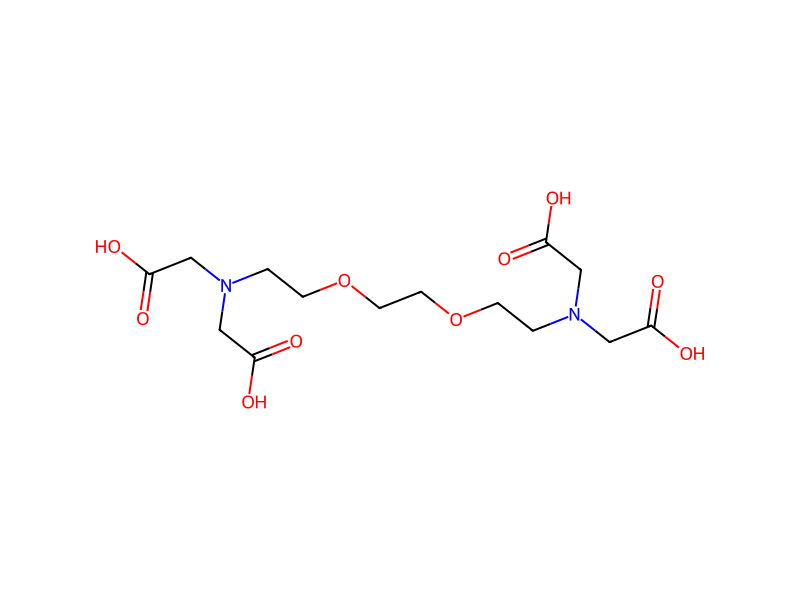
Basic information
- CAS
67-42-5- Standard SMILES
O=C(O)CN(CCOCCOCCN(CC(=O)O)CC(=O)O)CC(=O)O- InChIKey
DEFVIWRASFVYLL-UHFFFAOYSA-N- Molecular formula
- C14H24N2O10
- Average molar mass
- 380.35 g/mol
- Monoisotopic mass
- 380.14309497
Overview
Ethylene glycol bis(2-aminoethyl)tetraacetic acid is a diether that is ethylene glycol in which the hydrogens of the hydroxy groups have been replaced by 2-[bis(carboxymethyl)amino]ethyl group respectively. It has a role as a chelator. It is a tetracarboxylic acid, a diether and a tertiary amino compound.
Names & identifiers
- Preferred name
- Egta
- IUPAC
- 2-[2-[2-[2-[bis(carboxymethyl)amino]ethoxy]ethoxy]ethyl-(carboxymethyl)amino]acetic acid
- English name
- Ethylenebis(oxyethylenenitrilo)tetraacetic acid
- Molecular formula
- C14H24N2O10
- Molecular weight
- 380.35
Names & synonyms
EGTA67-42-5Egtazic acidGedtaEthylenebis(oxyethylenenitrilo)tetraacetic acidEbontaAcide egtaziqueAcido egtazicoAcidum egtazicum6,9-Dioxa-3,12-diazatetradecanedioic acid, 3,12-bis(carboxymethyl)-Ethylene Glycol Tetraacetic Acid[Ethylenebis(oxyethylenenitrilo)]tetraacetic acid
Show more names
Ethylene Glyc1,2-bis(2-dicarboxymethylaminoethoxy)ethaneethylenedioxybis(ethyleneamino)tetraaceticacidAEGTGIETAEgtazic
DTXSID2045151Ethylenedioxybis(ethyleneamino)tetraacetic acidEthylene glycol bis(2-aminoethyl ether)tetraacetic acid(Ethylenebis(oxyethylenenitrilo))tetraacetic acidNSC-615010Ethylene glycol bis(aminoethyl ether)tetraacetate526U7A2651Glycoletherdiamine-N,N,N',N'-tetraacetic Acid
Database identifiers
- CAS
67-42-5
Properties
Computed structural propertiesFilling in
- XLogP
- -6.2
- Topological polar surface area
- 174 Ų
- Hydrogen bond donors
- 4
- Hydrogen bond acceptors
- 12
- Rotatable bonds
- 17
- Heavy atoms
- 26
- Formal charge
- 0
- Complexity
- 397
Experimental & physicochemical properties
Chemical ClassesOther Uses -> Chelating Agents
Physical DescriptionWhite powder; [Sigma-Aldrich MSDS]
Physicochemical properties
- Melting point
- 241 °C · 241 °C (dec.)(lit.)
- Boiling point
- 507.99 °C · 507.99°C (rough estimate)
- Density
- 1.2838 · 1.2838 (rough estimate)
- bulk density
- 450 kg/m3 · 450kg/m3
- refractive index
- 1.459 · 1.4590 (estimate)
- storage temp.
- room temp
- solubility
- 0.1 M · 0.1 M NaOH: 0.1 M at 20 °C, clear, colorless
- form
- Crystalline Powder
- pka
- 1.47 · 1.47±0.10(Predicted)
- color
- White
- biological source
Safety & regulation
Safety information is for reference only and does not replace the supplier’s Safety Data Sheet (SDS), applicable regulations, or professional assessment.
GHS classification
GHS Classification
This chemical does not meet GHS hazard criteria for 83.3% (10 of 12) of all reports.
Warning
H315 (16.7%): Causes skin irritation [Warning Skin corrosion/irritation]
P264, P280, P302+P352, P321, P332+P317, and P362+P364 (click each P-code to see the statement)
Aggregated GHS information provided per 12 reports by companies from 3 notifications to the ECHA C&L Inventory.
Hazard information
Regulatory Information
Chemical: 6,9-Dioxa-3,12-diazatetradecanedioic acid, 3,12-bis(carboxymethyl)-
EGTA: Does not have an individual approval but may be used under an appropriate group standard
Hazards SummaryMay cause irritation; [Sigma-Aldrich MSDS] See Edetic acid.
Hazard Classes and CategoriesSkin Irrit. 2 (16.7%)
Safety data
- PPE
- Eyeshields, Gloves, type N95 (US)
- wgk
- 2
- tsca
- TSCA listed
- rtecs
- AH3760000
- hs_code
- 29225000
- Toxicity
- LD50 orally in Rabbit: 3587 mg/kg
- risk_code
- 36/37/38
- Signal word
- Warning
- Symbol(GHS)
- GHS07
- hazard_code
- Xi
- safety_code
Chemistry & industry
Pharmacology
MeSH Pharmacological Classification
Agents counteracting or neutralizing the action of POISONS.
Substances that bind to and sequester CALCIUM ions.
Uses & manufacturing
UsesUsed as a metal chelator and reagent for maintaining calcium concentrations; [Merck Index] A chelating agent relatively more specific for calcium and less toxic than EDETIC ACID. [ChemIDplus]
General Manufacturing Information6,9-Dioxa-3,12-diazatetradecanedioic acid, 3,12-bis(carboxymethyl)-: ACTIVE
Applications
DescriptionEthylenebis(oxyethylenenitrilo)tetraacetic acid is also named as Egtazic acid. It works as a chelating agent for the determination of calcium in the presence of magnesium.
UsesPharmaceutic aid. EGTA.
UsesEthylene glycol-O,O'-bis(2-aminoethyl)-N,N,N',N'-tetraacetic acid is a chelating agent used for making complexes, especially for calcium ions, which help to determine calcium in the presence of magnesium. It can be used experimentally for treating animals possessing cerium poisoning. It is useful in the separation of thorium from monazite. It also acts as a buffer and is used in protein purification.
UsesA chelating agent useful for the determination of calcium in the presence of magnesium.
Upstream & downstream products
Upstream raw materials
Related reactions
16 records




Compound notes
Loading…