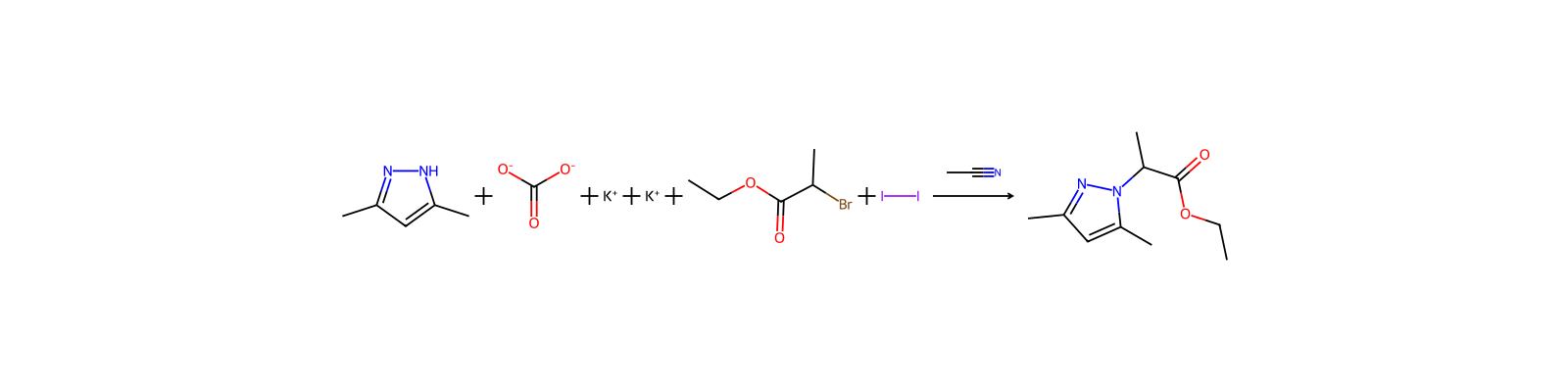
HRID 38676As reactant
Completing data — refresh the page later to see the latest

67-51-6Cc1cc(C)[nH]n1SDXAWLJRERMRKF-UHFFFAOYSA-N3,5-Dimethylpyrazole is a member of pyrazoles.
67-51-6DTXSID5058777CHEMBL1828957CHEBI:229331CBI
White crystalline solid; [Sigma-Aldrich MSDS]
Safety information is for reference only and does not replace the supplier’s Safety Data Sheet (SDS), applicable regulations, or professional assessment.
This chemical does not meet GHS hazard criteria for 4.5% (10 of 220) of reports.
Warning
H302 (92.7%): Harmful if swallowed [Warning Acute toxicity, oral]
P203, P260, P261, P264, P264+P265, P270, P271, P280, P301+P317, P302+P352, P304+P340, P305+P351+P338, P318, P319, P321, P330, P332+P317, P337+P317, P362+P364, P403+P233, P405, and P501 (click each P-code to see the statement)
Aggregated GHS information provided per 220 reports by companies from 22 notifications to the ECHA C&L Inventory. Each notification may be associated with multiple companies.
Danger
Chemical: 1H-Pyrazole, 3,5-dimethyl-
1H-Pyrazole, 3,5-dimethyl- is listed on the EPA's Chemical Data Reporting (CDR) system. Manufacturers and importers of 1H-Pyrazole, 3,5-dimethyl- are required to report information about their production and use of this chemical to the EPA under the Toxic Substances Control Act (TSCA). (40 eCFR Part 711)
REACH registered substance: 3,5-dimethylpyrazole (EC: 200-657-5)
1H-Pyrazole, 3,5-dimethyl-: Does not have an individual approval but may be used as a component in a product covered by a group standard. It is not approved for use as a chemical in its own right.
Causes general anesthesia and ataxia in oral lethal-dose studies of mice; [RTECS] Prolonged or repeated exposure may cause liver injury; Suspected of being toxic to fertility or the developing child; [ECHA REACH Registrations] A skin and strong eye irritant; Harmful by ingestion; [Sigma-Aldrich MSDS]
Acute Tox. 4 (92.7%)
Acute toxicity (Oral) - Category 4
Miscellaneous Manufacturing
1H-Pyrazole, 3,5-dimethyl-: ACTIVE
UsesCommon reagent for the preparation of pyrazolato ligated complexes.1,2 Also used to prepare N-1-substituted derivatives having antibacterial activity.3
Uses3,5-Dimethylpyrazole his a catalyst in the sulfonation of acetic anhydride to sulfoacetic acid and methanedisulfonic acid. 3,5-Dimethylpyrazole has been used in the synthesis of bipyrazolic tripodal derivatives with in vitro antitumor, antifungal and antibacterial activities.
Uses3,5-Dimethylpyrazole is used as intermediate for the manufacture of organic dyestuffs and photochemicals. Product Data Sheet
PreparationIn a reaction vessel, add 1000 kg of water, 370 kg of acetylacetone, and an appropriate amount of glacial acetic acid. Then, add hydrazine hydrate dropwise, keeping the reaction temperature below 50°C. After all the hydrazine hydrate has been added, maintain the reaction at 50°C for 3 hours. Cool to 10°C, centrifuge, rinse, and vacuum dry to obtain 3,5-dimethylpyrazole.


