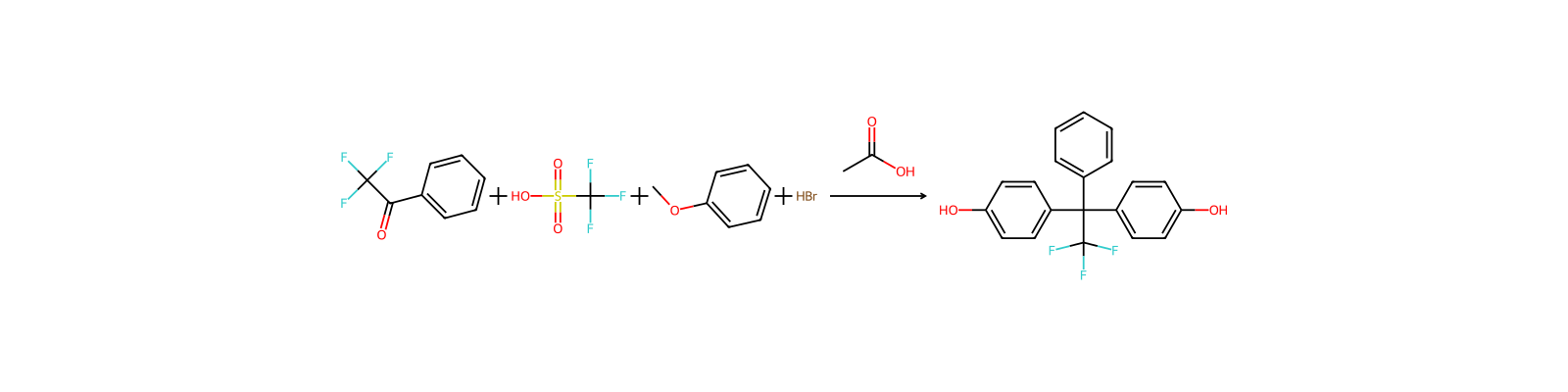
HRID 1185As reactant
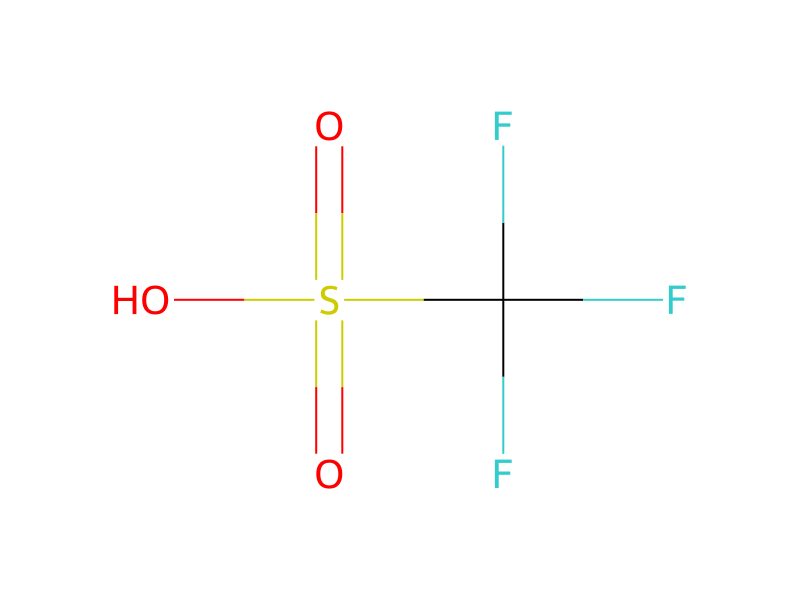
1493-13-6O=S(=O)(O)C(F)(F)FITMCEJHCFYSIIV-UHFFFAOYSA-NTriflic acid is a one-carbon compound that is methanesulfonic acid in which the hydrogens attached to the methyl carbon have been replaced by fluorines. It is a perfluoroalkanesulfonic acid and a one-carbon compound. It is a conjugate acid of a triflate.
1493-13-6DTXSID2044397CHEMBL1236265CHEBI:48511Other Classes -> Organic Acids
Ionic Liquids -> Fluorinated Ionic Liquids
Ionic Liquids
PFAS -> Perfluorosulfonic acids
PFAS -> Ultra Short Chain PFsulfonic acids
PFAS -> PFAS identified in REACH Regulation EC No. 1272/2008
PFAS -> Suspected persistent, mobile, toxic (PMT) PFAS or PFAS-like compounds
PFAS -> PFAS with analytical method available
Liquid
Colorless hygroscopic liquid; [Merck Index]
Safety information is for reference only and does not replace the supplier’s Safety Data Sheet (SDS), applicable regulations, or professional assessment.
Danger
H290 (92.8%): May be corrosive to metals [Warning Corrosive to Metals]
P234, P260, P261, P264, P270, P271, P280, P301+P317, P301+P330+P331, P302+P361+P354, P304+P340, P305+P354+P338, P316, P319, P321, P330, P363, P390, P403+P233, P405, P406, and P501 (click each P-code to see the statement)
Aggregated GHS information provided per 2365 reports by companies from 34 notifications to the ECHA C&L Inventory. Each notification may be associated with multiple companies.
Warning
H319: Causes serious eye irritation [Warning Serious eye damage/eye irritation]
Chemical: Methanesulfonic acid, trifluoro-
Methanesulfonic acid, 1,1,1-trifluoro- is listed on the EPA's Chemical Data Reporting (CDR) system. Manufacturers and importers of Methanesulfonic acid, 1,1,1-trifluoro- are required to report information about their production and use of this chemical to the EPA under the Toxic Substances Control Act (TSCA). (40 eCFR Part 711)
Status: Active Update: 03-11-2021 https://echa.europa.eu/registration-dossier/-/registered-dossier/5311
Trifluoromethanesulphonic acid: Does not have an individual approval but may be used under an appropriate group standard
Highly corrosive to skin; [Quick CPC] One of the strongest acids known. May cause burns; [Merck Index] Oral LD50 (rat) is between 500 and 2,000 mg/kg; An acute dermal toxicity study of rats at 2,000 mg/kg produced extensive and severe local skin effects considered to be life threatening; 50 mg/kg doses were tolerated and showed no significant adverse effects at necropsy; No evidence of skin sensitization in guinea pigs; No evidence of mutagenicity; [EPA TSCA] Causes burns; Inhalation of high concentration can cause chemical pneumonitis; [Alfa Aesar MSDS]
Silver and its compounds can be absorbed via inhalation, while silver compounds can also be absorbed orally and dermally. It distributes throughout the body in the blood, particularily to the liver. Insoluble silver salts are transformed into soluble silver sulfide albuminates, bind to amino or carboxyl groups in RNA, DNA, and proteins, or are reduced to metallic silver by ascorbic acid or catecholamines. Metallic silver is oxidized and may deposit in the tissues, causing arygria. Silver is eliminated primarily in the faeces. (L808)
Used as a catalyst, solvent for ESR, acid titrant, and with trifluoroacetic acid in peptide synthesis; [Merck Index]
Silver trifluoromethanesulfonate is used in inorganic and organometallic chemistry to replace halide anions or ligands. (L833)
Not Known or Reasonably Ascertainable
Methanesulfonic acid, 1,1,1-trifluoro-: ACTIVE
DescriptionTrifluoromethanesulfonic acid, also known as triflic acid, TFMS, TFSA, HOTf or TfOH, is a sulfonic acid with the chemical formula CF3SO3H. It is often regarded as one of the strongest acids, and is one of a number of so-called "superacids". it is used in the manufacture of pharmaceuticals, agricultural chemicals and polymers. The anhydrous form is widely used in fine chemical synthesis. It is non-oxidizing, has a high thermal stability, and is resistance to both oxidation and reduction, which makes it one of the more useful compounds in the super acids class. In the pharma industry, it is used to make a number of drug classes, including nucleosides, antibiotics, steroids, proteins and glycosides. Triflic anhydride reacts readily with water and has an unfavorable toxicity profile.
Met. Corr. 1 (92.8%)
Serious eye damage/eye irritation - Category 2A-2B
4.8 [mg/m3]
53 [mg/m3]
320 [mg/m3]
Silver itself is not toxic to humans, but most silver salts are. In large doses, silver and compounds containing it can be absorbed into the circulatory system and become deposited in various body tissues, leading to argyria, which results in a blue-grayish pigmentation of the skin, eyes, and mucous membranes. Argyria is rare, and although, so far as known, this condition does not otherwise harm a person's health, it is disfiguring and usually permanent. Mild forms of argyria are sometimes mistaken for cyanosis. (L809)
Metallic silver is oxidized and may deposit in the tissues, causing arygria. The silver ion is known to inhibit glutathione peroxidase and NA+,K+-ATPase activity, disrupting selenium-catalyzed sulfhydryl oxidation-reduction reactions and intracellular ion concentrations, respectively. Silver nanoparticles are believed to disrupt the mitochondrial respiratory chain, causing oxidative stress, reduced ATP synthesis, and DNA damage. (L808, A243, A244, A245, A246)
Exposure to high levels of silver for a long period of time may result in a condition called arygria, a blue-gray discoloration of the skin and other body tissues. Argyria is a permanent effect but does not appear to be harmful to health. Exposure to high levels of silver in the air has resulted in breathing problems, lung and throat irritation, and stomach pains. Skin contact with silver can cause mild allergic reactions such as rash, swelling, and inflammation in some people. (L808)
UsesIt is used for organic synthesis, widely used in pharmaceutical and chemical industries, such as nucleosides, antibiotics, steroids, protein, sugar, vitamins synthesis, silicone rubber modification. Isomerization and alkylation of the catalyst, the preparation of 2, 3-dihydro-2-indanone, tetralone, glycosides in the removal of glycoproteins.
UsesA cost-effective process for synthesizing daidzein was developed by Hai Cao and colleagues[1]. A two-step synthesis of daidzein (Friedel–Crafts acylation and [5+1] cyclization) was developed via the employment of trifluoromethanesulfonic acid (TfOH) as an effective promoting reagent. Due to the facilitating effect of TfOH, the Friedel–Crafts acylation was completed within 10 min at 90 °C and the [5+1] cyclization was completed within 180 min at 25 °C.
UsesTrifluoromethanesulfonic acid acts as a catalyst in Friedel-Crafts type acylation, alkylation and polymerization reactions; as a solvent for ESR; as a nonaqueous strong acid titrant; with trifluoroacetic acid, q.v., in solid-phase peptide synthesis. One of the strongest available monoprotic acids.
General DescriptionTrifluoromethanesulfonic acid is a strong organic acid. It can be prepared by reacting bis(trifluoromethylthio)mercury with H2O2. On mixing with HNO3, it affords a nitrating reagent (a nitronium salt). This reagent is useful for the nitration of aromatic compounds. Its dissociation in various organic solvents has been studied.
PreparationYellow-brown liquid. The boiling point is 167~170 ℃.The refractive index is 1.331.The relative density is 1.708.It is the strongest organic acids, easily soluble in water.Use carbon disulfide as raw material, with the reaction of iodine pentafluoride to produce trifluoromethyl disulfide.(CF3S) 2Hg was obtained when reacting with mercury; Then through oxidation of hydrogen oxide, trifluoromethanesulfonic acid is acquired.
DefinitionChEBI: Trifluoromethanesulfonic acid is a one-carbon compound that is methanesulfonic acid in which the hydrogens attached to the methyl carbon have been replaced by fluorines. It is a one-carbon compound and a perfluoroalkanesulfonic acid. It is a conjugate acid of a triflate.