HomeMCPWorkbenchSkills
HomeWorkbenchNotificationsMe
llms.txt · MCP GuidePrivacy Policy · Terms of Service · Supportv1.8.3
  1. Home
  2. /Compound

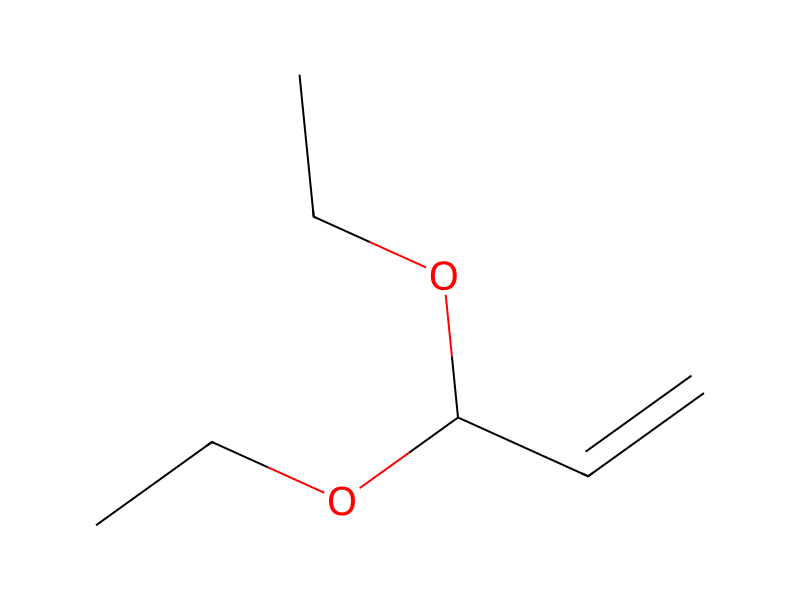
3,3-Diethoxy-1-propene

HCID 62477
New reaction
Print
Basic informationOverviewNames & identifiersPropertiesSafety & regulationChemistry & industryRelated reactionsCompound notes
Substructure searchFind similar structures

Basic information

CAS
3054-95-3
Standard SMILES
C=CC(OCC)OCC
InChIKey
MCIPQLOKVXSHTD-UHFFFAOYSA-N
Molecular formula
C7H14O2
Average molar mass
130.18 g/mol
Monoisotopic mass
130.09937969

Overview

3,3-diethoxypropene appears as a colorless liquid with an agreeable odor. Very volatile. Less dense than water. Vapors heavier than air. Used as a solvent and to make cosmetics.

Names & identifiers

Preferred name
3,3-Diethoxy-1-propene
IUPAC
3,3-diethoxyprop-1-ene
English name
Acrolein diethyl acetal
Molecular formula
C7H14O2
Molecular weight
130.18

Names & synonyms

Acrolein diethyl acetal3054-95-3Acrolein diethylacetalAcrolein acetal3,3-Diethoxy-1-propene1,1-Diethoxy-2-propeneAcrolein, diethyl acetal3,3-DiethoxypropenePropenal diethyl acetalAcrylaldehyde diethyl acetalAcrolein, diethylacetalDTXSID0020024
Show more names
3,3-DIETHOXYPROP-1-ENE1-Propene, 3,3-diethoxy-3 3-DIETHOXYPROPENEAVAC-013ein DiethyLACROLEIN DEAAvacopan Impurity 6ACROLEINDITHYLACETAL
NSC-60135DTXCID002433XN703369PROPENE, 3,3-DIETHOXY-diethoxypropeneAcrylylaldehyde diethyl acetalRefChem:109416221-276-0

Database identifiers

CAS
3054-95-3
PubChem CID
62477
DTXSID
DTXSID0020024
ChEMBL
CHEMBL3182978
UNII
33XN703369
EC Number
221-276-0
Nikkaji
J83.950G

Properties

Computed structural properties

XLogP
1.4
Topological polar surface area
18.5 Ų
Hydrogen bond donors
0
Hydrogen bond acceptors
2
Rotatable bonds
5
Heavy atoms
9
Formal charge
0
Complexity
65.3

Experimental & physicochemical properties

Chemical Classes · 2 items

Other Classes -> Acetals

Flammable agents - 3rd degree

SpringerMaterials PropertiesOptical coefficient
Physical Description · 2 items

3,3-diethoxypropene appears as a colorless liquid with an agreeable odor. Very volatile. Less dense than water. Vapors heavier than air. Used as a solvent and to make cosmetics.

Colorless liquid with a pleasant odor; [CAMEO]

Physicochemical properties

Melting point
120 · 120-124 °C
Boiling point
124 °C · 124 °C
Density
0.85 · 0.85
refractive index
1.4 · 1.40
Flash point
15 °C · 15 °C
storage temp.
2 · 2-8°C
solubility
Chloroform (Soluble), Ethyl Acetate (Slightly)
form
clear liquid
color
Colorless to Almost colorless
Water Solubility
Slightly soluble in water.
BRN
1701567 · 1701567
Stability
Light sensitive
InChI
1S/C7H14O2/c1-4-7(8-5-2)9-6-3/h4,7H,1,5-6H2,2-3H3
InChIKey
MCIPQLOKVXSHTD-UHFFFAOYSA-N
SMILES
CCOC(OCC)C=C
LogP
1.56 · 1.560
CAS DataBase Reference
3054 · 3054-95-3(CAS DataBase Reference)
FDA UNII
33 XN703369 · 33XN703369
NIST Chemistry Reference
1 · 1-Propene, 3,3-diethoxy-(3054-95-3)
EPA Substance Registry System
1 · 1-Propene, 3,3-diethoxy- (3054-95-3)
UNSPSC Code
12352100 · 12352100
NACRES
22 · NA.22
Symbol(GHS)
2 · GHS02,GHS07
Signal word
Danger
Hazard statements
315 · H315-H319-H225
Precautionary statements
501 · P501-P240-P210-P233-P243-P241-P242-P264-P280-P370+P378-P337+P313-P305+P351+P338-P362+P364-P303+P361+P353-P332+P313-P403+P235
PPE
Eyeshields, Faceshields, Gloves, type ABEK (EN14387) respirator filter
Hazard Codes
F,Xi
Risk Statements
11 · 11-36
Safety Statements
9 · 9-16-26-33-29-7/9
RIDADR
2374 · UN 2374
WGK Germany
3 · 3
RTECS
1370000 · AS1370000
F
8 · 8-13
HazardClass
3 · 3
PackingGroup
II
HS Code
2911000000 · 2911000000
Storage Class
3 · 3 - Flammable liquids
Hazard Classifications
2 Flam · Eye Irrit. 2Flam. Liq. 2
Limited Quantities
1 L · 1.0 L (0.3 gallon) (liquid)
Excepted Quantities
Max Inner Pack (30g or 30ml) and Max Outer Pack (500g or 500ml)

Safety & regulation

Safety information is for reference only and does not replace the supplier’s Safety Data Sheet (SDS), applicable regulations, or professional assessment.

GHS classification

GHS Classification · 4 items

Danger

H225 (100%): Highly Flammable liquid and vapor [Danger Flammable liquids]

P210, P233, P240, P241, P242, P243, P264+P265, P280, P303+P361+P353, P305+P351+P338, P337+P317, P370+P378, P403+P235, and P501 (click each P-code to see the statement)

Aggregated GHS information provided per 188 reports by companies from 6 notifications to the ECHA C&L Inventory. Each notification may be associated with multiple companies.

Hazard information

Regulatory Information · 2 items

1-Propene, 3,3-diethoxy-: Does not have an individual approval but may be used under an appropriate group standard

The New Jersey Worker and Community Right to Know Act requires public and private employers to provide information about hazardous substances at their workplaces. (N.J.S.A. 34:5A-1 et. seq.)

DOT LabelFlammable Liquid
Fire Hazards · 2 items

Excerpt from ERG Guide 127 [Flammable Liquids (Water-Miscible)]:

· HIGHLY FLAMMABLE: Will be easily ignited by heat, sparks or flames.

Health Hazards · 2 items

Excerpt from ERG Guide 127 [Flammable Liquids (Water-Miscible)]:

· Inhalation or contact with material may irritate or burn skin and eyes.

Hazards SummaryMay form unstable peroxides on exposure to air; [CAMEO] A strong eye irritant; [Alfa Aesar MSDS]
DOT ID and Guide2374 127
Reactive GroupEthers
Reactivity AlertsHighly Flammable
Reactivity Profile · 1 item

Ethers, such as 3,3-DIETHOXYPROPENE, can act as bases. They form salts with strong acids and addition complexes with Lewis acids. The complex between diethyl ether and boron trifluoride is an example. Ethers may react violently with strong oxidizing agents. In other reactions, which typically involve the breaking of the carbon-oxygen bond, ethers are relatively inert.

DOT Hazard Classification · 4 items

3,3-Diethoxypropene

UN2374

Class 3 Flammable and combustible liquid (49 eCFR § 173.120)

PG II: the degree of danger presented by the material is medium

Air and Water ReactionsHighly flammable. Soluble in water. Likely to slowly form peroxidized product when exposed to air. The formed peroxide is likely to be unstable.
Peroxide Forming Chemical · 3 items

3,3-Diethoxypropene

D*: Other compounds that may form peroxides

Bretherick's

Safety & protection

Fire FightingExcerpt from ERG Guide 127 [Flammable Liquids (Water-Miscible)]:
Accidental Release Measures · 2 items

· CALL 911. Then call emergency response telephone number on shipping paper. If shipping paper not available or no answer, refer to appropriate telephone number listed on the inside back cover.

· ELIMINATE all ignition sources (no smoking, flares, sparks or flames) from immediate area.

First Aid · 2 items

Excerpt from ERG Guide 127 [Flammable Liquids (Water-Miscible)]:

General First Aid:

Exposure Control and Personal Protection· Wear positive pressure self-contained breathing apparatus (SCBA).
Nonfire Spill ResponseExcerpt from ERG Guide 127 [Flammable Liquids (Water-Miscible)]:
Isolation and Evacuation · 2 items

Excerpt from ERG Guide 127 [Flammable Liquids (Water-Miscible)]:

Immediate precautionary measure

Personal Protective Equipment (PPE)Excerpt from ERG Guide 127 [Flammable Liquids (Water-Miscible)]:
Emergency Response Planning GuidelinesCAUTION: The majority of these products have a very low flash point. Use of water spray when fighting fire may be inefficient.

Safety data

F
8-13
PPE
Eyeshields, Faceshields, Gloves, type ABEK (EN14387) respirator filter
wgk
3
rtecs
AS1370000
ridadr
UN 2374
hs_code
2911000000
risk_code
11-36
Signal word
Danger
Symbol(GHS)
GHS02,GHS07
hazard_code
F,Xi
safety_code
9-16-26-33-29-7/9
hazard_class
3
Storage Class
3 - Flammable liquids
packing_group
II
Hazard statements
H315-H319-H225
Limited Quantities
1.0 L (0.3 gallon) (liquid)
Excepted Quantities
Max Inner Pack (30g or 30ml) and Max Outer Pack (500g or 500ml)
Hazard Classifications
Eye Irrit. 2Flam. Liq. 2
Precautionary statements
P501-P240-P210-P233-P243-P241-P242-P264-P280-P370+P378-P337+P313-P305+P351+P338-P362+P364-P303+P361+P353-P332+P313-P403+P235

Chemistry & industry

Uses & manufacturing

UsesUsed as a solvent and to make cosmetics; [CAMEO]
Applications · 4 items

Description3,3-Diethoxypropene is a colorless flammableliquid; Molecular weight=130.21; Boiling point=123.5℃;Flash point=4.4℃. Hazard Identification (based on HMISRating System scale: 0-4): Health 1, Flammability 3,Reactivity 1. Water solubility=not determined.

UsesAcrolein diethyl acetal is a reagent used for the synthesis of a variety of compounds, including cinnamaldehydes.

UsesAcrolein diethyl acetal is widely used to carry out chemoselective Heck arylation to synthesize either 3-arylpropanoate esters or cinnamaldehyde derivatives.It can also be used as one of the precursors to synthesize natural products like ()-(Z)-Deoxypukalide, ()-Laulimalide, botryodiplodin, neolaulimalide and isolaulimalide.

General DescriptionA colorless liquid with an agreeable odor. Very volatile. Flash point 70°F. Less dense than water. Vapors heavier than air. Used as a solvent and to make cosmetics.

Upstream & downstream products

Downstream products

3,3-Diethoxy-1-propanol1,1,3-TriethoxypropaneGlycidaldehyde diethylacetal5,6-Benzoquinoline3-(trifluoromethyl) Cinnamaldehyde4-Nitrocinnamaldehyde2,2-Diethoxyacetophenone7-Nitro-quinoline3-(3-Trifluoromethyl-phenyl)-propionic acid ethyl ester6-Iodoquinoline7-Hydroxyquinoline7-Methylquinoline6-Methoxyquinoline6-Quinolinol

Related reactions

49 records
New reaction record
HRID 330821 reaction equation
HRID 330821As reactant
HRID 336702 reaction equation
HRID 336702As reactant
HRID 368695 reaction equation
HRID 368695As reactant
HRID 493405 reaction equation
HRID 493405As product
HRID 555498 reaction equation
HRID 555498As reactant
HRID 588716 reaction equation
HRID 588716As product
HRID 597882 reaction equation
HRID 597882As reactant
HRID 702136 reaction equation
HRID 702136As reactant
PreviousPage 1 of 7

Compound notes

On this pageBasic informationOverviewNames & identifiersPropertiesSafety & regulationChemistry & industryRelated reactionsCompound notes