
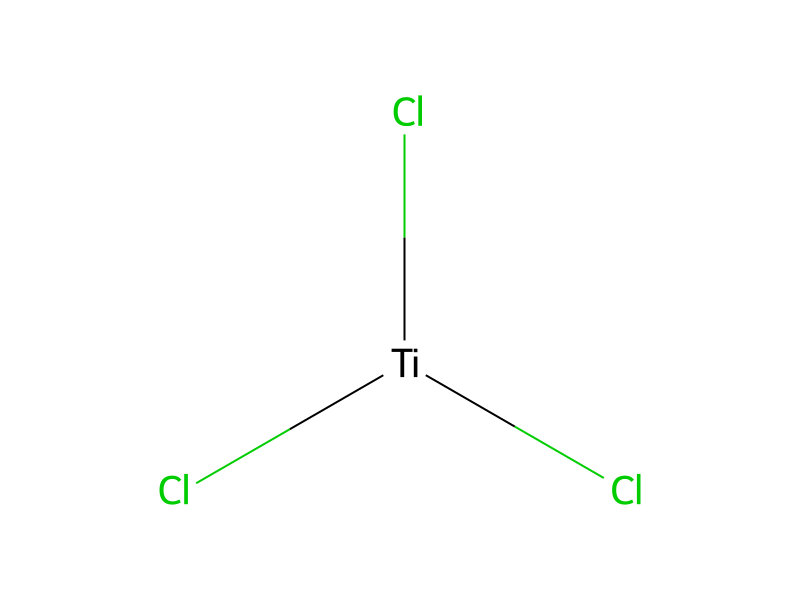
Basic information
- CAS
7705-07-9- Standard SMILES
[Cl][Ti]([Cl])[Cl]- InChIKey
YONPGGFAJWQGJC-UHFFFAOYSA-K- Molecular formula
- Cl3Ti
- Average molar mass
- 154.22 g/mol
- Monoisotopic mass
- 152.85450434
Names & identifiers
- Preferred name
- TITANIUM CHLORIDE (TiCl3)
- IUPAC
- trichlorotitanium
- English name
- Titanous chloride
- Molecular formula
- TiCl3
- Molecular weight
- 154.22
Names & synonyms
TITANIUM TRICHLORIDETrichlorotitanium7705-07-9Titanium chloride (TiCl3)TiCl3TAC 121TAC 131Lynx 900GVD566MM7KTEN 12TGY 24TOS 17
Show more names
TITANIUM(III) CHLORIDETitanium (III) chloride (solid)Titanium(iii) chloride, 20% w/w solution in 2n hydrochloric acidtac121tac131
RefChem:190167TAC 140TAC 144TAS 101231-728-9LYNX-900TAC-121TAS-101
Database identifiers
- CAS
7705-07-9- PubChem CID
- 62646
- DTXSID
DTXSID1052870- EC Number
- 231-728-9
Properties
Computed structural properties
- Topological polar surface area
- 0 Ų
- Hydrogen bond donors
- 0
- Hydrogen bond acceptors
- 0
- Rotatable bonds
- 0
- Heavy atoms
- 4
- Formal charge
- 0
- Complexity
- 8
Experimental & physicochemical properties
Chemical Classes
Metals -> Metals, Inorganic Compounds
Flammable agents - 3rd degree
SpringerMaterials Propertiescrystal structure
Density1.772 @25 °C
Boiling Point136.4 °C @760 [mm Hg]
Melting Point-30 °C
Vapor Pressure10 [mm Hg] @21.3 °C
Physical DescriptionDark red-violet deliquescent solid; [Merck Index] Purple powder; [Sigma-Aldrich MSDS]
Physicochemical properties
- Melting point
- 440 °C · 440 °C (dec.)(lit.)
- Boiling point
- 100 °C · 100 °C
- Density
- 1.192 g/mL · 1.192 g/mL at 25 °C
- solubility
- 2 O · reacts with H2O
- form
- powder
- color
- Purple
- Water Solubility
- Soluble
- Specific Heat Capacity
- 0.63 J/ · Cp(crystal): 0.63 J/(g·K), at 25℃
- Sensitive
- Air Sensitive
- Merck
- 14 · 14,9481
- Stability
- Stable, but reacts violently with water and is spontaneously flammable in air.
- InChI
- InChI=1S/2ClH.Ti/h2*1H;/q;;+2/p-2
- InChIKey
- ZWYDDDAMNQQZHD-UHFFFAOYSA-L
- SMILES
- Cl[Ti](Cl)Cl
- CAS DataBase Reference
- 7705 · 7705-07-9(CAS DataBase Reference)
- FDA UNII
- 566 MM7K · GVD566MM7K
- NIST Chemistry Reference
- Titanium(iii) chloride(7705-07-9)
- EPA Substance Registry System
- Titanium chloride (TiCl3) (7705-07-9)
- UNSPSC Code
- 12352302 · 12352302
- NACRES
- 22 · NA.22
- Symbol(GHS)
- 2 · GHS02,GHS05,GHS06
- Signal word
- Danger
- Hazard statements
- 252 · H252-H290-H301-H314-H318
- Precautionary statements
- 210 · P210-P222-P231+P232-P233-P280-P235-P234-P260-P264-P370+P378-P390-P301+P330+P331-P303+P361+P353-P363-P304+P340-P310-P305+P351+P338-P407-P420-P406-P405-P501
- target organs
- Respiratory system
- Hazard Codes
- C,F
- Risk Statements
- 34 · 34-37-35-17-14
- Safety Statements
- 6 · 6-26-30-36/37/39-43-45
- RIDADR
- 2441 · UN 2441
- WGK Germany
- 3 · 3
- RTECS
- 1924000 · XR1924000
- F
- 10 · 10-23
- TSCA
- TSCA listed
- HazardClass
- 4.2 · 4.2
- PackingGroup
- I
- HS Code
- 28273990 · 28273990
- Storage Class
- 8 B · 8B - Non-combustible corrosive hazardous materials
- Hazard Classifications
- 1 Met · Eye Dam. 1Met. Corr. 1Skin Corr. 1BSTOT SE 3
- REACH Registrations
- Active
- Limited Quantities
- 1 Kg · 1 Kg (2.2 lbs) (solid)
- Excepted Quantities
- Max Inner Pack (30g or 30ml) and Max Outer Pack (500g or 500ml)
Safety & regulation
GHS classification
GHS Classification
Danger
H250 (96.6%): Catches fire spontaneously if exposed to air [Danger Pyrophoric liquids]
P210, P222, P231, P233, P260, P261, P264, P264+P265, P271, P272, P280, P284, P301+P330+P331, P302+P335+P334, P302+P352, P302+P361+P354, P304+P340, P305+P354+P338, P316, P317, P319, P320, P321, P333+P317, P362+P364, P363, P370+P378, P403+P233, P405, and P501 (click each P-code to see the statement)
Aggregated GHS information provided per 236 reports by companies from 9 notifications to the ECHA C&L Inventory. Each notification may be associated with multiple companies.
Danger
H250: Catches fire spontaneously if exposed to air [Danger Pyrophoric liquids]
Hazard information
Regulatory Information
Chemical: Titanium chloride (TiCl3)
REACH registered substance: Titanium trichloride (EC: 231-728-9)
Titanium (III) chloride: Does not have an individual approval but may be used under an appropriate group standard
The New Jersey Worker and Community Right to Know Act requires public and private employers to provide information about hazardous substances at their workplaces. (N.J.S.A. 34:5A-1 et. seq.)
Fire Hazards· Non-combustible, substance itself does not burn but may decompose upon heating to produce corrosive and/or toxic fumes.
Health Hazards· TOXIC and/or CORROSIVE; inhalation, ingestion or contact (skin, eyes) with vapors, dusts or substance may cause severe injury, burns or death.
Hazards Summary
Unstable and highly reactive; Powder is pyrophoric; Dissociates rapidly from moisture in air; A powerful reducing agent; [Merck Index] A strong reducing agent; Decomposed by moisture evolving hydrochloric acid; Dry powder is pyrophoric; Corrosive to skin and mucous membranes; [CAMEO] Pyrophoric; Reacts violently with water evolving hydrogen chloride gas; Causes burns; Inhalation may cause corrosive injuries to upper respiratory tract; [Sigma-Aldrich MSDS]
DOT ID and Guide2869 157
DOT Hazard Classification
Titanium trichloride, pyrophoric or Titanium trichloride mixtures, pyrophoric
UN2441
Div 4.2 Spontaneously combustible material (49 eCFR § 173.124)
Div 4.2 Spontaneously combustible material (49 eCFR § 173.124)
PG I: the degree of danger presented by the material is great
Hazard Classes and Categories
Pyr. Sol. 1 (96.6%)
Pyrophoric solids - Category 1
Pyrophoric solids - Category 1
Flammable agents - 3rd degree, Reactive agents - 3rd degree
CSL Reaction Information
CSL00173
Titanium chloride (TiCl3) + Water
Reaction vessel ruptured due to pressure increase
Not Available
User Reported
04/21/2022
Safety & protection
Accidental Release Measures
· CALL 911. Then call emergency response telephone number on shipping paper. If shipping paper not available or no answer, refer to appropriate telephone number listed on the inside back cover.
· ELIMINATE all ignition sources (no smoking, flares, sparks or flames) from immediate area.
First AidGeneral First Aid:
Exposure Control and Personal Protection· Wear positive pressure self-contained breathing apparatus (SCBA).
Isolation and EvacuationImmediate precautionary measure
Protective Action Criteria (PAC)
1.2 [mg/m3]
13 [mg/m3]
79 [mg/m3]
Emergency Response Planning Guidelines· Note: Some foams will react with the material and release corrosive/toxic gases.
Toxicology
Adverse EffectsDermatotoxin - Skin burns.
Safety data
- F
- 10-23
- wgk
- 3
- tsca
- TSCA listed
- rtecs
- XR1924000
- ridadr
- UN 2441
- hs_code
- 28273990
- risk_code
- 34-37-35-17-14
- Signal word
- Danger
- Symbol(GHS)
- GHS02,GHS05,GHS06
- hazard_code
- C,F
- safety_code
- 6-26-30-36/37/39-43-45
- hazard_class
- 4.2
- Storage Class
- 8B - Non-combustible corrosive hazardous materials
- packing_group
- I
- target organs
- Respiratory system
- Hazard statements
- H252-H290-H301-H314-H318
- Limited Quantities
- 1 Kg (2.2 lbs) (solid)
- Excepted Quantities
- Max Inner Pack (30g or 30ml) and Max Outer Pack (500g or 500ml)
- REACH Registrations
- Active
- Hazard Classifications
- Eye Dam. 1Met. Corr. 1Skin Corr. 1BSTOT SE 3
- Precautionary statements
- P210-P222-P231+P232-P233-P280-P235-P234-P260-P264-P370+P378-P390-P301+P330+P331-P303+P361+P353-P363-P304+P340-P310-P305+P351+P338-P407-P420-P406-P405-P501
Chemistry & industry
Uses & manufacturing
UsesUsed as a reducing agent (nitrate to ammonia), laundry stain remover, and analytical reagent; [Merck Index]
General Manufacturing InformationTitanium chloride (TiCl3): ACTIVE
Applications
UsesIt is mainly used as a strong reducing agent; as the catalyst of Α-olefin polymerization. It can be used for azo dye analysis. It can be used as the titrant of azo dye analysis and strong reducing agent.
UsesTitanium Chloride (≥12% HCl Solution) is ued in the optimized gas chromatography tandem mass spectrometry for 1,1''-sulfonylbis[2-(methylthio)ethane] quantification in human urine
UsesAs powerful reducing agent, Titanous chlorideb can reduces nitrate to ammonia; when boiled with aqueous SO2, sulfur is separated; hence is used as an aqueous solution for estimation of nitro groups, ferric ions, per-salts, etc. Removes stains, etc. (stripper) in laundering.
General DescriptionA dark violet crystalline solid. Denser than water. Contact may burn skin, eyes, and mucous membranes. May be toxic by ingestion, inhalation and skin absorption. Used to make other chemicals.
Preparation methods
PreparationAluminum reduction process: apply an excess of titanium tetrachloride to react with aluminum powder at 136 °C with aluminum chloride being taken as the initiator to produce titanium trichloride and aluminum trichloride. Heat and steam out excess amount titanium tetrachloride for recycling usage. Meanwhile, the aluminum trichloride undergoes sublimation to get finished product of titanium trichloride. Its reaction equation is: 3TiCl4 + Al → 3TiCl3 + A1C13
PreparationTitanium trichloride may be prepared by reducing titanium tetrachloride with hydrogen at 600°C. The tetrachloride may alternatively be reduced with aluminum, zinc, magnesium, tin, or by electrolysis.
Upstream & downstream products
Upstream raw materials
Downstream products
Suppliers86 total
国药集团化学试剂有限公司86-21-63210123 · [email protected]
江西益众化工有限公司15307925109 15350027073 · [email protected]
阿诺西(上海)生物技术有限公司400-1107768 15058188853 · [email protected]
上海阿拉丁生化科技股份有限公司400-6206333 13167063860 · [email protected]
杭州品高化工有限公司0571-87658025 · [email protected]
杭州摩库生物医药科技有限公司+86-057181025280; +8617767106207 · [email protected]
山东昱轩化工产品有限公司18953919089
江苏星科元信息科技有限公司400-605-7200 15335295587
Dayang Chem (Hangzhou) Co.,Ltd.+86-0571-88938639 17705817739 · [email protected]
武汉绿景丰华生物科技有限公司19972070065 · [email protected]
上海迈瑞尔生化科技有限公司4006356688 18621169109 · [email protected]
上海晶抗生物工程有限公司021-54721350 13524668266 · [email protected]
武汉市聚舜化工有限公司027-02783261126 18971318572 · [email protected]
阿法埃莎(中国)化学有限公司400-6106006 · [email protected]
安耐吉化学&3A(安徽泽升科技股份有限公司)400-0056266 · [email protected]
上海景颜化工科技有限公司13817811078 · [email protected]
嘉兴市艾森化工有限公司0573-85285100 18627885956 · [email protected]
Beckmann-Kenko GmbH+49 4241 9308 88 · [email protected]
山东西亚化学有限公司13355009207 13355009207 · [email protected]
广东大小化工有限公司1866-171603 18666171603 · [email protected]
玛雅试剂+86 (573) 82222445 (0)18006601000 452520369 · [email protected]
四川库利南科技有限公司400-1166-196 18981987031 · [email protected]
南京化学试剂股份有限公司025-58369808 17895012682 · [email protected]
南京一化生物科技有限公司13236563309 · [email protected]
艾科试剂4008-755-333 18080918076 · [email protected]
赛默飞世尔科技(中国)有限公司800-810-5118 · [email protected]
北京伊诺凯科技有限公司400-810-7969 010-59572699 · [email protected]
北京京土恒盛化工科技有限公司00-13911456598 13911456598 · [email protected]
上海乐晨国际贸易有限公司021-67256163 · [email protected]
北京环宇世纪化学科技有限公司hysj_bj.com
上海将来实业股份有限公司400-0066400 13621662912 · [email protected]
上海将来实业股份有限公司021-61552785 · [email protected]
成都零六生物科技有限公司400-1166-196 13458535857 · [email protected]
上海麦克林生化科技股份有限公司15221275939 15221275939 · [email protected]
杭州杰恒化工有限公司0571-87396432 · [email protected]
康迪斯化工(湖北)有限公司13125172151 · [email protected]
成都润泽本土化工有限公司13096311329 028-88469284 616445927 · [email protected]
Sigma-Aldrich西格玛奥德里奇(上海)贸易有限公司021-61415566 800-8193336 · [email protected]
九鼎化学(上海)科技有限公司4009209199 · [email protected]
昆山中莱特贸易有限公司0512-55170668 13913095008;13770601296 · [email protected]
上海玻尔化学试剂有限公司19102157732 · [email protected]
启源(广东)医药化工有限公司18026564465 · [email protected]
成都润泽本土化工有限公司028-88469284 18000562381 · [email protected]
南通市苏北化工原料有限公司0513-85290972 18762756250 · [email protected]
艾万拓威达优尔国际贸易(上海)有限公司400-821-8006 · [email protected]
山东西亚化学有限公司4009903999 13395398332 · [email protected]
安泰精细化工技术有限公司18503026267 · [email protected]
成都华纯科技有限公司400-1166-196 15982826727 · [email protected]
上海新平精细化学品有限公司18221735425 · [email protected]
上海贤鼎生物科技有限公司021-021-52271985 17721149837 · [email protected]
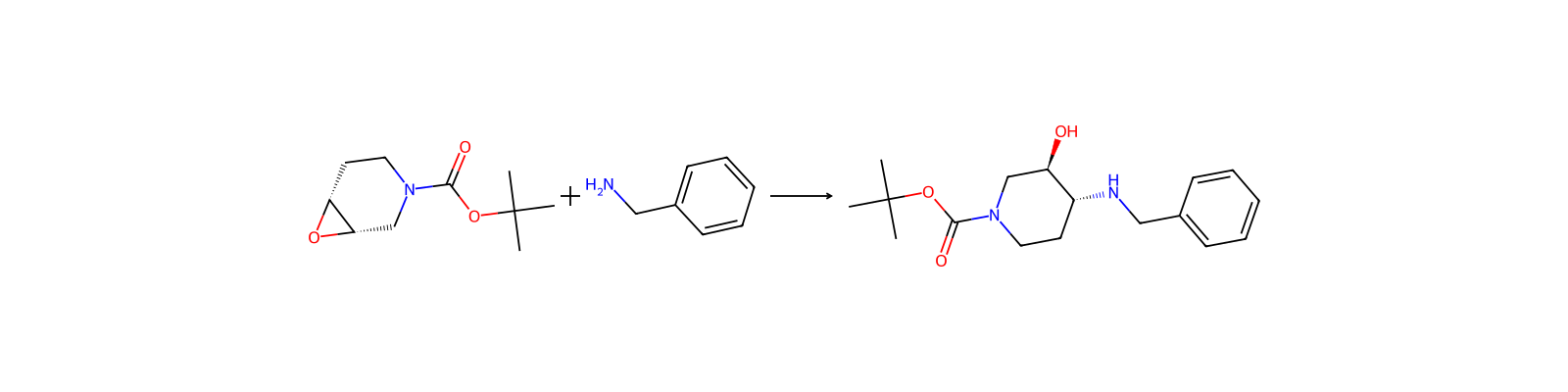
Related reactions
9 records




Compound notes
Loading…