HomeMCPWorkbenchSkills
HomeWorkbenchNotificationsMe
llms.txt · MCP GuidePrivacy Policy · Terms of Service · Supportv1.8.3
  1. Home
  2. /Compound

2,2-Dimethyloctanoic acid

HCID 62847
New reaction
Print
Basic informationOverviewNames & identifiersPropertiesSafety & regulationChemistry & industryRelated reactionsCompound notes
Substructure searchFind similar structures

Basic information

CAS
29662-90-6
Standard SMILES
CCCCCCC(C)(C)C(=O)O
InChIKey
IKNDGHRNXGEHTO-UHFFFAOYSA-N
Molecular formula
C10H20O2
Average molar mass
172.26 g/mol
Monoisotopic mass
172.14632988

Overview

2,2-dimethyl octanoic acid is a colorless liquid with a burning, rancid odor. Floats on water. (USCG, 1999)

Names & identifiers

Preferred name
2,2-Dimethyloctanoic acid
IUPAC
2,2-dimethyloctanoic acid
English name
2,2-Dimethyloctanoic acid
Molecular formula
C10H20O2
Molecular weight
172.26

Names & synonyms

2,2-Dimethyloctanoic acidOctanoic acid, 2,2-dimethyl-2,2-dimethyl octanoic acidUNII-5RV14V52PN5RV14V52PNDTXSID0058356.ALPHA.,.ALPHA.-DIMETHYLOCTANOIC ACIDRefChem:810972,2,-dimethyl octanoic acidalpha,alpha-dimethyloctanoic acidDTXCID40320872,2-DIMETHYLCAPRYLIC ACID
Show more names
Butyl Parahydroxybenzoate Impurity 1 (Butyl Parahydroxybenzoate EP Impurity A)
29662-90-62,2-Dimethyloctanoicacid2,2-Dimethyloctanoic Acid; a,a-Dimethyloctanoic Acid; 2,2-Dimethyl-Octanoic Acid;2,2-Dimethyloctanoic acid #SCHEMBL284791EBA66290AKOS012034274AT41178

Database identifiers

CAS
29662-90-6
PubChem CID
62847
DTXSID
DTXSID0058356
UNII
5RV14V52PN
EC Number
980-158-3
Nikkaji
J283.209G

Properties

Computed structural properties

XLogP
3.7
Topological polar surface area
37.3 Ų
Hydrogen bond donors
1
Hydrogen bond acceptors
2
Rotatable bonds
6
Heavy atoms
12
Formal charge
0
Complexity
139

Experimental & physicochemical properties

SpringerMaterials PropertiesDensity
Physical Description2,2-dimethyl octanoic acid is a colorless liquid with a burning, rancid odor. Floats on water. (USCG, 1999)

Physicochemical properties

Boiling point
262.98 °C · 262.98°C (estimate)
Density
0.9047 · 0.9047 (rough estimate)
refractive index
1.4175 · 1.4175 (estimate)
solubility
DMSO (Slightly), Methanol (Slightly)
form
Oil
pka
4.86 · 4.86±0.45(Predicted)
color
Colourless
FDA UNII
5 RV14V52PN · 5RV14V52PN
EPA Substance Registry System
2 · Octanoic acid, 2,2-dimethyl- (29662-90-6)
Symbol(GHS)
7 · GHS07

Safety & regulation

Safety information is for reference only and does not replace the supplier’s Safety Data Sheet (SDS), applicable regulations, or professional assessment.

GHS classification

GHS Classification · 4 items

Danger

H315 (100%): Causes skin irritation [Warning Skin corrosion/irritation]

P261, P264, P264+P265, P271, P280, P302+P352, P304+P340, P305+P354+P338, P317, P319, P321, P332+P317, P362+P364, P403+P233, P405, and P501 (click each P-code to see the statement)

Aggregated GHS information provided per 3 reports by companies from 2 notifications to the ECHA C&L Inventory. Each notification may be associated with multiple companies.

Hazard information

Regulatory InformationOctanoic acid, 2,2-dimethyl-: Does not have an individual approval but may be used under an appropriate group standard
Health Hazards · 1 item

Irritating to the eyes, nose, throat, upper respiratory tract, and skin. Inhalation may be fatal as a result of spasm, inflammation and edema of the larynx and bronchi, chemical pneumonitis, and pulmonary edema. Symptoms of exposure may include burning sensation, coughing, wheezing, laryngitis, shortness of breath, headache, nausea, and vomiting. (USCG, 1999)

Reactive GroupAcids, Carboxylic
Reactivity Profile · 1 item

2,2-DIMETHYL OCTANOIC ACID reacts exothermically with bases. May corrode or dissolve iron, steel, and aluminum parts and containers. May react with active metals to form gaseous hydrogen and a metal salt. Reacts with cyanide salts to generate gaseous hydrogen cyanide. Reacts with diazo compounds, dithiocarbamates, isocyanates, mercaptans, nitrides, and sulfides to generate flammable and/or toxic gases and heat. Reacts with sulfites, nitrites, thiosulfates (to give H2S and SO3), dithionites (SO2), to generate flammable and/or toxic gases and heat. Reacts with carbonates and bicarbonates to generate a harmless gas (carbon dioxide) but some heat. Exothermically oxidized by strong oxidizing agents and reduced by strong reducing agents to give a range of products. May initiate polymerization reactions or catalyze other chemical reactions.

Chemistry & industry

Applications

Uses2,2-Dimethyloctanoic Acid is used in biological studies as benzyl dimethyloctanoate metabolite of sewage bacteria.

General DescriptionColorless liquid with a burning, rancid odor. Floats on water.

Related reactions

3 records
New reaction record
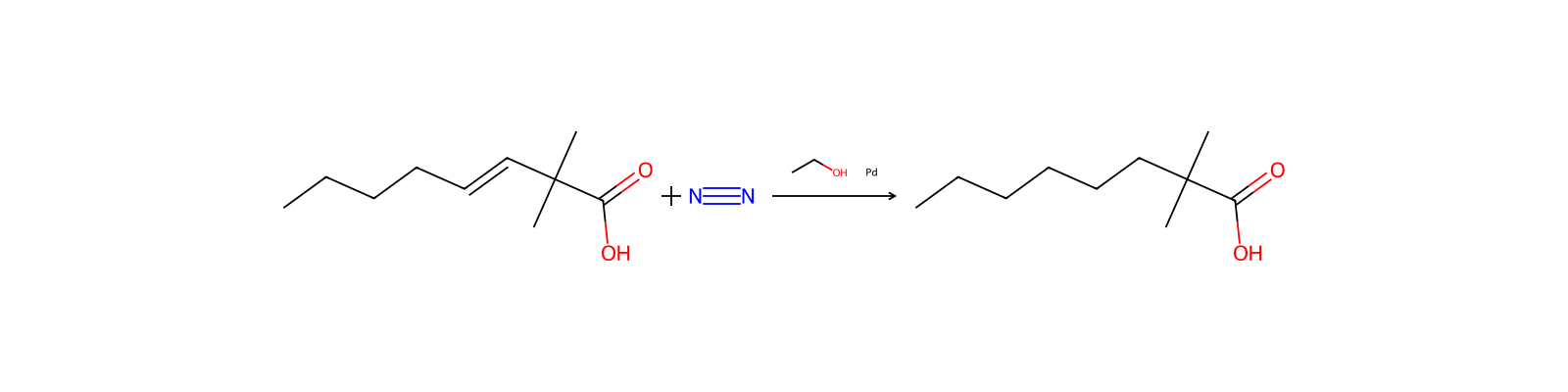
HRID 377635 reaction equation
HRID 377635As product
HRID 798999 reaction equation
HRID 798999As product
HRID 1107714 reaction equation
HRID 1107714As product

Compound notes

On this pageBasic informationOverviewNames & identifiersPropertiesSafety & regulationChemistry & industryRelated reactionsCompound notes
Signal word
Warning
Hazard statements
302 · H302-H315-H319-H335
Precautionary statements
280 · P280-P305+P351+P338
HS Code
2915900090 · 2915900090
Air and Water ReactionsNo rapid reaction with air. No rapid reaction with water.
Hazard Classes and CategoriesSkin Irrit. 2 (100%)

Safety & protection

Fire FightingFire Extinguishing Agents: CO2, dry chemical, foam, or water spray. (USCG, 1999)
First AidINHALATION: Remove victim to fresh air. If breathing has stopped, give artificial respiration. If breathing is difficult, give oxygen.
Nonfire Spill ResponseNeutralizing Agents for Acids and Caustics: Caustic soda, soda ash, lime (USCG, 1999)
Personal Protective Equipment (PPE)Approved respirator, chemical resistant gloves, chemical safety gloves, other protective clothing. (USCG, 1999)

Safety data

hs_code
2915900090
Signal word
Warning
Symbol(GHS)
GHS07
Hazard statements
H302-H315-H319-H335
Precautionary statements
P280-P305+P351+P338