
Completing data — refresh the page later to see the latest

Basic information
- CAS
153439-40-8- Standard SMILES
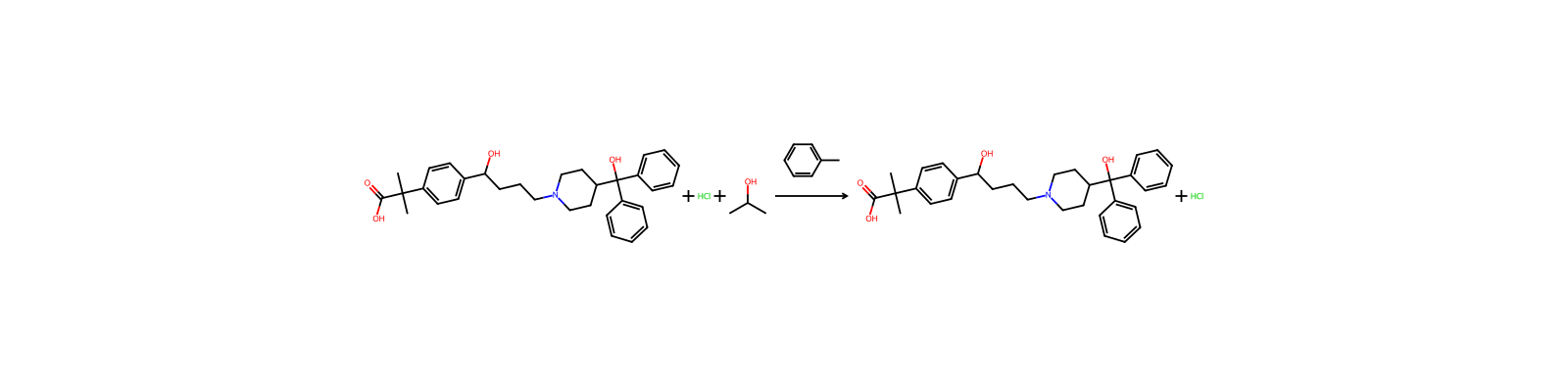
CC(C)(C(=O)O)c1ccc(C(O)CCCN2CCC(C(O)(c3ccccc3)c3ccccc3)CC2)cc1.Cl- InChIKey
RRJFVPUCXDGFJB-UHFFFAOYSA-N- Molecular formula
- C32H40ClNO4
- Average molar mass
- 538.1 g/mol
- Monoisotopic mass
- 537.2645865
Names & identifiers
- Preferred name
- Fexofenadine Hydrochloride
- IUPAC
- 2-[4-[1-hydroxy-4-[4-[hydroxy(diphenyl)methyl]piperidin-1-yl]butyl]phenyl]-2-methylpropanoic acid;hydrochloride
- English name
- Fexofenadine hydrochloride
- Molecular formula
- C32H40ClNO4
- Molecular weight
- 538.13
Names & synonyms
FEXOFENADINE HYDROCHLORIDE153439-40-8FEXOFENADINE HCLAllegra AllergyAllegra HivesMDL 16,455ADTXSID5048716Children's Allegra HivesMDL-16455AChildren's Allegra Allergy2S068B75ZUDTXCID2028642
Show more names
FexoAllegra2-[4-[1-Hydroxy-4-[4-(hydroxy-diphenyl-methyl)-1-piperidyl]-butyl]phenyl]-2-methyl-propanoic acid hydrochlorideTelfastAlernexFeksineFexofenFexadyneVivafeksTelfast BD
Benzeneacetic acid, 4-(1-hydroxy-4-(4-(hydroxydiphenylmethyl)-1-piperidinyl)butyl)-alpha,alpha-dimethyl-, hydrochlorideAllergillicIAllergy ReliefChildren AllergyWal-fexbasic care allergyFex-Allergy ReliefDye Free Wal Fex
Database identifiers
- CAS
153439-40-8- PubChem CID
- 63002
- DTXSID
Properties
Computed structural propertiesFilling in
- Topological polar surface area
- 81 Ų
- Hydrogen bond donors
- 4
- Hydrogen bond acceptors
- 5
- Rotatable bonds
- 10
- Heavy atoms
- 38
- Formal charge
- 0
- Complexity
- 678
Experimental & physicochemical properties
Solubility71.8 [ug/mL] (The mean of the results at pH 7.4)
Physicochemical properties
- Melting point
- 148 · 148-150oC
- RTECS
- 1633377 · CY1633377
- storage temp.
- 2 · 2-8°C
- solubility
- Soluble in Dimethyl sulfoxide (50 mM), and methanol.
- form
- powder
- color
- white to beige
- Merck
- 14 · 14,4068
- InChIKey
- RRJFVPUCXDGFJB-UHFFFAOYSA-N
- SMILES
- C(C1C=CC=CC=1)(C1C=CC=CC=1)(C1CCN(CCCC(C2C=CC(C(C)(C)C(=O)O)=CC=2)O)CC1)O.Cl
- CAS DataBase Reference
- 153439 · 153439-40-8(CAS DataBase Reference)
- NCI Dictionary of Cancer Terms
- Allegra
- FDA UNII
- 2 S068B75ZU · 2S068B75ZU
- NCI Drug Dictionary
Safety & regulation
Safety information is for reference only and does not replace the supplier’s Safety Data Sheet (SDS), applicable regulations, or professional assessment.
GHS classification
GHS Classification
This chemical does not meet GHS hazard criteria for 14.3% (1 of 7) of reports.
Danger
H302 (28.6%): Harmful if swallowed [Warning Acute toxicity, oral];H312 (14.3%): Harmful in contact with skin [Warning Acute toxicity, dermal];H315 (28.6%): Causes skin irritation [Warning Skin corrosion/irritation];H317 (42.9%): May cause an allergic skin reaction [Warning Sensitization, Skin];H319 (28.6%): Causes serious eye irritation [Warning Serious eye damage/eye irritation];H335 (14.3%): May cause respiratory irritation [Warning Specific target organ toxicity, single exposure; Respiratory tract irritation];H360 (42.9%): May damage fertility or the unborn child [Danger Reproductive toxicity];H361d (14.3%): Suspected of damaging the unborn child [Warning Reproductive toxicity]
P203, P261, P264, P264+P265, P270, P271, P272, P280, P301+P317, P302+P352, P304+P340, P305+P351+P338, P317, P318, P319, P321, P330, P332+P317, P333+P317, P337+P317, P362+P364, P403+P233, P405, and P501 (click each P-code to see the statement)
Aggregated GHS information provided per 7 reports by companies from 6 notifications to the ECHA C&L Inventory. Each notification may be associated with multiple companies.;Reported as not meeting GHS hazard criteria per 1 of 7 reports by companies.;There are 5 notifications provided by 6 of 7 reports by companies with hazard statement code(s).;Information may vary between notifications depending on impurities, additives, and other factors. The percentage value in parenthesis indicates the notified classification ratio from companies that provide hazard codes. Only hazard codes with percentage values above 10% are shown. For more detailed information, please visit ECHA C&L website.
Hazard information
Hazard Classes and CategoriesAcute Tox. 4 (28.6%);Acute Tox. 2 (14.3%);Skin Irrit. 2 (28.6%);Skin Sens. 1 (42.9%);Eye Irrit. 2A (28.6%);STOT SE 3 (14.3%);Repr. 1B (42.9%);Repr. 2 (14.3%)
Toxicology
Chemistry & industry
Pharmacology
Metabolism/MetabolitesApproximately 5% of the total dose is metabolized, by cytochrome P450 3A4 and by intestinal microflora.
Half Life: 14.4 hours
FDA Pharmacological Classification
FEXOFENADINE HCL
Histamine-1 Receptor Antagonist [EPC]; Histamine H1 Receptor Antagonists [MoA]
FEXOFENADINE HYDROCHLORIDE
Histamine H1 Receptor Antagonists [MoA]; Histamine-1 Receptor Antagonist [EPC]
FEXOFENADINE HYDROCHLORIDE 180 MG
Histamine-1 Receptor Antagonist [EPC]; Histamine H1 Receptor Antagonists [MoA]
MeSH Pharmacological Classification
Agents that are used to treat allergic reactions. Most of these drugs act by preventing the release of inflammatory mediators or inhibiting the actions of released mediators on their target cells. (From AMA Drug Evaluations Annual, 1994, p475)
A class of non-sedating drugs that bind to but do not activate histamine receptors (DRUG INVERSE AGONISM), thereby blocking the actions of histamine or histamine agonists. These antihistamines represent a heterogenous group of compounds with differing chemical structures, adverse effects, distribution, and metabolism. Compared to the early (first generation) antihistamines, these non-sedating antihistamines have greater receptor specificity, lower penetration of BLOOD-BRAIN BARRIER, and are less likely to cause drowsiness or psychomotor impairment.
Uses & manufacturing
UsesAn antihistamine drug used in the treatment of hayfever and similar allergy symptoms.
Applications
DescriptionFexofenadine hydrochloride (trade name: Allegra) belongs to a second-generation antihistamine pharmaceutical drug. It is mainly used for the treatment of allergy symptoms including watery eyes, hay fever, nasal congestion, urticaria, runny nose, itching eyes/nose, sneezing, hives, and itching. It is a kind of selectively peripheral H1 blocker. Its mechanism of action in vivo is through preventing the histamine-mediated activation of the H1 receptors, thus alleviating the symptoms related to allergy. Compared to the first-generation antihistamine drug, it is less prone to penetrate the blood-brain barrier, reducing the possibility to cause side effects such as drowsiness.
Related reactions
40 records




Compound notes
Loading…