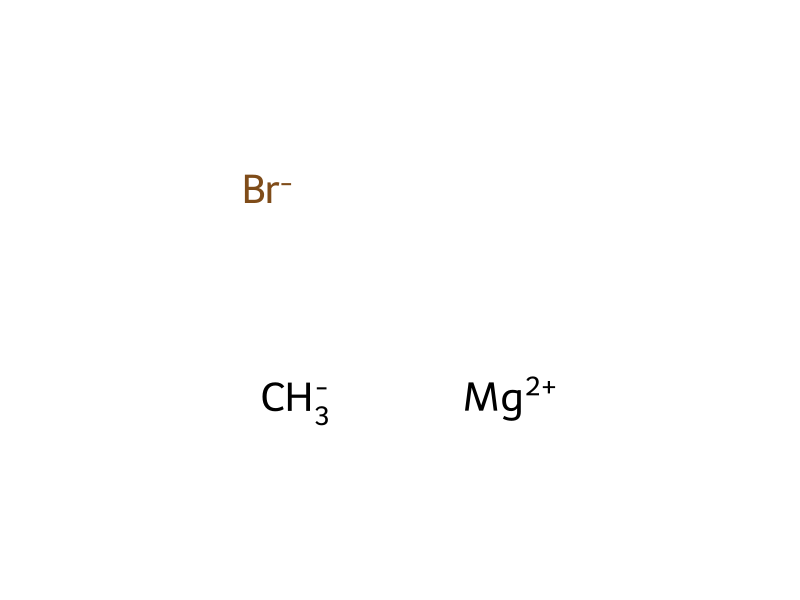
Basic information
- CAS
75-16-1- Standard SMILES
[Br-].[CH3-].[Mg+2]- InChIKey
AVFUHBJCUUTGCD-UHFFFAOYSA-M- Molecular formula
- CH3BrMg
- Average molar mass
- 119.24 g/mol
Overview
Methyl magnesium bromide in ethyl ether appears as a colorless cloudy solution in diethyl ether. Vapors heavier than air.
Names & identifiers
- Preferred name
- Methyl magnesium bromide
- IUPAC
- magnesium;carbanide;bromide
- English name
- Methylmagnesium Bromide
- Molecular formula
- CH3BrMg
- Molecular weight
- 119.24
Names & synonyms
Show more names
Database identifiers
- CAS
75-16-1- PubChem CID
- 6349
- DTXSID
DTXSID7052496- EC Number
- 200-844-1
Properties
Computed structural properties
- Topological polar surface area
- 0 Ų
- Hydrogen bond donors
- 0
- Hydrogen bond acceptors
- 2
- Rotatable bonds
- 0
- Heavy atoms
- 3
- Formal charge
- 0
- Complexity
- 4.8
Experimental & physicochemical properties
Physical Description
Methyl magnesium bromide in ethyl ether appears as a colorless cloudy solution in diethyl ether. Vapors heavier than air.
Diethyl ether solution: Cloudy colorless liquid; [CAMEO] In 1.4m toluene/tetrahydrofuran solution: Orange liquid; [MSDSonline]
Other Experimental Properties
Moisture sensitive
... May react violently with water. /Methyl magnesium bromide in ethyl ether/
Physicochemical properties
- Boiling point
- 78 · 78-80℃
- Density
- 1.035 g/mL · 1.035 g/mL at 25 °C
- Flash point
- 77 °F · 77 °F
- storage temp.
- water-free area
- form
- Solution, may develop some turbidity precipitate
- color
- Pale brown
- Water Solubility
- Reacts with water.
- Sensitive
- Air & Moisture Sensitive
- BRN
- 3535220 · 3535220
- InChI
- InChI=1S/CH3.BrH.Mg/h1H3;1H;/q;;+1/p-1
- InChIKey
- AVFUHBJCUUTGCD-UHFFFAOYSA-M
- SMILES
- [Mg](C)Br
- CAS DataBase Reference
- 75 · 75-16-1(CAS DataBase Reference)
- FDA UNII
- 22 CW9773DF · 22CW9773DF
- EPA Substance Registry System
- Magnesium, bromomethyl- (75-16-1)
- UNSPSC Code
- 12352111 · 12352111
- NACRES
- 22 · NA.22
- Symbol(GHS)
- 2 · GHS02,GHS05,GHS07,GHS08
- Signal word
- Danger
- Hazard statements
- 302 · H302-H314-H371-H372-H351-H335-H224-H260
- Precautionary statements
- 501 · P501-P223-P270-P202-P240-P231+P232-P260-P210-P233-P201-P243-P241-P242-P271-P264-P280-P370+P378-P335+P334-P308+P311-P303+P361+P353-P301+P330+P331-P363-P301+P312+P330-P304+P340+P310-P305+P351+P338+P310-P403+P233-P402+P404-P403+P235-P405
- target organs
- Respiratory system
- PPE
- Faceshields, Gloves, Goggles, type ABEK (EN14387) respirator filter
- Hazard Codes
- C,F+,F
- Risk Statements
- 12 · 12-14-19-22-34-66-67-52/53-10-65-63-48/20-14/15-11-37
- Safety Statements
- 9 · 9-16-26-45-61-36/37/39-62-43-36/37-23
- RIDADR
- 1928 · UN 1928
- WGK Germany
- 2 · 2
- RTECS
- 3700000 · OM3700000
- F
- 1 · 1-3-10
- TSCA
- TSCA listed
- HazardClass
- 4.3 · 4.3
- PackingGroup
- I
- HS Code
- 29319090 · 29319090
- Storage Class
- 4.3 · 4.3 - Hazardous materials which set free flammable gases upon contact with water
- Hazard Classifications
- 3 Eye · Aquatic Chronic 3Eye Dam. 1Flam. Liq. 3Skin Corr. 1BSTOT SE 3Water-react 1
- Hazardous Substances Data
- 75 · 75-16-1(Hazardous Substances Data)
- REACH Registrations
- Active
- Excepted Quantities
- Not Permitted as Excepted Quantity
Safety & regulation
GHS classification
GHS Classification
Danger
H225 (39.7%): Highly Flammable liquid and vapor [Danger Flammable liquids]
P210, P223, P231+P232, P233, P240, P241, P242, P243, P260, P264, P280, P301+P330+P331, P302+P335+P334, P302+P361+P354, P303+P361+P353, P304+P340, P305+P354+P338, P316, P321, P363, P370+P378, P402+P404, P403+P235, P405, and P501 (click each P-code to see the statement)
Aggregated GHS information provided per 73 reports by companies from 5 notifications to the ECHA C&L Inventory. Each notification may be associated with multiple companies.
Hazard information
Regulatory Information
REACH registered substance: Methylmagnesium bromide (EC: 200-844-1)
Magnesium, bromomethyl-: Does not have an individual approval but may be used under an appropriate group standard
Fire Potential
SEE ETHERS. ...ETHERS...ARE...DANGEROUS FIRE HAZARDS. ...EASILY IGNITED & HAVE LOW FLASH POINTS. IT IS NECESSARY TO CONTROL SMOKING, OPEN FLAMES...HOT PLATES...WHERE LOW MOLECULAR WT ETHERS ARE APT TO REACH 1% CONCN OR MORE IN AIR. /ETHERS/
FLAMMABLE, DANGEROUS FIRE...RISK
Hazards Summary
May have violent reaction with water; [HSDB] A strong reducing agent that is highly flammable; Reacts with water evolving methane; May form unstable peroxides on contact with air; [CAMEO] Apart from their instability in air and their caustic basic properties, organomagnesium compounds and the precipitated inorganic magnesium salts produced during their use display no pronounced toxicity or side effects of environmental concern. [Ullmann] Reacts violently with water; May form explosive peroxides; A corrosive substance that can cause injury to the skin, eyes, and respiratory tract; Inhalation may cause chemical pneumonitis and pulmonary edema; Inhalation of high concentrations can cause CNS depression; [MSDSonline]
Reactivity Profile
Organometallics, such as METHYL MAGNESIUM BROMIDE, are reactive with many other groups. Incompatible with acids and bases. Organometallics are good reducing agents and therefore incompatible with oxidizing agents. Often reactive with water to generate toxic or flammable gases.
DOT Hazard Classification
Methyl magnesium bromide, in ethyl ether
UN1928
Div 4.3 Dangerous when wet material (49 eCFR § 173.124)
Div 4.3 Dangerous when wet material (49 eCFR § 173.124)
PG I: the degree of danger presented by the material is great
Air and Water Reactions
Highly flammable. The solution reacts with water or moisture in the air to form flammable methane gas. The heat from this reaction may be sufficient to ignite the produced methane. Unstable peroxides may form with exposure of the ether to air. This is a slow process.
Safety & protection
Fire Fighting Procedures
If material on fire or involved in fire: Do not extinguish fire unless flow can be stopped. Use "alcohol" foam, dry chemical or carbon dioxide. Cool all affected containers with flooding quantities of water. Apply water from as far a distance as possible. Do not use water on material itself. /Methyl magnesium bromide in ethyl ether/
Evacuation: If fire becomes uncontrollable or container is exposed to direct flame - consider evacuation of one-third (1/3) mile radius. /Methyl magnesium bromide in ethyl ether/
Storage Conditions
...MATERIALS WHICH ARE TOXIC AS STORED OR WHICH CAN DECOMPOSE INTO TOXIC COMPONENTS...SHOULD BE STORED IN A COOL, WELL VENTILATED PLACE, OUT OF THE DIRECT RAYS OF THE SUN, AWAY FROM AREAS OF HIGH FIRE HAZARD, AND SHOULD BE PERIODICALLY INSPECTED. INCOMPATIBLE MATERIALS SHOULD BE ISOLATED... /TOXIC HAZARDS/
Disposal Methods
SRP: At the time of review, criteria for land treatment or burial (sanitary landfill) disposal practices are subject to significant revision. Prior to implementing land disposal of waste residue (including waste sludge), consult with environmental regulatory agencies for guidance on acceptable disposal practices.
Preventive Measures
If material not on fire and not involved in fire: Keep sparks, flames, and other sources of ignition away. Build dikes to contain flow as necessary. Use water spray to knock-down vapors. Do not use water on material itself. /Methyl magnesium bromide in ethyl ether/
Personnel protection: Avoid breathing vapors. Keep upwind. ... Do not handle broken packages unless wearing appropriate personal protective equipment. Wash away any material which may have contacted the body with copious amounts of water or soap and water. /Methyl magnesium bromide in ethyl ether/
If material leaking (not on fire) consider evacuation from downwind area based on amount of material spilled, location and weather conditions. /Methyl magnesium bromide in ethyl ether/
Protective Action Criteria (PAC)
1.2 [mg/m3]
13 [mg/m3]
79 [mg/m3]
Personal Protective Equipment (PPE)
Excerpt from ERG Guide 138 [Substances - Water-Reactive (Emitting Flammable Gases)]:
Personnel protection: ... Wear appropriate chemical protective gloves, boots and goggles. ... /Methyl magnesium bromide in ethyl ether/
Toxicology
Safety data
- F
- 1-3-10
- PPE
- Faceshields, Gloves, Goggles, type ABEK (EN14387) respirator filter
- wgk
- 2
- tsca
- TSCA listed
- rtecs
- OM3700000
- ridadr
- UN 1928
- hs_code
- 29319090
- risk_code
- 12-14-19-22-34-66-67-52/53-10-65-63-48/20-14/15-11-37
- Signal word
- Danger
- Symbol(GHS)
- GHS02,GHS05,GHS07,GHS08
- hazard_code
- C,F+,F
- safety_code
- 9-16-26-45-61-36/37/39-62-43-36/37-23
- hazard_class
- 4.3
- Storage Class
- 4.3 - Hazardous materials which set free flammable gases upon contact with water
- packing_group
- I
- target organs
- Respiratory system
- Hazard statements
- H302-H314-H371-H372-H351-H335-H224-H260
- Excepted Quantities
- Not Permitted as Excepted Quantity
- REACH Registrations
- Active
- Hazard Classifications
- Aquatic Chronic 3Eye Dam. 1Flam. Liq. 3Skin Corr. 1BSTOT SE 3Water-react 1
- Precautionary statements
- P501-P223-P270-P202-P240-P231+P232-P260-P210-P233-P201-P243-P241-P242-P271-P264-P280-P370+P378-P335+P334-P308+P311-P303+P361+P353-P301+P330+P331-P363-P301+P312+P330-P304+P340+P310-P305+P351+P338+P310-P403+P233-P402+P404-P403+P235-P405
- Hazardous Substances Data
- 75-16-1(Hazardous Substances Data)
Chemistry & industry
Uses & manufacturing
Uses
Used as alkylating agent in organic synthesis and as a Grignard reagent; [HSDB]
ALKYLATING AGENT IN ORG SYNTHESIS; GRIGNARD REAGENT
Applications
UsesGrignard reagent in greener solvent, 2-methyltetrahydrofuran (2-MeTHF)
UsesMethylmagnesium bromide is widely used in organic synthesis.
General DescriptionA colorless cloudy solution in diethyl ether. Flash point -49°F. Vapors heavier than air.
Upstream & downstream products
Upstream raw materials
Downstream products
Suppliers100 total
Additional notes
DefinitionAvailable in solution inether.
Related reactions
No reaction records under the current filter.
Compound notes
Loading…