
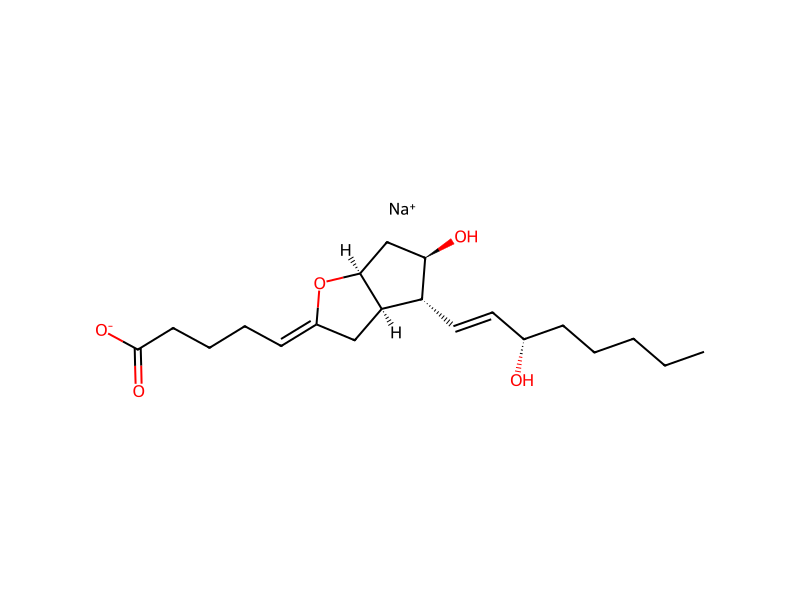
Basic information
- Standard SMILES
CCCCC[C@H](O)/C=C/[C@@H]1[C@H]2C/C(=C/CCCC(=O)[O-])O[C@H]2C[C@H]1O.[Na+]- InChIKey
LMHIPJMTZHDKEW-XQYLJSSYSA-M- Molecular formula
- C20H31NaO5
- Average molar mass
- 374.4 g/mol
- Monoisotopic mass
- 374.20691837
Overview
Epoprostenol Sodium is the sodium salt form of epoprostenol, a synthetic prostacyclin, a member of the family of prostaglandins, with vasodilatory and anticoagulant activity. Epoprostenol sodium directly simulates prostaglandin receptors in arterial vascular smooth muscle, thereby causing vasodilatation. This agent also inhibits platelet aggregation by antagonizing platelet glycoprotein (GP) IIb/IIIa receptors, thereby preventing thrombus formation.
Names & identifiers
- Preferred name
- Epoprostenol Sodium
- IUPAC
- sodium (5Z)-5-[(3aR,4R,5R,6aS)-5-hydroxy-4-[(E,3S)-3-hydroxyoct-1-enyl]-3,3a,4,5,6,6a-hexahydrocyclopenta[b]furan-2-ylidene]pentanoate
Names & synonyms
Epoprostenol sodium61849-14-7Prostacyclin sodium saltCyclo-ProstinSodium prostacyclinDTXSID30466174K04IQ1OF4U-53217AU-53,217ADTXCID1026617Prosta-5,13-dien-1-oic acid, 6,9-epoxy-11,15-dihydroxy-, sodium salt, (5Z,9alpha,11alpha,13E,15S)-RefChem:57240
Show more names
263-273-7Sodium(Z)-(3aR,4R,5R,6aS)-hexahydro-5-hydroxy-4-((E)-(3S)-3-hydroxy-1-octenyl)-2H-cyclopenta(b)furan-delta(sup 2,delta)-valerateFlolanProstacyclin sodiumSodium (Z)-5-((3aR,4R,5R,6aS)-5-hydroxy-4-((S,E)-3-hydroxyoct-1-en-1-yl)hexahydro-2H-cyclopenta[b]furan-2-ylidene)pentanoateC20H31NaO5sodium;(5Z)-5-[(3aR,4R,5R,6aS)-5-hydroxy-4-[(E,3S)-3-hydroxyoct-1-enyl]-3,3a,4,5,6,6a-hexahydrocyclopenta[b]furan-2-ylidene]pentanoateEpoprostenol sodium [USAN:BAN]
Database identifiers
- CAS
61849-14-7- PubChem CID
- 6364626
- DTXSID
DTXSID3046617- ChEMBL
CHEMBL962- UNII
- 4K04IQ1OF4
- EC Number
- 263-273-7
- Nikkaji
- J18.157I
Properties
Computed structural properties
- Topological polar surface area
- 89.8 Ų
- Hydrogen bond donors
- 2
- Hydrogen bond acceptors
- 5
- Rotatable bonds
- 10
- Heavy atoms
- 26
- Formal charge
- 0
- Complexity
- 491
Experimental & physicochemical properties
Human Drugs
FDA approved drugs -> Active ingredient
FDA approved drugs -> Active ingredient
Safety & regulation
GHS classification
GHS Classification
Warning
H302 (97.4%): Harmful if swallowed [Warning Acute toxicity, oral]
P261, P264, P270, P271, P280, P301+P317, P302+P352, P304+P340, P317, P321, P330, P362+P364, and P501 (click each P-code to see the statement)
Aggregated GHS information provided per 39 reports by companies from 2 notifications to the ECHA C&L Inventory. Each notification may be associated with multiple companies.
Hazard information
Hazard Classes and CategoriesAcute Tox. 4 (97.4%)
Toxicology
Drug Induced Liver Injury
Drug Induced Liver Injury Rank (DILIrank 2.0)
Epoprostenol sodium
Ambiguous-DILI-concern
7
Adverse reactions
DOI:10.1016/j.drudis.2016.02.015
Chemistry & industry
Pharmacology
MeSH Pharmacological Classification
Drugs used in the treatment of acute or chronic vascular HYPERTENSION regardless of pharmacological mechanism. Among the antihypertensive agents are DIURETICS; (especially DIURETICS, THIAZIDE); ADRENERGIC BETA-ANTAGONISTS; ADRENERGIC ALPHA-ANTAGONISTS; ANGIOTENSIN-CONVERTING ENZYME INHIBITORS; CALCIUM CHANNEL BLOCKERS; GANGLIONIC BLOCKERS; and VASODILATOR AGENTS.
Drugs or agents which antagonize or impair any mechanism leading to blood platelet aggregation, whether during the phases of activation and shape change or following the dense-granule release reaction and stimulation of the prostaglandin-thromboxane system.
Related reactions
1 records
Linked notes
Loading…