
Cobalt oxide
HCID 6432046
Basic information
- CAS
11104-61-3- Standard SMILES
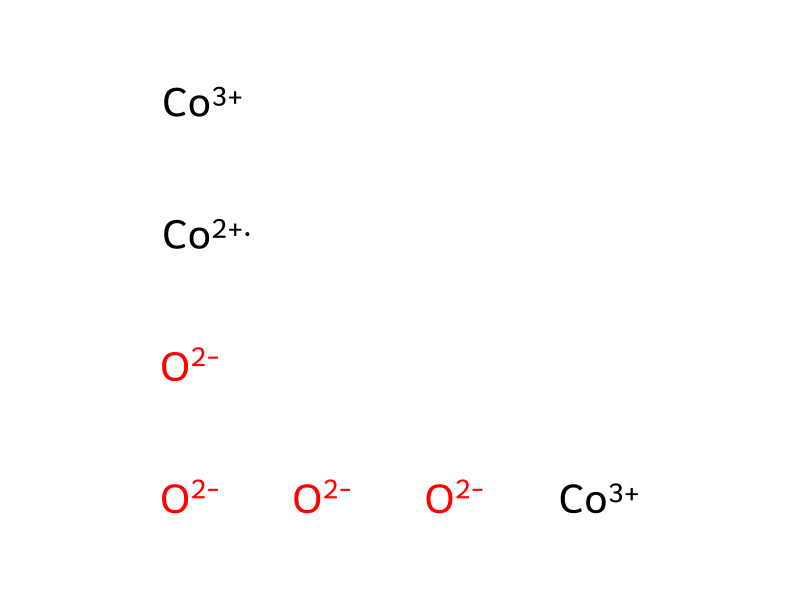
[Co+2].[Co+3].[Co+3].[O-2].[O-2].[O-2].[O-2]- InChIKey
UBEWDCMIDFGDOO-UHFFFAOYSA-N- Molecular formula
- Co3O4
- Average molar mass
- 240.797 g/mol
- Monoisotopic mass
- 240.77924
Overview
Cobalt(II, III) oxide is a mixed valence oxide of cobalt. It is a black antiferromagnetic solid. Cobalt is a metallic element with the atomic number 27. It is found naturally in rocks, soil, water, plants, and animals. In small amounts cobalt is an essential element for life, as it is part of vitamin B12. However, excess exposure is known to exhibit toxic effects. (L29, L30)
Names & identifiers
- Preferred name
- Cobalt oxide
- IUPAC
- cobalt(2+);bis(cobalt(3+));tetrakis(oxygen(2-))
- English name
- Cobalt oxide
- Molecular formula
- CoO
- Molecular weight
- 0
Names & synonyms
Cobalt tetraoxideUSK772NS5611104-61-3234-334-5Co(3)O(4)Cobalt oxideCobaltum OxydatumDTXSID801014561RefChem:58007Tricobalt tetraoxideCobaltic-cobaltous oxidecobalt(2+);cobalt(3+);oxygen(2-)
Show more names
cobalt(2+),oxygen(2-)cobalt(2+),oxygen(2 oxygen(2-)
Cobalt oxide blackoxocobalt; oxo(oxocobaltiooxy)cobaltEINECS 215-157-2Cobalt oxide (II,III)Cobalt (II, III) oxideUNII-USK772NS56COBALT OXIDE [MART.]SCHEMBL5054762
Database identifiers
- CAS
11104-61-3、1308-06-1- PubChem CID
- 6432046
- UNII
- USK772NS56
- EC Number
- 215-157-2、234-334-5
Properties
Computed structural properties
- Topological polar surface area
- 4 Ų
- Hydrogen bond donors
- 0
- Hydrogen bond acceptors
- 4
- Rotatable bonds
- 0
- Heavy atoms
- 7
- Formal charge
- 0
- Complexity
- 0
Experimental & physicochemical properties
SpringerMaterials Propertiesdielectric constant
Food Contact SubstancesFCS -> FDA Inventory of Food Contact Substances Listed in 21 CFR
Physical DescriptionLarge Crystals; Dry Powder
Physicochemical properties
- Indirect Additives used in Food Contact Substances
- COBALT OXIDE
- FDA UNII
- 772 NS56 · USK772NS56
- EPA Substance Registry System
- Cobalt oxide (11104-61-3)
- TSCA
- TSCA listed
Safety & regulation
Safety information is for reference only and does not replace the supplier’s Safety Data Sheet (SDS), applicable regulations, or professional assessment.
GHS classification
GHS Classification
This chemical does not meet GHS hazard criteria for 100% (7 of 7) of all reports.
Not Classified
Aggregated GHS information provided per 7 reports by companies from 1 notifications to the ECHA C&L Inventory.
Danger
H301: Toxic if swallowed [Danger Acute toxicity, oral]
P203, P233, P260, P261, P264, P270, P271, P272, P280, P284, P301+P316, P302+P352, P304+P340, P316, P318, P319, P320, P321, P330, P333+P317, P342+P316, P362+P364, P403, P403+P233, P405, and P501 (click each P-code to see the statement)
Hazard information
Regulatory Information
Chemical: Cobalt oxide
Cobalt oxide is listed on the EPA's Chemical Data Reporting (CDR) system. Manufacturers and importers of Cobalt oxide are required to report information about their production and use of this chemical to the EPA under the Toxic Substances Control Act (TSCA). (40 eCFR Part 711)
Other Safety InformationIMAP assessments - Cobalt oxide: Human health tier II assessment
Hazard Classes and Categories
Not Classified
Specific target organ toxicity (repeated exposure) - category 1
Safety & protection
Minimum Risk LevelChronic Inhalation: 0.0001 mg/m3 (L134)
Intermediate Oral: 0.01 mg/kg/day (L134)
Protective Action Criteria (PAC)
0.082 [mg/m3]
Chemistry & industry
Pharmacology
Metabolism/Metabolites
Cobalt is absorbed though the lungs, gastrointestinal tract, and skin. Since it is a component of the vitamin B12 (cyanocobalamin), it is distributed to most tissues of the body. It is transported in the blood, often bound to albumin, with the highest levels being found in the liver and kidney. Cobalt is excreted mainly in the urine and faeces. (L29)
Uses & manufacturing
UsesNo data.
U.S. Production2023: 468,662 lb
Consumer UsesOther
Industry UsesOther
General Manufacturing Information
Petroleum Refineries
Cobalt oxide: ACTIVE
Applications
UsesCobalt oxide is used in the manufacture of paint pigments, ceramic glazes, and cobalt catalysts, etc.
Related reactions
6 records

HRID 1672081As product

HRID 1672082As product

HRID 1672083As product

HRID 1672084As product

HRID 1672085As product