
HRID 845850As product
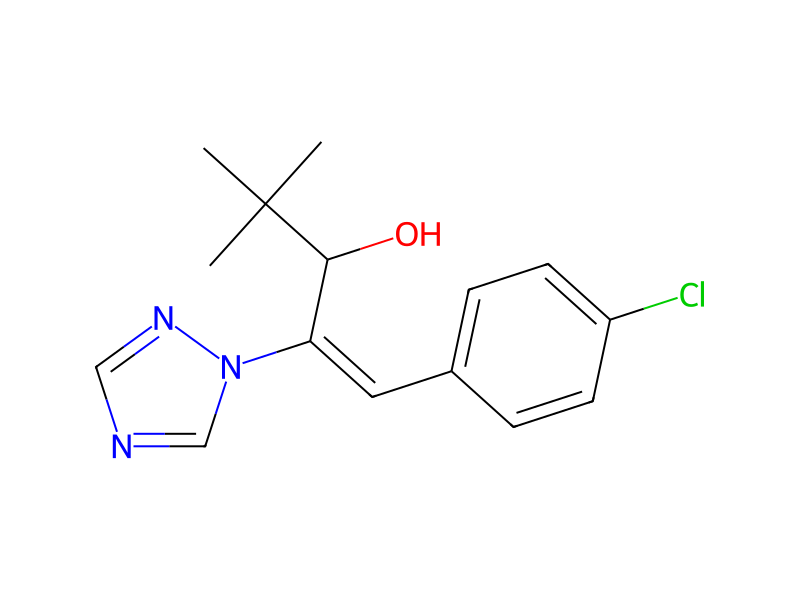
83657-22-1CC(C)(C)C(O)/C(=C\c1ccc(Cl)cc1)n1cncn1YNWVFADWVLCOPU-MDWZMJQESA-N(1E)-1-(4-chlorophenyl)-4,4-dimethyl-2-(1H-1,2,4-triazol-1-yl)pent-1-en-3-ol is a member of the class of triazoles that is 1,2,4-triazole which is substituted at position 1 by a 1-(p-chlorophenyl)-3-hydroxy-4,4-dimethylpent-1-en-2-yl group. It is a secondary alcohol, a member of triazoles and a member of monochlorobenzenes.
Plant Growth Regulators
Active substance -> EU Pesticides database: Not approved
Pesticide (Uniconazole) -> USDA PDB
Safety information is for reference only and does not replace the supplier’s Safety Data Sheet (SDS), applicable regulations, or professional assessment.
Warning
H302 (100%): Harmful if swallowed [Warning Acute toxicity, oral]
P264, P270, P301+P317, P330, and P501 (click each P-code to see the statement)
Aggregated GHS information provided per 40 reports by companies from 2 notifications to the ECHA C&L Inventory.
DescriptionUniconazole is a plant growth regulator. It has a low water solubility, is quite volatile and there is also a slight risk of leaching to groundwater. It can be persistent in both soil and aquatic systems. It is moderately toxic to mammals but would not be expected to bioaccumulate. It shows a moderate level of toxicity to most aquatic species honeybees, earthworms and birds.
UsesUniconazole is a plant growth regulator, absorbed by the stems and roots. Uniconazole is used to reduce lodging in rice; to reduce vegetative growth and increase flowering of ornamentals; and to reduce vegetative growth and the need for pruning in trees. Uniconazole is an insecticide.
DefinitionChEBI: (1E)-1-(4-chlorophenyl)-4,4-dimethyl-2-(1H-1,2,4-triazol-1-yl)pent-1-en-3-ol is a member of the class of triazoles that is 1,2,4-triazole which is substituted at position 1 by a 1-(p-chlorophenyl)-3-hydroxy-4,4-dimethylpent-1-en-2-yl group. It is a member of monochlorobenzenes, a secondary alcohol and a member of triazoles.


83657-22-1DTXSID7032505CHEMBL138177CHEBI:86428