Reactants or products are incomplete; the equation cannot be generated
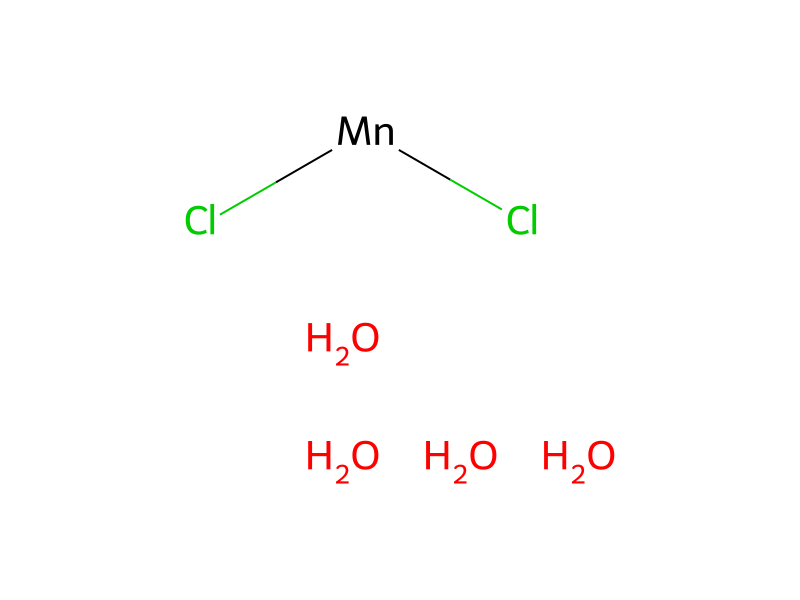
Basic information
- CAS
13446-34-9- Standard SMILES
O.O.O.O.[Cl][Mn][Cl]- InChIKey
CNFDGXZLMLFIJV-UHFFFAOYSA-L- Molecular formula
- Cl2H8MnO4
- Average molar mass
- 197.9 g/mol
- Monoisotopic mass
- 196.918007
Names & identifiers
- Preferred name
- Manganese Chloride Tetrahydrate
- IUPAC
- dichloromanganese;tetrahydrate
- English name
- Manganese chloride tetrahydrate
- Molecular formula
- Cl2H2MnO
- Molecular weight
- 143.85
Names & synonyms
Manganese chloride tetrahydrateLumenhanceManganous chloride tetrahydrateManganese(2+) chloride tetrahydratemanganese chloride, tetrahydrateManganese chloride (USP)Manganese chloride in plastic containerCHEBI:86368DTXSID00858866MANGANESE(II) CHLORIDE, TETRAHYDRATEManganese chloride [USP]RefChem:55546
Show more names
MnClMANGANOUS CHLORIDEMANGANESE (II) CHLORIDEMANGANESE CHLORIDE TETRAHYDRATE INSEanese(Ⅱ) chLManganese(Ⅱ) chLdichloromanganeseoride tetrahydrateManganeseChlorideAr
DTXCID70809608603-826-513446-34-9Manganese dichloride tetrahydratemanganese(II) chloride tetrahydratedichloromanganese;tetrahydrateManganese chloride (MnCl2), tetrahydrateLumenhance (TN)
Database identifiers
- CAS
13446-34-9- PubChem CID
- 643989
- DTXSID
DTXSID00858866- ChEBI
CHEBI:86368- EC Number
- 603-826-5
Properties
Computed structural properties
- Topological polar surface area
- 4 Ų
- Hydrogen bond donors
- 4
- Hydrogen bond acceptors
- 4
- Rotatable bonds
- 0
- Heavy atoms
- 7
- Formal charge
- 0
- Complexity
- 2
Experimental & physicochemical properties
Density2.01 @25 °C
Melting Point58 °C
Physical DescriptionReddish solid; Slightly deliquescent; [Merck Index] Light red crystalline solid; [Aldrich MSDS]
Physicochemical properties
- Melting point
- 58 °C · 58 °C(lit.)
- Boiling point
- 1190 °C · 1190 °C
- Density
- 2 · 2,01 g/cm3
- bulk density
- 1150 kg/m3 · 1150kg/m3
- storage temp.
- 5 °C · Store at +5°C to +30°C.
- solubility
- 2 O: · H2O: 0.5 M at 20 °C, clear, colorless
- form
- Solid
- color
- Red
- Specific Gravity
- 2.01 · 2.01
- PH
- 3.5 · 3.5-6 (50g/l, H2O, 25℃)
- PH Range
- 4 · 4 - 6
- Odor Threshold
- Odorless
- Water Solubility
- 1980 g/L · 1980 g/L (20 ºC)
- Sensitive
- Hygroscopic
- λmax
- 260 nm · λ: 260 nm Amax: 0.01λ: 280 nm Amax: 0.01
- Merck
- 14 · 14,5728
- Exposure limits
- 0.02 mg/m3; · ACGIH: TWA 0.02 mg/m3; TWA 0.1 mg/m3OSHA: Ceiling 5 mg/m3NIOSH: IDLH 500 mg/m3; TWA 1 mg/m3; STEL 3 mg/m3
- Stability
- Stable. Incompatible with moisture, strong acids, sodium, potassium, zinc.
- InChI
- 1S/2ClH.Mn.4H2O/h2*1H;;4*1H2/q;;+2;;;;/p-2
- InChIKey
- CNFDGXZLMLFIJV-UHFFFAOYSA-L
- SMILES
- Cl[Mn]Cl.[H]O[H].[H]O[H].[H]O[H].[H]O[H]
- LogP
- -1.38 · -1.380 (est)
- CAS DataBase Reference
- 13446 · 13446-34-9(CAS DataBase Reference)
- Substances Added to Food (formerly EAFUS)
- MANGANESE CHLORIDE
- FDA UNII
- 170 PANO · QQE170PANO
- EPA Substance Registry System
- Manganese chloride (MnCl2), tetrahydrate (13446-34-9)
- UNSPSC Code
- 41116107 · 41116107
- NACRES
- 24 · NB.24
- Symbol(GHS)
- 5 · GHS05,GHS06,GHS08
- Signal word
- Danger
- Hazard statements
- 301 · H301-H318-H373
- Precautionary statements
- 260 · P260-P264-P280-P301+P310-P305+P351+P338-P314
- target organs
- Brain
- Hazard Codes
- Xn,Xi
- Risk Statements
- 22 · 22-52-48/22
- Safety Statements
- 61 · 61-45-24/25
- RIDADR
- 3077 · UN 3077 9 / PGIII
- WGK Germany
- 1 · 1
- RTECS
- 9650000 · OO9650000
- F
- 3 · 3
- TSCA
- Yes
- HS Code
- 2827 · 2827 39 85
- HazardClass
- 6.1 · 6.1
- PackingGroup
- III
- Storage Class
- 6.1 D · 6.1D - Non-combustible acute toxic Cat.3toxic hazardous materials or hazardous materials causing chronic effects
- Hazard Classifications
- 3 OralEye · Acute Tox. 3 OralEye Dam. 1STOT RE 2
- Toxicity
- 50 in · LD 50 in rats (mmole/kg): 7.5 orally; 0.70 i.p. (Holbrook)
- Limited Quantities
- 5 kg · 5.0 kg (11 lbs) (solid)
- Excepted Quantities
- Max Inner Pack (30g or 30ml) and Max Outer Pack (1Kg or 1L)
Safety & regulation
GHS classification
GHS Classification
This chemical does not meet GHS hazard criteria for 3.2% (5 of 158) of reports.
Danger
H301 (15.2%): Toxic if swallowed [Danger Acute toxicity, oral];H302 (81.6%): Harmful if swallowed [Warning Acute toxicity, oral];H318 (33.5%): Causes serious eye damage [Danger Serious eye damage/eye irritation];H319 (22.8%): Causes serious eye irritation [Warning Serious eye damage/eye irritation];H373 (32.9%): May causes damage to organs through prolonged or repeated exposure [Warning Specific target organ toxicity, repeated exposure];H411 (43%): Toxic to aquatic life with long lasting effects [Hazardous to the aquatic environment, long-term hazard]
P260, P264, P264+P265, P270, P273, P280, P301+P316, P301+P317, P305+P351+P338, P305+P354+P338, P317, P319, P321, P330, P337+P317, P391, P405, and P501 (click each P-code to see the statement)
Aggregated GHS information provided per 158 reports by companies from 12 notifications to the ECHA C&L Inventory. Each notification may be associated with multiple companies.;Reported as not meeting GHS hazard criteria per 5 of 158 reports by companies.;There are 11 notifications provided by 153 of 158 reports by companies with hazard statement code(s).;Information may vary between notifications depending on impurities, additives, and other factors. The percentage value in parenthesis indicates the notified classification ratio from companies that provide hazard codes. Only hazard codes with percentage values above 10% are shown. For more detailed information, please visit ECHA C&L website.
Hazard information
Regulatory Information
Chemical: Manganese chloride (MnCl2), tetrahydrate
Regulation (EC) No 1831/2003 (amended)
Manganese (II) chloride, tetrahydrate: Does not have an individual approval but may be used under an appropriate group standard
Other Safety InformationIMAP assessments - Soluble manganese compounds: Human health tier II assessment
Hazards Summary
Causes changes in liver, surface EEG, and recordings from peripheral motor nerves in intraperitoneal toxic-dose studies of rats; Causes degenerative changes of brain and effects on dopamine in striatum and spermatogenesis in repeated oral studies of rats; [RTECS] May cause irritation; Harmful by ingestion and skin absorption; Targets CNS and lungs; [Aldrich MSDS] See Manganese and linked occupational diseases.
Hazard Classes and Categories
Acute Tox. 3 (15.2%);Acute Tox. 4 (81.6%);Eye Dam. 1 (33.5%);Eye Irrit. 2 (22.8%);STOT RE 2 (32.9%);Aquatic Chronic 2 (43%)
Acute toxicity (ingestion) - category 4;Eye damage - category 1;Specific target organ toxicity (repeated exposure) - category 1
Acute toxicity (Oral) - Category 4;Reproductive toxicity - Category 2;Specific target organ toxicity - Repeated exposure - Category 1 (nervous system, respiratory organs);Hazardous to the aquatic environment (Acute) - Category 3;Hazardous to the aquatic environment (Long-term) - Category 2
Safety & protection
Exposure Control and Personal Protection0.2 [mg/m3], as Mn (inhalable fraction), 0.02 mg/m3, as Mn (respirable fraction)[German Research Foundation (DFG)]
Threshold Limit Values (TLV)0.02 [mg/m3], as Mn (respirable fraction), 0.1 mg/m3, as Mn (inhalable fraction)
Protective Action Criteria (PAC)
11 [mg/m3]
18 [mg/m3]
290 [mg/m3]
Toxicology
Adverse EffectsNeurotoxin - Parkinsonism
Regulatory information
Regulatory Information
Chemical: Manganese chloride (MnCl2), tetrahydrate
Regulation (EC) No 1831/2003 (amended)
Manganese (II) chloride, tetrahydrate: Does not have an individual approval but may be used under an appropriate group standard
Safety data
- F
- 3
- wgk
- 1
- tsca
- Yes
- rtecs
- OO9650000
- ridadr
- UN 3077 9 / PGIII
- hs_code
- 2827 39 85
- Toxicity
- LD 50 in rats (mmole/kg): 7.5 orally; 0.70 i.p. (Holbrook)
- risk_code
- 22-52-48/22
- Signal word
- Danger
- Symbol(GHS)
- GHS05,GHS06,GHS08
- hazard_code
- Xn,Xi
- safety_code
- 61-45-24/25
- hazard_class
- 6.1
- Storage Class
- 6.1D - Non-combustible acute toxic Cat.3toxic hazardous materials or hazardous materials causing chronic effects
- packing_group
- III
- target organs
- Brain
- Hazard statements
- H301-H318-H373
- Limited Quantities
- 5.0 kg (11 lbs) (solid)
- Excepted Quantities
- Max Inner Pack (30g or 30ml) and Max Outer Pack (1Kg or 1L)
- Hazard Classifications
- Acute Tox. 3 OralEye Dam. 1STOT RE 2
- Precautionary statements
- P260-P264-P280-P301+P310-P305+P351+P338-P314
Chemistry & industry
Uses & manufacturing
Uses
Used in dyeing, disinfecting, and purifying natural gas; Also used to make linseed oil (dryer) and batteries; [Merck Index] Used as nutrient supplement; [ExPub: FDA]
Petroleum Production and Refining [Category: Industry];Battery Manufacturing [Category: Industry];Using Disinfectants or Biocides [Category: Clean];Textiles (Printing, Dyeing, or Finishing) [Category: Industry]
Applications
UsesManganese Chloride Tetrahydrate is an inorganic chemical reagent used in oxidation studies and reactions.
UsesManganese chloride tetrahydrate is a useful agent to detect phospholipid vesicles.
UsesIn dyeing (manganese bister); disinfecting; purifying natural gas; linseed oil drier; in electric batteries.
General DescriptionManganese(II) chloride tetrahydrate is a hydrated metal chloride.3 Its toxicity in Swiss mice has been assessed. It participates in the preparation of metal(II) complexes of mixed ligands-dimethydithiocarbamic and p-aminobenzoic acids.3
Upstream & downstream products
Upstream raw materials
Suppliers100 total
国药集团化学试剂有限公司86-21-63210123 · [email protected]
梯希爱(上海)化成工业发展有限公司021-67121386 · [email protected]
上海阿拉丁生化科技股份有限公司400-6206333 13167063860 · [email protected]
合肥翰刚医药科技有限公司+8618062405514 · [email protected]
武汉欣扬瑞和化学科技有限公司153-07155313 15307155313 · [email protected]
Baoji Guokang Healthchem co.,ltd+8615604608665 15604608665 · [email protected]
Hebei Henghe Import and Export Trading Co. LTD+8618032935937 18032916000 · [email protected]
Dayang Chem (Hangzhou) Co.,Ltd.+86-0571-88938639 17705817739 · [email protected]
上海弘顺生物科技有限公司15901914505 · [email protected]
韶远科技(上海)有限公司021-50795510 4000665055 · [email protected]
上海迈瑞尔生化科技有限公司4006356688 18621169109 · [email protected]
上海晶抗生物工程有限公司021-54721350 13524668266 · [email protected]
天津中信凯泰化工有限公司022-66880623 · [email protected]
阿法埃莎(中国)化学有限公司400-6106006 · [email protected]
安耐吉化学&3A(安徽泽升科技股份有限公司)400-0056266 · [email protected]
北京绿百草科技发展有限公司010-61136123 · [email protected]
上海瀚鸿科技股份有限公司021-54306202 13764082696 · [email protected]
上海泰坦科技股份有限公司400-6009262 15618770481 · [email protected]
天津金汇太亚化学试剂有限公司022-59582624 18622766592 · [email protected]
山东亿来新材料科技发展有限公司13296445501 · [email protected]
山东西亚化学有限公司13355009207 13355009207 · [email protected]
玛雅试剂+86 (573) 82222445 (0)18006601000 452520369 · [email protected]
天津希恩思生化科技有限公司400 638 7771 · [email protected]
Xiamen AmoyChem Co., Ltd+86-86-5926051114 · [email protected]
湖南汇百侍生物科技有限公司0731-85526065 13308475853 · [email protected]
南京化学试剂股份有限公司025-58369808 17895012682 · [email protected]
武汉吉业升化工有限公司027-13545242311 13545242311 · [email protected]
斯百全化学(上海)有限公司021-021-021-67601398-809-809-809 15221380277 · [email protected]
上海源叶生物科技有限公司13636370518 · [email protected]
艾科试剂4008-755-333 18080918076 · [email protected]
上海思域化工科技有限公司86-21-34053660 · [email protected]
赛默飞世尔科技(中国)有限公司800-810-5118 · [email protected]
TCI AMERICA800-4238616 · [email protected]
TOKYO CHEMICAL INDUSTRY CO., LTD.03-36680489 · [email protected]
TCI Europe320-37350700 · [email protected]
淄博爱肯新材料科技有限公司0533-4915568 18653327685 · [email protected]
HBCChem, Inc.+1-510-219-6317 · [email protected]
郑州鸿晟医药科技有限公司0371-0371-13526885213 15637198702 · [email protected]
上海创赛科技有限公司400-6087598 15021221957 · [email protected]
上海麦克林生化科技股份有限公司15221275939 15221275939 · [email protected]
杭州杰恒化工有限公司0571-87396432 · [email protected]
上海兴鲁化工科技有限公司02120970332 · [email protected]
湖北巨胜科技有限公司027-59599241 18871490274 · [email protected]
池州凯隆进出口贸易有限公司[email protected]
Sigma-Aldrich西格玛奥德里奇(上海)贸易有限公司021-61415566 800-8193336 · [email protected]
桦特昇生物科技(武汉)有限公司027-59207879 1972026995 18140587686 · [email protected]
九鼎化学(上海)科技有限公司4009209199 · [email protected]
Henan Alfa Chemical Co., Ltd+8618339805032 · [email protected]
厦门志信化学有限公司+86-5922680277 +86-13806087780 · [email protected]
廊坊乾耀科技有限公司0316-2132008 19932680339 · [email protected]
Related reactions
1 records
Compound notes
Loading…