HomeMCPWorkbenchSkills
HomeWorkbenchNotificationsMe
llms.txt · MCP GuidePrivacy Policy · Terms of Service · Supportv1.8.3
  1. Home
  2. /Compound

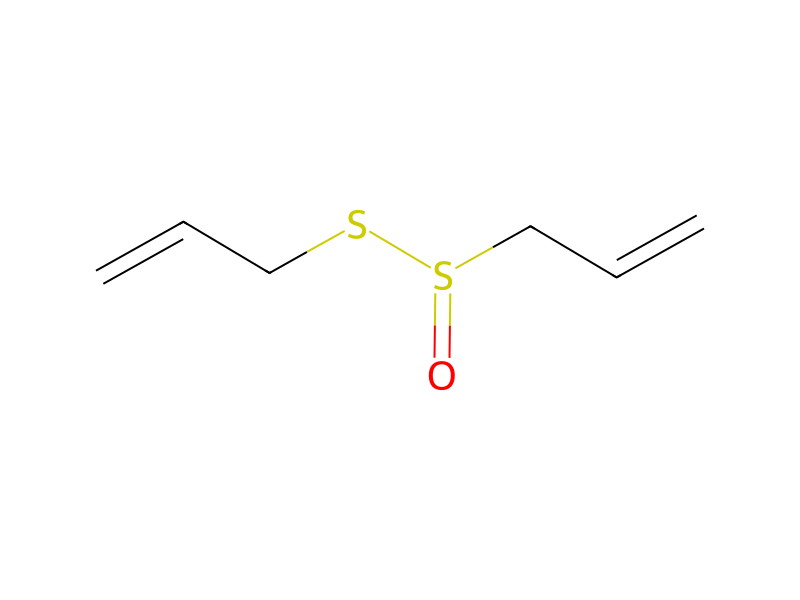
Allicin

HCID 65036
New reaction
Print
Basic informationOverviewNames & identifiersPropertiesSafety & regulationChemistry & industryRelated reactionsCompound notes
Substructure searchFind similar structures

Basic information

CAS
539-86-6
Standard SMILES
C=CCSS(=O)CC=C
InChIKey
JDLKFOPOAOFWQN-UHFFFAOYSA-N
Molecular formula
C6H10OS2
Average molar mass
162.3 g/mol
Monoisotopic mass
162.01730729

Overview

Allicin is a sulfoxide and a botanical anti-fungal agent. It has a role as an antibacterial agent.

Names & identifiers

Preferred name
Allicin
IUPAC
3-prop-2-enylsulfinylsulfanylprop-1-ene
English name
Allicin
Molecular formula
C6H10OS2
Molecular weight
162.27

Names & synonyms

Allicin539-86-6Diallyl thiosulfinateThio-2-propene-1-sulfinic acid S-allyl esterAllylthiosulphinic acid allyl ester3-prop-2-enylsulfinylsulfanylprop-1-ene2-Propene-1-sulfinothioic acid S-2-propenyl esterDTXSID60437073C39BY17Y63-[(prop-2-ene-1-sulfinyl)sulfanyl]prop-1-eneCHEBI:284113-((prop-2-ene-1-sulfinyl)sulfanyl)prop-1-ene
Show more names
Allitridgarlic mealAlliMedalliosanC6H10S2OAllisatinARICINE(P)ALLICIN(SH)Allicin 10%
RefChem:5523DTXCID4023707208-727-7S-allyl prop-2-ene-1-sulfinothioateDiallyldisulfid-S-oxid2-Propene-1-sulfinothioic acid, S-2-propenyl esterC6H10OS2DADSO

Database identifiers

CAS
539-86-6
PubChem CID
65036
DTXSID
DTXSID6043707
ChEMBL
CHEMBL359965
ChEBI
CHEBI:28411
UNII
3C39BY17Y6
EC Number
208-727-7
Nikkaji
J71.032F、J816.011B

Properties

Computed structural properties

XLogP
1.3
Topological polar surface area
61.6 Ų
Hydrogen bond donors
0
Hydrogen bond acceptors
3
Rotatable bonds
5
Heavy atoms
9
Formal charge
0
Complexity
120

Experimental & physicochemical properties

Solubility24 mg/mL at 10 °C
Melting Point25 °C
Physical DescriptionSolid

Physicochemical properties

Melting point
25 °C · < 25 °C (77 °F; 298 K)
Boiling point
decomposes
Density
1.112 g · 1.112 g cm−3
refractive index
20 · nD20 1.561
storage temp.
4 °C, · 4°C, away from moisture and light
solubility
5 mg/mL · DMSO : 5 mg/mL (30.81 mM; Need ultrasonic)H2O : < 0.1 mg/mL (insoluble)
form
liquid
color
Colourless
Water Solubility
24 g/L · 24g/L(10 ºC)
InChI
InChI=1S/C6H10OS2/c1-3-5-8-9(7)6-4-2/h3-4H,1-2,5-6H2

Safety & regulation

Safety information is for reference only and does not replace the supplier’s Safety Data Sheet (SDS), applicable regulations, or professional assessment.

GHS classification

GHS Classification · 4 items

Warning

H315 (100%): Causes skin irritation [Warning Skin corrosion/irritation]

P261, P264, P264+P265, P271, P280, P302+P352, P304+P340, P305+P351+P338, P319, P321, P332+P317, P337+P317, P362+P364, P403+P233, P405, and P501 (click each P-code to see the statement)

Aggregated GHS information provided per 39 reports by companies from 2 notifications to the ECHA C&L Inventory. Each notification may be associated with multiple companies.

Hazard information

Hazard Classes and CategoriesSkin Irrit. 2 (100%)

Safety data

hs_code
2932999099
Toxicity
LD50 in mice (mg/kg): 60 i.v.; 120 s.c. (Cavallito, Bailey)
Signal word
Warning
Symbol(GHS)
GHS07
Hazard statements
H315-H319-H335
Precautionary statements
P264-P280-P305+P351+P338-P337+P313P-P264-P280-P302+P352-P321-P332+P313-P362

Chemistry & industry

Pharmacology

Metabolism/MetabolitesDADSO is a known human metabolite of diallyl disulfide.
MeSH Pharmacological Classification · 5 items

Substances that prevent infectious agents or organisms from spreading or kill infectious agents in order to prevent the spread of infection.

Substances that lower the levels of certain LIPIDS in the BLOOD. They are used to treat HYPERLIPIDEMIAS.

Naturally occurring or synthetic substances that inhibit or retard oxidation reactions. They counteract the damaging effects of oxidation in animal tissues.

Substances which lower blood glucose levels.

Substances that eliminate free radicals. Among other effects, they protect PANCREATIC ISLETS against damage by CYTOKINES and prevent myocardial and pulmonary REPERFUSION INJURY.

Cellular LocationsCytoplasm
Applications · 4 items

DescriptionAllicin is one of the major allergens in garlic (Allium sativum L.). It is responsible of the characteristical fiavour of the bulbs.

DescriptionAllicin is a natural product originally isolated from A. sativum that has wide-ranging biological effects including antioxidative, anticancer, antimicrobial, and antifungal activities. It inhibits the cysteine proteases cathepsin B and L, facipain 2, and rhodesain with Ki values of 8.6 and 9.3, 1.04, and 5.31 μM, respectively. It shows antiparasitic activity against P. falciparum (IC50 = 5.2 μM) and T. b. brucei (IC50 = 13.8 μM), the parasites that cause malaria and African sleeping sickness, respectively. Allicin (5-10 μM) dose-dependently inhibits cell adhesion, invasion, and migration in various lung adenocarcinoma cell lines. It also alters the balance of tissue inhibitors of matrix metalloproteinases (TIMPs) and matrix metalloproteinases (MMPs), decreases phosphorylation of Akt, and decreases PI3K/Akt signaling.

HistoryAs the main active substance of garlic, garlic was separated by Cavallito and Bailey in 1944 from crushed garlic. Cavallito firstly clarified the physical properties and chemical structure of the scent of garlic.Fresh garlic does not contain free allicin but only its precursor material alliin. When the garlic undergoes physical mechanical crushing, garlic alliinase is activated and catalyzes the breakdown of alliin into allicin.The reported preparation methods of allicin contain extraction, biosynthesis, and chemical synthesis. Chemical synthesis starts from raw material of diallyldisulfides, m-chloroperoxy benzoic acid to get crude allicin. According to the United States patent report, biosynthesis preparation of allicin comes from natural sources or synthetic, after it is made into a certain concentration of aqueous solution, it is converted into allicin by reaction with alliinase. Extraction of allicin with low boiling nonpolar solvent can acquire pure allicin, but it must be stored at 70°C to prevent from decomposing.

Related reactions

5 records
New reaction record
HRID 349158 reaction equation
HRID 349158As product
HRID 349159 reaction equation
HRID 349159As product
HRID 349160 reaction equation
HRID 349160As reactant
HRID 468086 reaction equation
HRID 468086As product
HRID 1514802 reaction equation
HRID 1514802As product

Compound notes

On this pageBasic informationOverviewNames & identifiersPropertiesSafety & regulationChemistry & industryRelated reactionsCompound notes
InChIKey
JDLKFOPOAOFWQN-UHFFFAOYSA-N
SMILES
C(S(SCC=C)=O)C=C
LogP
1.133 · 1.133 (est)
FDA UNII
3 C39BY17Y6 · 3C39BY17Y6
Comptox DTXSID
6043707 · DTXSID6043707
Symbol(GHS)
7 · GHS07
Signal word
Warning
Hazard statements
315 · H315-H319-H335
Precautionary statements
264 · P264-P280-P305+P351+P338-P337+P313P-P264-P280-P302+P352-P321-P332+P313-P362
HS Code
2932999099 · 2932999099
Toxicity
50 in · LD50 in mice (mg/kg): 60 i.v.; 120 s.c. (Cavallito, Bailey)

UsesAllicin is naturally formed by the action of the enzyme allicinase on alliin when the tissue of the garlic bulb is disrupted. Allicin shows antibacterial activity.

Upstream & downstream products

Upstream raw materials

Garlic P.ESodium thiosulfateSodium thiosulfate pentahydrate

Downstream products

Allyl mercaptan

Additional notes

DefinitionAn antibacterial substance extracted from garlic (allium).