Basic information
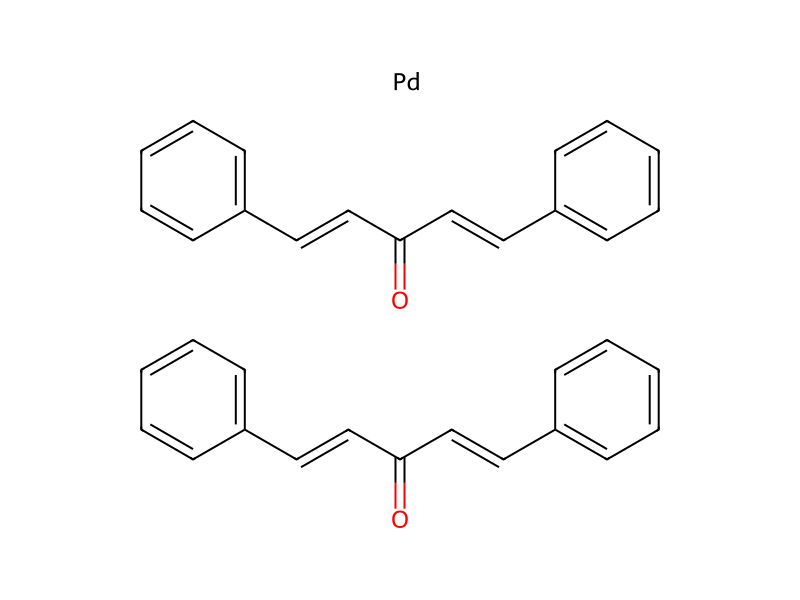
- Standard SMILES
O=C(/C=C/c1ccccc1)/C=C/c1ccccc1.O=C(/C=C/c1ccccc1)/C=C/c1ccccc1.[Pd]- InChIKey
UKSZBOKPHAQOMP-SVLSSHOZSA-N- Molecular formula
- C34H28O2Pd
- Average molar mass
- 575 g/mol
- Monoisotopic mass
- 574.11241
Names & identifiers
- Preferred name
- (1E,4E)-1,5-diphenylpenta-1,4-dien-3-one; palladium
- IUPAC
- bis((1E,4E)-1,5-diphenylpenta-1,4-dien-3-one);palladium
- English name
- Tris(dibenzylideneacetone)dipalladium
- Molecular formula
- C51H42O3Pd2
- Molecular weight
- 915.71738
Names & synonyms
52409-22-0(1E,4E)-1,5-diphenylpenta-1,4-dien-3-one; PalladiumRefChem:392699620-687-632005-36-0Bis(dibenzylideneacetone)palladium(0)PD(DBA)2MFCD00051942(1E,4E)-Bis(dibenzylideneacetone)palladiumC34H28O2Pd190385-99-0Bis(dibenzylideneacetone)palladium (Technical Grade)
Show more names
Pd(dba)3PALLADIUM(0) BIS(DIBENZYLIDENEACETONE)Bis(dibenzylideneacetone)dipalladiumTris(dibenzylideneacetone)diplalladium(I)tris(dibenzylideneacetone)dipalladium(o)(pd2(dba)3)Tris(dibenzylideneacetoneTris(dibenzylideneacetone)dipalladiumBIS(DIBENZYLIDENEACETONE) PALLADIUM(0)Tris(dibenzilideneacetone)dipalladium(0)
60748-47-2TRIS(DIBENZYLIDENEACETONE)DIPALLADIUM(O)SCHEMBL2438441bis(dibenzylideneactone)palladiumbis (dibenzylideneacetone)palladiumbis(dibenzylidene acetone)palladiumbis(dibenzylidene-acetone)palladiumbis(dibenzylideneacetone)-palladium
Database identifiers
- CAS
52409-22-0- PubChem CID
- 6505921
- EC Number
- 620-687-6
Properties
Computed structural properties
- Topological polar surface area
- 34.1 Ų
- Hydrogen bond donors
- 0
- Hydrogen bond acceptors
- 2
- Rotatable bonds
- 8
- Heavy atoms
- 37
- Formal charge
- 0
- Complexity
- 272
Physicochemical properties
- Melting point
- 152 · 152-155 °C(lit.)
- storage temp.
- 2 · Keep in dark place,Inert atmosphere,2-8°C
- InChI
- InChI=1S/2C17H14O.Pd/c2*18-17(13-11-15-7-3-1-4-8-15)14-12-16-9-5-2-6-10-16;/h2*1-14H;/b2*13-11+,14-12+;
- InChIKey
- UKSZBOKPHAQOMP-SVLSSHOZSA-N
- SMILES
- [Pd].C(=C/C1=CC=CC=C1)\C(/C=C/C1=CC=CC=C1)=O.C(=C/C1=CC=CC=C1)\C(/C=C/C1=CC=CC=C1)=O
- CAS DataBase Reference
- 52409 · 52409-22-0(CAS DataBase Reference)
- Symbol(GHS)
- 7 · GHS07
- Signal word
- Warning
- Hazard statements
- 302 · H302-H332
- Precautionary statements
- 261 · P261-P271-P304+P340-P312-P264-P270-P301+P312-P330-P501
- Hazard Codes
- Xi
- Risk Statements
- 36 · 36/38
- Safety Statements
- 22 · 22-24/25
- WGK Germany
- 3 · 3
Safety & regulation
GHS classification
GHS Classification
Danger
H228 (50%): Flammable solid [Danger Flammable solids];H302 (75%): Harmful if swallowed [Warning Acute toxicity, oral];H312 (25%): Harmful in contact with skin [Warning Acute toxicity, dermal];H315 (25%): Causes skin irritation [Warning Skin corrosion/irritation];H319 (25%): Causes serious eye irritation [Warning Serious eye damage/eye irritation];H332 (75%): Harmful if inhaled [Warning Acute toxicity, inhalation]
P210, P240, P241, P261, P264, P264+P265, P270, P271, P280, P301+P317, P302+P352, P304+P340, P305+P351+P338, P317, P321, P330, P332+P317, P337+P317, P362+P364, P370+P378, and P501 (click each P-code to see the statement)
Aggregated GHS information provided per 4 reports by companies from 3 notifications to the ECHA C&L Inventory. Each notification may be associated with multiple companies.;Information may vary between notifications depending on impurities, additives, and other factors. The percentage value in parenthesis indicates the notified classification ratio from companies that provide hazard codes. Only hazard codes with percentage values above 10% are shown. For more detailed information, please visit ECHA C&L website.
Hazard information
Hazard Classes and CategoriesFlam. Sol. 1 (50%);Acute Tox. 4 (75%);Acute Tox. 4 (25%);Skin Irrit. 2 (25%);Eye Irrit. 2 (25%);Acute Tox. 4 (75%)
Toxicology
Health EffectsContact with palladium may cause palladium sensitivity and allergy. Animal studies have shown that palladium may damage the liver and kidney. (L798)
Toxicity Summary
Due to their ability to form strong complexes with both inorganic and organic ligands, palladium ions can disturb cellular equilibria, replace other essential ions, and interact with functional groups of macromolecules, such as proteins or DNA. Palladium complexes binding to DNA and RNA leads to strand breakage. Palladium ions are able to inhibit most major cellular functions, including DNA and RNA synthesis. Palladium compounds have been shown to bind to and inhibit various enzymes, including creatine kinase and prolyl hydroxylase. (L798)
Signs and SymptomsSkin contact with palladium may cause contact dermatitis, erythema, and oedema. (L798)
Carcinogen ClassificationNo indication of carcinogenicity to humans (not listed by IARC).
Safety data
- wgk
- 3
- risk_code
- 36/38
- Signal word
- Warning
- Symbol(GHS)
- GHS07
- hazard_code
- Xi
- safety_code
- 22-24/25
- Hazard statements
- H302-H332
- Precautionary statements
- P261-P271-P304+P340-P312-P264-P270-P301+P312-P330-P501
Chemistry & industry
Pharmacology
Metabolism/Metabolites
Palladium may be absorbed through oral, dermal, and inhalation exposure. Once in the body it distributes to the kidney, liver, spleen, lymph nodes, adrenal gland, lung and bone. Palladium's ability to form complexes allows it the bind to amino acids, proteins, DNA, and other macromolecules. Palladium and its metabolites are excreted in the urine and faeces. (A21)
Applications
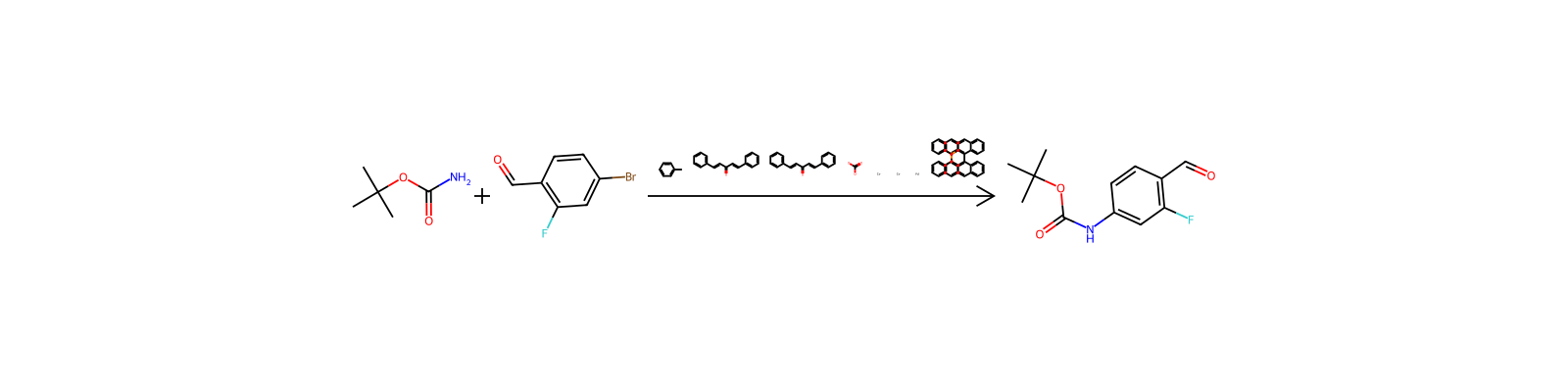
UsesTris(dibenzylideneacetone)dipalladium is used as a source of soluble Pd(0), in particular as a catalyst for various coupling reactions. Examples of reactions using this reagent are the Negishi coupling, Suzuki coupling, Carroll rearrangement, and Trost asymmetric allylic alkylation, as well as Buchwald–Hartwig amination
Suppliers50 total
北京华美互利生物化工010-56205725 · [email protected]
VladaChem GmbH+49-7246-3082843 +86-18411632868 · [email protected]
Dayang Chem (Hangzhou) Co.,Ltd.+86-0571-88938639 17705817739 · [email protected]
武汉华瀚鼎诚新材料科技有限公司027-81388558 18963961905 · [email protected]
毕佳索(上海毕得医药科技股份有限公司)400-6005915 · [email protected]
郑州德元凯化工有限公司17837139533 · [email protected]
上海迈瑞尔生化科技有限公司4006356688 18621169109 · [email protected]
宁波亿诺化学品有限公司86-574-27787657 · [email protected]
安耐吉化学&3A(安徽泽升科技有限公司)021-58432009 400-005-6266 · [email protected]
武汉凯威斯科技有限公司86-027-67849912 · [email protected]
北京亿思研科技开发中心010-56645598 13366904824 · [email protected]
上海瀚鸿科技股份有限公司021-54306202 13764082696 · [email protected]
湖北魏氏化学试剂股份有限公司027-59102966 18717199209 · [email protected]
上海钰康生物科技有限公司+86-18930848214 +86-021-56762820 · [email protected]
上海景颜化工科技有限公司13817811078 · [email protected]
湖北魏氏化学试剂股份有限公司17771898297 13125137661 · [email protected]
上海健超生物科技有限公司15021035486 18081542813 · [email protected]
上海楷石化工有限公司021-50273253 13641951838 · [email protected]
南京维奥化工有限公司Please Send Email 18652950785 · [email protected]
金克隆(北京)生物技术有限公司400-910-1997 15330005590 · [email protected]
深圳法默科技有限公司0755-86648230 · [email protected]
苏州思变化学技术有限公司0512-65617459 18915409046 · [email protected]
成都麦卡希化工有限公司028-85632863 18108198598 · [email protected]
北京格林凯默科技有限公司131-21959385 18804271668 · [email protected]
南京圣赛化工有限公司025-85205967 13951876367 · [email protected]
HBCChem, Inc.+1-510-219-6317 · [email protected]
北京国方鼎盛科技有限公司18610472091 · [email protected]
上海石洋化工有限公司021-56795766 · [email protected]
陕西缔都医药化工有限公司+86-029-81138252 +86-173 9270 1263 · [email protected]
上海御略医药科技有限公司021-60345187 13671753212 · [email protected]
上海麦克林生化科技股份有限公司15221275939 15221275939 · [email protected]
上海寰川实业有限公司021-61478794 · [email protected]
南京多隆生物科技有限公司18905173768 · [email protected]
上海嵩爰化工科技有限公司010-1234567 18521000990 · [email protected]
上海孚一生物科技有限公司+86 (21) 61124340
武汉佳德瑞峰新材料有限公司18271874579 / 18971104330 18971104330 · [email protected]
武汉赛西尔化学技术有限公司027-81388558 18171261719 · [email protected]
上海皓之翔生物科技有限公司(原上海拓青化工有限公司)526763801 13301653310 · [email protected]
诺尔凯立科技有限公司86-(0)21-31261262 373522135 · [email protected]
九鼎化学(上海)科技有限公司4009209199 · [email protected]
上海谱振生物科技有限公司4001650900 13817534909 · [email protected]
厦门志信化学有限公司+86-5922680277 +86-13806087780 · [email protected]
武汉沃轩科技有限公司13322067656 · [email protected]
上海玻尔化学试剂有限公司19102157732 · [email protected]
Alfa Chemistry+1-5166625404 · [email protected]
陕西缔都医药化工有限公司029-029-81120477 17792793610 · [email protected]
上海石洋化工有限公司+86-021-56795779 +86-13651600618 · [email protected]
成都润泽本土化工有限公司028-88469284 18000562381 · [email protected]
上海天习化工有限公司021-20960837,QQ1332204249 · [email protected]
南京艾比克斯生化科技有限公司025-87193546 18652950785 · [email protected]
Related reactions
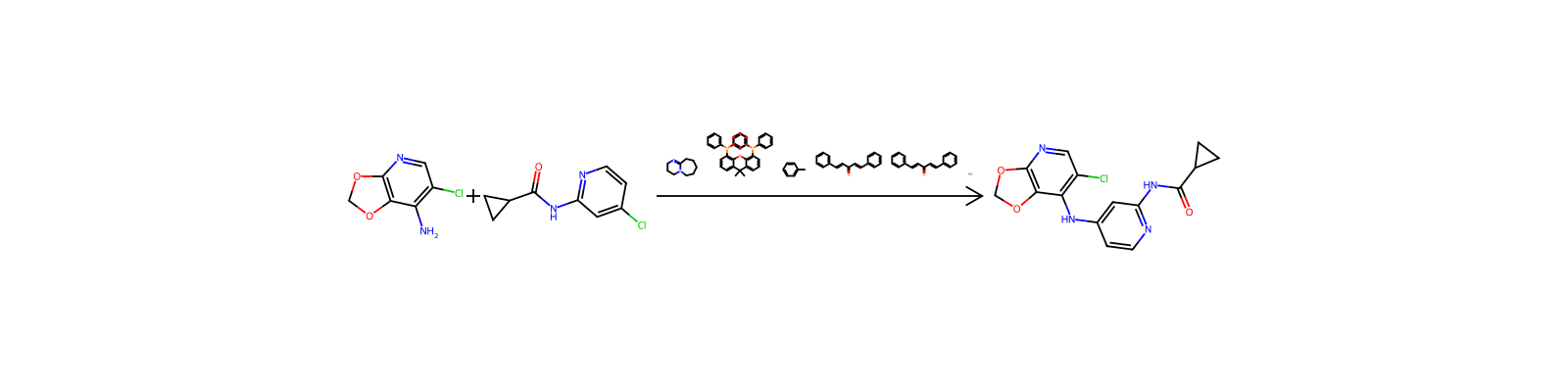
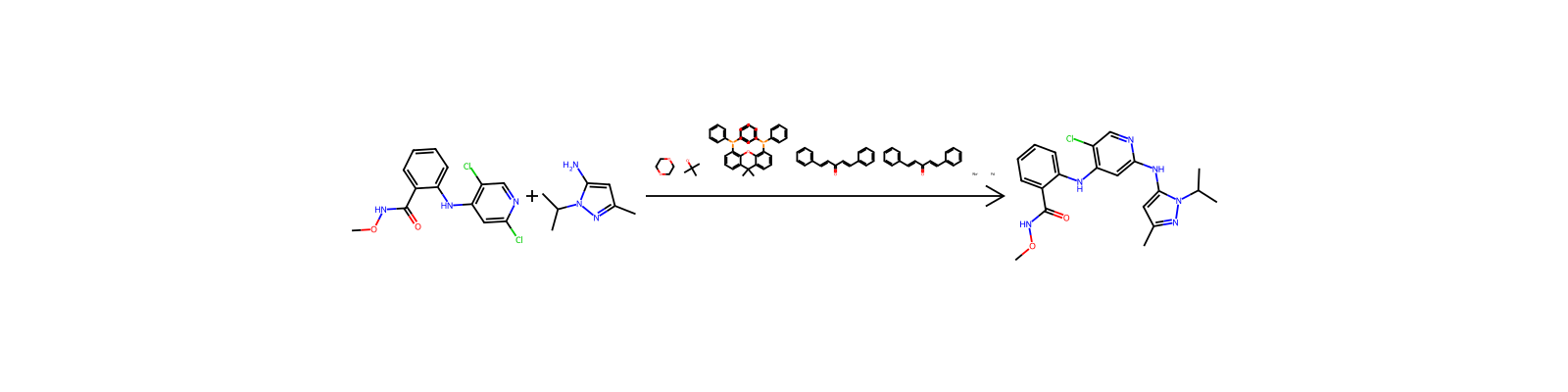
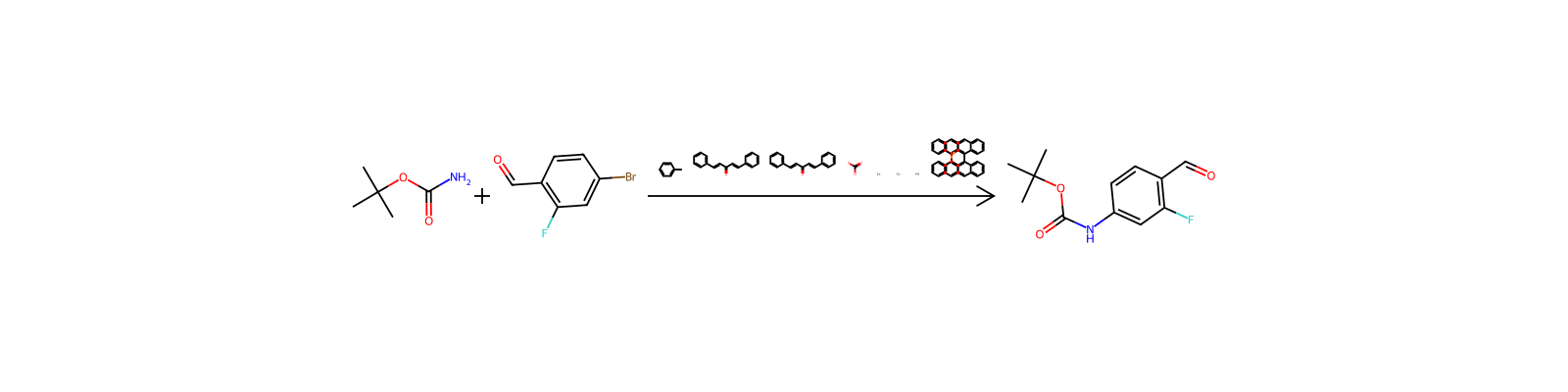
835 records




Linked notes
Loading…