
Basic information
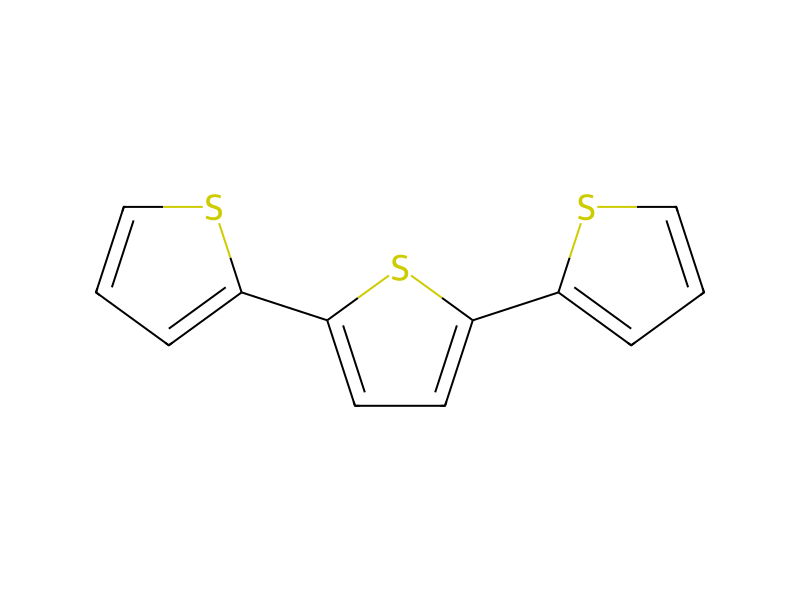
- Standard SMILES
c1csc(-c2ccc(-c3cccs3)s2)c1- InChIKey
KXSFECAJUBPPFE-UHFFFAOYSA-N- Molecular formula
- C12H8S3
- Average molar mass
- 248.4 g/mol
- Monoisotopic mass
- 247.97881326
Overview
2,2':5',2''-terthiophene is a terthiophene.
Names & identifiers
- Preferred name
- 2,2':5',2''-Terthiophene
- IUPAC
- 2,5-dithiophen-2-ylthiophene
- English name
- 2,2':5',2''-Terthiophene
- Molecular formula
- C12H8S3
- Molecular weight
- 248.39
Names & synonyms
2,2':5',2''-Terthiophene1081-34-1alpha-Terthienyl2,2',5',2''-Terthienyl2,5-dithiophen-2-ylthiophene0P77RAU2RRCHEBI:103352,2,5,2''-terthiopheneRefChem:555954640-441-1alpha-Terthiophene2,5-Di(2-thienyl)thiophene
Show more names
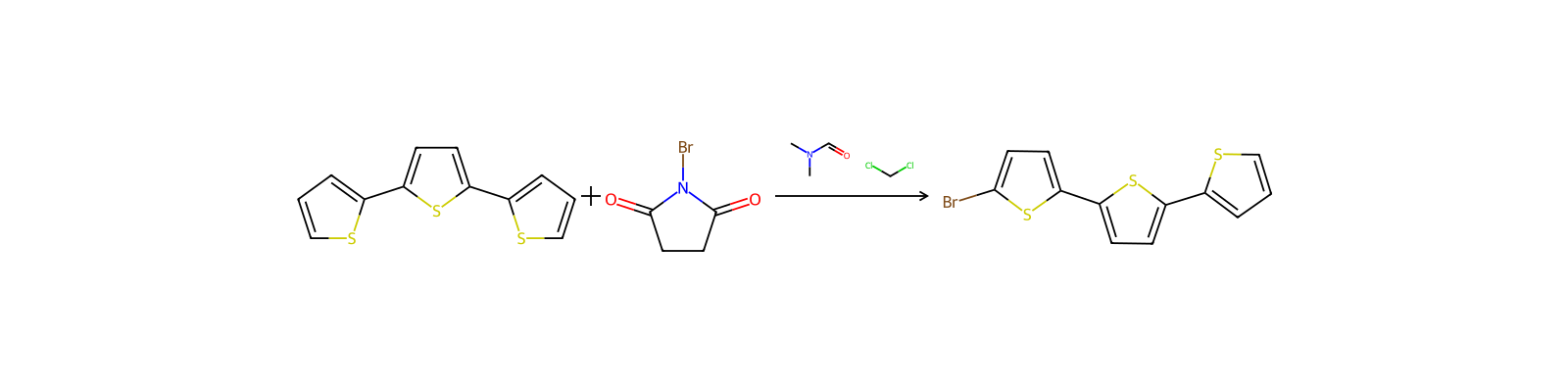
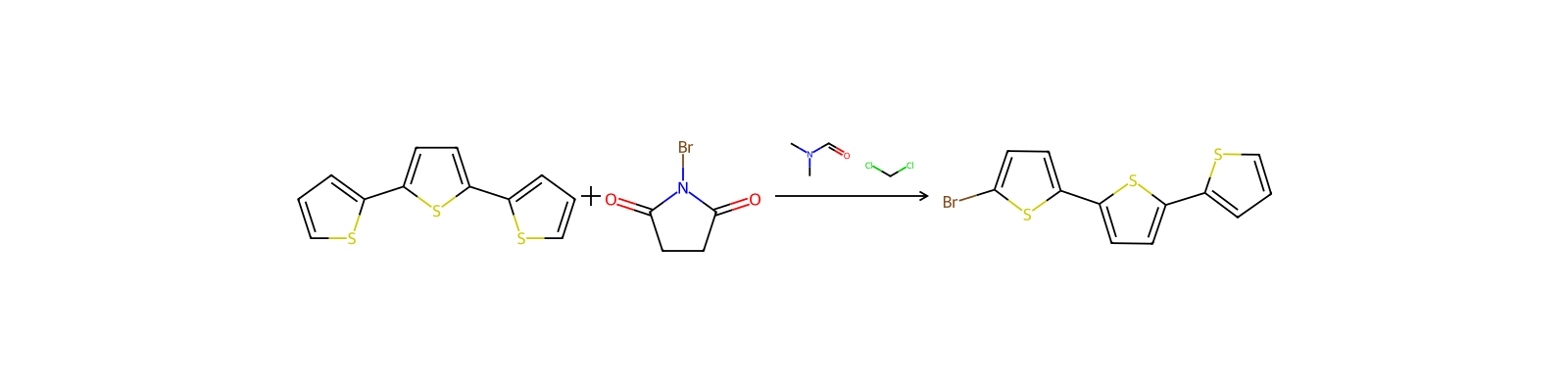
α-TerthiopheneterthienylTERTHIOPHENE3THTThS11302,2':5'2,2':5',2a-Terthienyl5-BroMo-[2,2'
2,5-bis(2-thienyl)thiopheneMFCD00012167C12H8S35-(thiophen-2-yl)-2,2'-bithiopheneDTXSID20412062,2:5,2-Terthiophene.alpha.-Terthienyl2,2':5'2''-Terthiophene
Database identifiers
- CAS
1081-34-1- PubChem CID
- 65067
- DTXSID
DTXSID2041206- ChEMBL
CHEMBL90017- ChEBI
CHEBI:10335- UNII
- 0P77RAU2RR
- EC Number
- 640-441-1
- Nikkaji
- J102.960F
Properties
Computed structural properties
- XLogP
- 4.4
- Topological polar surface area
- 84.7 Ų
- Hydrogen bond donors
- 0
- Hydrogen bond acceptors
- 3
- Rotatable bonds
- 2
- Heavy atoms
- 15
- Formal charge
- 0
- Complexity
- 197
Experimental & physicochemical properties
SpringerMaterials PropertiesAngular frequency
Collision Cross Section146.4 Ų [M]+ [CCS Type: DT; Buffer gas: N2; Ionization: APCI+; Dataset: TOXCAST; Source Identifier: DTXSID2041206]
Physicochemical properties
- Melting point
- 93 · 93-95 °C(lit.)
- Boiling point
- 160 °C · 160 °C (0.1 mmHg)
- Density
- 1.4602 · 1.4602 (rough estimate)
- refractive index
- 1.62 · 1.6200 (estimate)
- Flash point
- 160 °C/0.1mm · 160°C/0.1mm
- storage temp.
- Keep in dark place,Sealed in dry,Room Temperature
- solubility
- Chloroform (Slightly), Methanol (Slightly)
- form
- Solid
- color
- Light Yellow
- Water Solubility
- Insoluble in water.
- Merck
- 14 · 14,9174
- BRN
- 178604 · 178604
- InChI
- InChI=1S/C12H8S3/c1-3-9(13-7-1)11-5-6-12(15-11)10-4-2-8-14-10/h1-8H
- InChIKey
- KXSFECAJUBPPFE-UHFFFAOYSA-N
- SMILES
- C1(C2SC(C3SC=CC=3)=CC=2)SC=CC=1
- CAS DataBase Reference
- 1081 · 1081-34-1(CAS DataBase Reference)
- EWG's Food Scores
- 1 · 1
- FDA UNII
- 0 P77RAU2RR · 0P77RAU2RR
- EPA Substance Registry System
- .alpha.-Terthiophene (1081-34-1)
- UNSPSC Code
- 12352103 · 12352103
- NACRES
- 23 · NA.23
- Symbol(GHS)
- 7 · GHS07
- Signal word
- Warning
- Hazard statements
- 315 · H315-H319-H335
- Precautionary statements
- 261 · P261-P305+P351+P338
- PPE
- 95 · Eyeshields, Gloves, type N95 (US)
- Risk Statements
- 36 · 36/37/38
- Safety Statements
- 22 · 22-24/25
- WGK Germany
- 3 · 3
- RTECS
- 9717750 · WZ9717750
- F
- 8 · 8-10
- HS Code
- 29349990 · 29349990
- Storage Class
- 11 · 11 - Combustible Solids
Safety & regulation
GHS classification
GHS Classification
This chemical does not meet GHS hazard criteria for 50% (2 of 4) of reports.
Warning
H315 (25%): Causes skin irritation [Warning Skin corrosion/irritation]
P261, P264, P264+P265, P271, P273, P280, P302+P352, P304+P340, P305+P351+P338, P319, P321, P332+P317, P337+P317, P362+P364, P403+P233, P405, and P501 (click each P-code to see the statement)
Aggregated GHS information provided per 4 reports by companies from 4 notifications to the ECHA C&L Inventory. Each notification may be associated with multiple companies.
Hazard information
Hazard Classes and CategoriesSkin Irrit. 2 (25%)
Safety data
- F
- 8-10
- PPE
- Eyeshields, Gloves, type N95 (US)
- wgk
- 3
- rtecs
- WZ9717750
- hs_code
- 29349990
- risk_code
- 36/37/38
- Signal word
- Warning
- Symbol(GHS)
- GHS07
- safety_code
- 22-24/25
- Storage Class
- 11 - Combustible Solids
- Hazard statements
- H315-H319-H335
- Precautionary statements
- P261-P305+P351+P338
Chemistry & industry
Pharmacology
MeSH Pharmacological Classification
Substances that prevent infectious agents or organisms from spreading or kill infectious agents in order to prevent the spread of infection.
Agents used in the prophylaxis or therapy of VIRUS DISEASES. Some of the ways they may act include preventing viral replication by inhibiting viral DNA polymerase; binding to specific cell-surface receptors and inhibiting viral penetration or uncoating; inhibiting viral protein synthesis; or blocking late stages of virus assembly.
Pesticides designed to control insects that are harmful to man. The insects may be directly harmful, as those acting as disease vectors, or indirectly harmful, as destroyers of crops, food products, or textile fabrics.
Drugs that are pharmacologically inactive but when exposed to ultraviolet radiation or sunlight are converted to their active metabolite to produce a beneficial reaction affecting the diseased tissue. These compounds can be administered topically or systemically and have been used therapeutically to treat psoriasis and various types of neoplasms.
Uses & manufacturing
UsesSynthetic Polymer MALDI Matrix Compounds
Applications
Usesα-Terthienyl was first recognized as a nematicidal constituent of marigolds, but in the presence of light, it is also highly toxic to larvae of several insect species, including mosquitoes. This electron donor thiophenederivative phototoxin is biosynthesized from polyacetylene precursors and appears to function as a photosensitizer catalyzing the formation of reactive oxygen species at the target site (25).
Uses2,2'':5'',2''''-Terthiophene is a thiophene compound isolated from the roots of Echinops transiliensis, and was studied for its larvicidal activity against Aedes aegypti. 2,2'':5'',2''''-Terthiophene also showed inhibitory effects on dispersal ability of Bursaphelenchus xylophilus when used synergistically with certain antibiotics.
General Description2,2′:5′,2′′-Terthiophene (TTh) may be prepared by nickel catalysed coupling reaction of grignard′s reagent derived from 2-bromothiophene and magnesium. It generates singlet oxygen. In nature, it is found in the floral extract of Tagetes minuta and Echinops grijisii. It is known to be toxic to mosquitoes. It also exihibits antifungal activity.
Upstream & downstream products
Upstream raw materials
Downstream products
Suppliers50 total
梯希爱(上海)化成工业发展有限公司021-67121386 · [email protected]
上海阿拉丁生化科技股份有限公司400-6206333 13167063860 · [email protected]
T&W GROUP021-61551611 13296011611 · [email protected]
北京安司莫森技术有限公司010-82954736 13391601435 · [email protected]
科瑞迪化学400-821-5857 021-64326257 · [email protected]
上海将来实业股份有限公司400-0066400 13621662912 · [email protected]
Syntechem Co.,Ltd[email protected]
上海迈瑞尔生化科技有限公司4006356688 18621169109 · [email protected]
北京华威锐科化工有限公司0757-86329057 18934348241 · [email protected]
北京东华力拓科技发展有限公司010-88425576 · [email protected]
阿法埃莎(中国)化学有限公司400-6106006 · [email protected]
上海柏卡化学技术有限公司400-026-1533/(021) 6478-0600 · [email protected]
成都普思生物科技股份有限公司028-85370565-229 18080489829 · [email protected]
上海景颜化工科技有限公司13817811078 · [email protected]
玛雅试剂+86 (573) 82222445 (0)18006601000 452520369 · [email protected]
天津希恩思生化科技有限公司400 638 7771 · [email protected]
武汉科美沃化工有限公司027-85736489 · [email protected]
上海钰康生物科技有限公司15618758386 15618758386 · [email protected]
南京维奥化工有限公司Please Send Email 18652950785 · [email protected]
河南多贝化工有限公司0370-2785118 17550508557 · [email protected]
艾科试剂4008-755-333 18080918076 · [email protected]
上海思域化工科技有限公司86-21-34053660 · [email protected]
上海遐瑞医药科技有限公司+86 21 61551611
江苏艾康生物医药研发有限公司025-66113011 13913916777 · [email protected]
TOKYO CHEMICAL INDUSTRY CO., LTD.03-36680489 · [email protected]
上海贤鼎生物科技有限公司4009209199 · [email protected]
越林试剂021-62960152 · [email protected]
深圳睿迅光电材料科技有限公司0755-26718755 13266723223 · [email protected]
成都瑞芬思德丹生物科技有限公司2355253622; 18981954830 · [email protected]
上海倍卓生物科技有限公司021-61119791,13386096464 · [email protected]
上海将来实业股份有限公司400-0066400 13621662912 · [email protected]
上海将来实业股份有限公司021-61552785 · [email protected]
安徽科迪达化工有限公司0554-2106669 · [email protected]
郑州鸿晟医药科技有限公司0371-0371-13526885213 15637198702 · [email protected]
四川省维克奇生物科技有限公司028-81700200 18116577057 · [email protected]
成都零六生物科技有限公司400-1166-196 13458535857 · [email protected]
雷丁试剂0510-85629785 18013409632 · [email protected]
扬州冠扬化工科技有限公司+86-514-87325376 +86-514-87180828 · [email protected]
郑州萃智医药科技有限公司19943855286 · [email protected]
上海御略医药科技有限公司021-60345187 13671753212 · [email protected]
天津安浩生物科技有限公司[email protected]
上海麦克林生化科技股份有限公司15221275939 15221275939 · [email protected]
上海永叶生物科技有限公司86-021-61559134 15921386130 · [email protected]
上海嵩爰化工科技有限公司010-1234567 18521000990 · [email protected]
上海孚一生物科技有限公司+86 (21) 61124340
郑州本和新材料有限公司17703858868 · [email protected]
池州凯隆进出口贸易有限公司[email protected]
Sigma-Aldrich西格玛奥德里奇(上海)贸易有限公司021-61415566 800-8193336 · [email protected]
ALB Technology Limited702-983-3769 · [email protected]
郑州盖科科技有限公司0371-63336364 17344886665 · [email protected]
Additional notes
DefinitionChEBI: 2,2':5',2''-terthiophene is a terthiophene.
Related reactions
10 records




Linked notes
Loading…