HomeMCPWorkbenchSkills
HomeWorkbenchNotificationsMe
llms.txt · MCP GuidePrivacy Policy · Terms of Service · Supportv1.8.0
  1. Home
  2. /Compound

Trimethylolpropane

HCID 6510
New noteNew reactionRequest quotes
Print preview
Basic informationOverviewNames & identifiersPropertiesSafety & regulationChemistry & industryRelated reactionsCompound notes
Substructure searchFind similar structures

Basic information

CAS
77-99-6
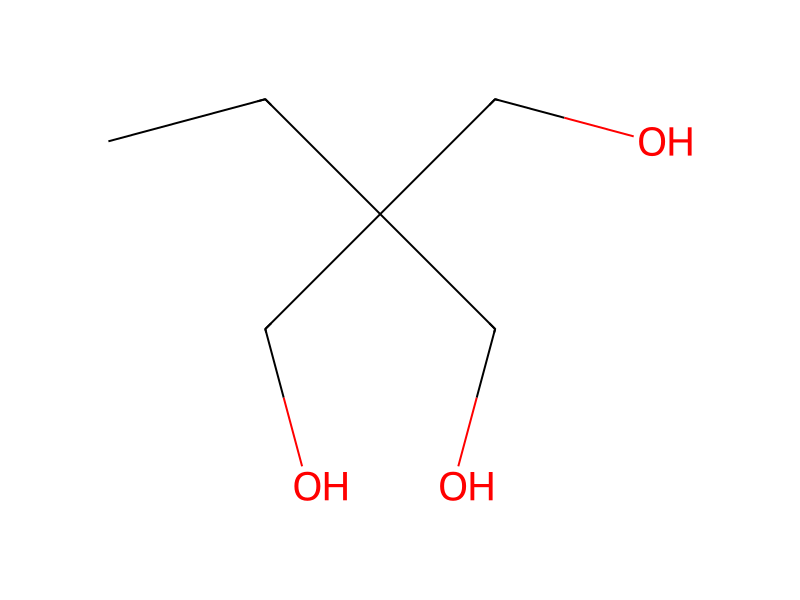
Standard SMILES
CCC(CO)(CO)CO
InChIKey
ZJCCRDAZUWHFQH-UHFFFAOYSA-N
Molecular formula
C6H14O3
Average molar mass
134.17 g/mol
Monoisotopic mass
134.0942943

Overview

Trimethylolpropane is a primary alcohol.

Names & identifiers

Preferred name
Trimethylolpropane
IUPAC
2-ethyl-2-(hydroxymethyl)propane-1,3-diol
English name
Trimethylolpropane
Molecular formula
C6H14O3
Molecular weight
134.17

Names & synonyms

Trimethylolpropane77-99-62-Ethyl-2-(hydroxymethyl)-1,3-propanediol1,1,1-TRIS(HYDROXYMETHYL)PROPANEEthriolHexaglycerineEtriolEttriolTMP (alcohol)Propylidynetrimethanol1,1,1-TrimethylolpropaneEthyltrimethylolmethane
Show more names
Trimethylol propaneHEXAGLYCEROLTrimethylopropaneTrimethylolpropanTrimethylol
1,3-Propanediol, 2-ethyl-2-(hydroxymethyl)-Tri(hydroxymethyl)propaneTris(hydroxymethyl)propane2,2-Bis(hydroxymethyl)-1-butanolMethanol, (propanetriyl)tris-2-Ethyl-2-(hydroxymethyl)propanediolPropane, 1,1,1-tris(hydroxymethyl)-DTXSID2026448

Database identifiers

CAS
77-99-6
PubChem CID
6510
DTXSID
DTXSID2026448
ChEMBL
CHEMBL3185136
ChEBI
CHEBI:183310
UNII
090GDF4HBD
EC Number
201-074-9
Nikkaji
J35.936J

Properties

Computed structural properties

XLogP
-0.8
Topological polar surface area
60.7 Ų
Hydrogen bond donors
3
Hydrogen bond acceptors
3
Rotatable bonds
4
Heavy atoms
9
Formal charge
0
Complexity
60.4

Experimental & physicochemical properties

Polymers · 3 items

Other Classes -> Alcohols and Polyols, Other

Plastics -> Heat stabilisers

Plastics -> N.a.

SpringerMaterials PropertiesBoiling point
LogP-0.5
Density1.084 g/cm³
Color/Form · 2 items

WHITE POWDER OR PLATES

COLORLESS CRYSTALS

Solubility · 2 items

SOL IN ALL PROP IN WATER, ALCOHOL; INSOL IN BENZENE, CARBON TETRACHLORIDE

Solubility in water at 20 °C: miscible

Flash Point172 °C c.c.
Boiling Point · 2 items

160 °C @ 5 MM HG

292-297 °C

Melting Point · 2 items

58 °C

58 °C

Vapor Density

Safety & regulation

Safety information is for reference only and does not replace the supplier’s Safety Data Sheet (SDS), applicable regulations, or professional assessment.

GHS classification

GHS Classification · 6 items

This chemical does not meet GHS hazard criteria for 94% (4784 of 5087) of all reports.

Not Classified

Aggregated GHS information provided per 5087 reports by companies from 12 notifications to the ECHA C&L Inventory.

Danger

H360: May damage fertility or the unborn child [Danger Reproductive toxicity]

P203, P280, P318, P405, and P501 (click each P-code to see the statement)

Hazard information

Regulatory Information · 4 items

Chemical: 1,3-Propanediol, 2-ethyl-2-(hydroxymethyl)-

1,3-Propanediol, 2-ethyl-2-(hydroxymethyl)- is listed on the EPA's Chemical Data Reporting (CDR) system. Manufacturers and importers of 1,3-Propanediol, 2-ethyl-2-(hydroxymethyl)- are required to report information about their production and use of this chemical to the EPA under the Toxic Substances Control Act (TSCA). (40 eCFR Part 711)

REACH registered substance: Propylidynetrimethanol (EC: 201-074-9)

Trimethylolpropane: Does not have an individual approval but may be used under an appropriate group standard

Other Safety InformationIMAP assessments - 1,3-Propanediol, 2-ethyl-2-(hydroxymethyl)-: Human health tier I assessment
Fire HazardsCombustible. Finely dispersed particles form explosive mixtures in air.
Hazards SummaryCauses somnolence and respiratory depression in lethal-dose feeding studies of rats and mice; [RTECS] An eye and respiratory tract irritant; [ICSC] May cause irritation; [MSDSonline]
Chemical DangersReacts violently with strong oxidants.
Hazard Classes and Categories

Chemistry & industry

Uses & manufacturing

Uses · 6 items

Used to make varnishes, alkyd resins, polyesters, UV cross linking agents, and esters; Also used in synthetic drying oils, urethane foams and coatings, silicone lube oils, lactone plasticizers, textile finishes, surfactants, epoxidation products, and as a cross-linking agent for spandex fibers; [HSDB] Used to make resins in closed systems; [OECD SIDS: Trimethylolpropane]

Textiles (Fiber & Fabric Manufacturing) [Category: Industry]

CONDITIONING AGENT; MFR OF VARNISHES, ALKYD RESINS; SYNTHETIC DRYING OILS; URETHANE FOAMS & COATINGS; SILICONE LUBE OILS; LACTONE PLASTICIZERS; TEXTILE FINISHES; SURFACTANTS; EPOXIDATION PRODUCTS

CHEM INT FOR POLYESTERS FOR POLYURETHANE FOAMS

CHEM INT FOR POLYESTERS FOR ALKYD SURFACE COATINGS

CHEM INT FOR PLASTICTZERS, EG, THE TRIHEPTANOATE ESTER

U.S. Exports · 2 items

(1979) No Data

(1981) No Data

U.S. Imports · 2 items

(1979) No Data

(1981) No Data

U.S. Production · 3 items

2023: 25,000,000 - <40,000,000 lb

(1979) 1.68X10+10 GRAMS (ESTIMATE)

(1981) 1.62X10+10 GRAMS (ESTIMATE)

Consumer UsesPigment
Industry UsesNot Known or Reasonably Ascertainable
Methods of ManufacturingALDOL CONDENSATION OF N-BUTYRALDEHYDE WITH EXCESS FORMALDEHYDE IN THE PRESENCE OF A BASE CATALYST, EG, SODIUM HYDROXIDE
Household ProductsInformation on 21 consumer products that contain Trimethylolpropane in the following categories is provided:
Use Classification · 2 items

Plastics -> Polymer Type -> N.a.

Plastics -> Heat stabilisers

Related reactions

139 records
New reaction record
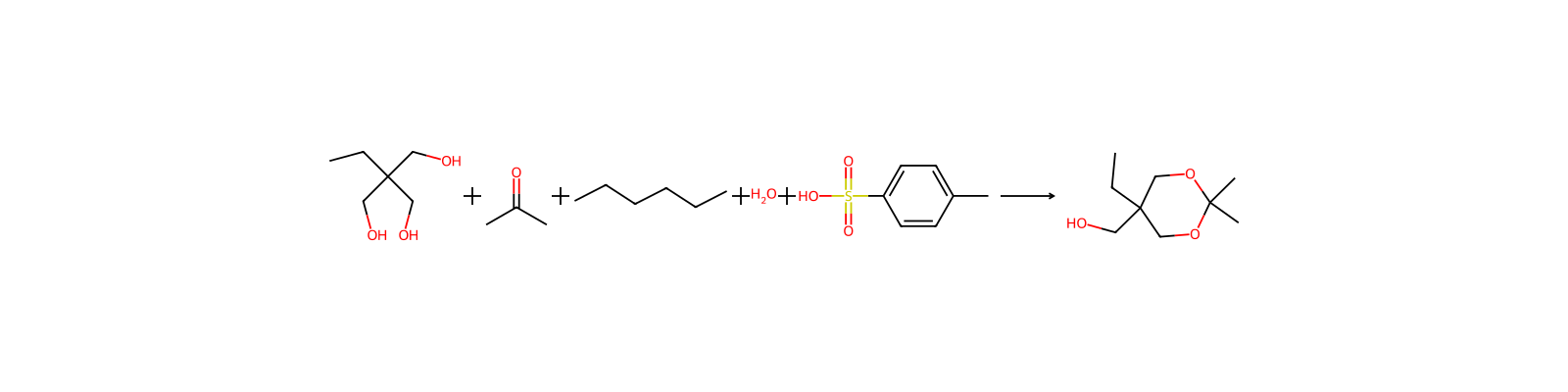
HRID 65293 reaction equation
HRID 65293As productuspto-grants-1986_09
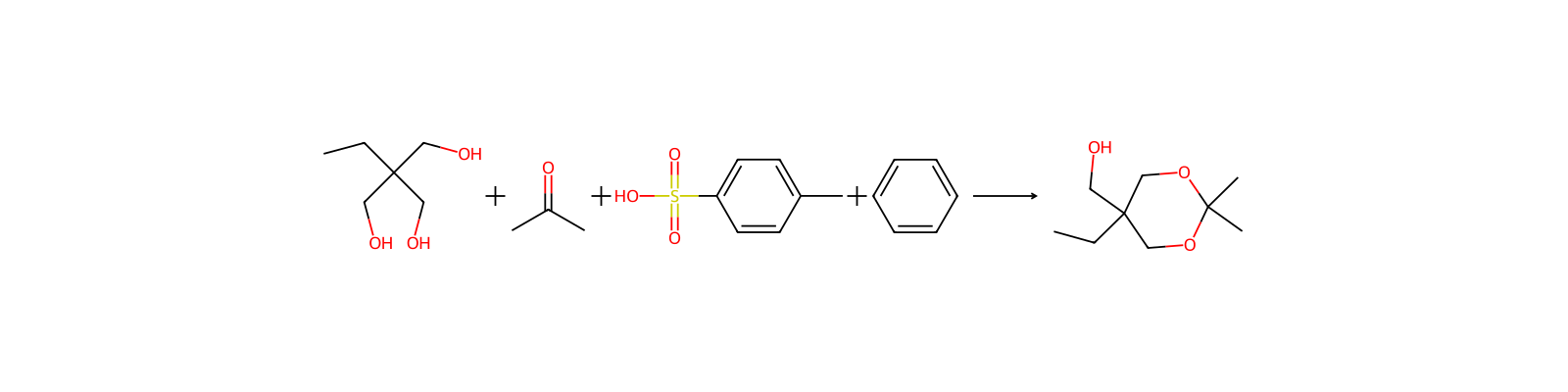
HRID 66693 reaction equation
HRID 66693As productuspto-grants-1982_08
HRID 134575 reaction equation
HRID 134575As reactantTraining data from https://doi.org/10.1039/C8SC04228D (9/10)
HRID 155940 reaction equation
HRID 155940As reactantTraining data from https://doi.org/10.1039/C8SC04228D (9/10)
HRID 215706 reaction equation
HRID 215706As productAs reactantuspto-grants-2012_06
HRID 223583 reaction equation
HRID 223583As productuspto-grants-1982_10
HRID 247050 reaction equation
HRID 247050As reactantuspto-grants-1987_11
HRID 259382 reaction equation
HRID 259382As reactantuspto-grants-1977_07
Page 1 of 18

Compound notes

Loading…

On this pageBasic informationOverviewNames & identifiersPropertiesSafety & regulationChemistry & industryRelated reactionsCompound notes
More actions
New noteNew reactionRequest quotes
Relative vapor density (air = 1): 4.63
Vapor Pressure0.0000449 [mmHg]
Food Contact Substances · 6 items

FCS -> FDA Cumulative Estimated Daily Intake (CEDI)

FCS -> FDA Inventory of Food Contact Substances Listed in 21 CFR

FCS -> FDA Inventory of Effective Food Contact Substance (FCS) Notifications

FCS -> FDA Inventory of Effective Food Contact Substance (FCS) Notifications

FCS -> FDA Inventory of Effective Food Contact Substance (FCS) Notifications

FCS -> FDA Inventory of Effective Food Contact Substance (FCS) Notifications

Physicochemical properties

Melting point
56 · 56-58 °C(lit.)
Boiling point
159 · 159-161 °C2 mm Hg(lit.)
Density
1.176 · 1.176
bulk density
700 kg/m3 · 700kg/m3
vapor density
4.8 · 4.8 (vs air)
vapor pressure
1 mm · <1 mm Hg ( 20 °C)
refractive index
1.485 · 1.4850 (estimate)
Flash point
172 °C · 172 °C
storage temp.
30 °C · Store below +30°C.
solubility
2 O: · H2O: 0.1 g/mL, clear
pka
14.01 · 14.01±0.10(Predicted)
form
Flakes
color
White
PH
6.5 · 6.5 (100g/l, H2O, 20℃)(External MSDS)
explosive limit
2 · 2-11.8%(V)
Water Solubility
soluble
BRN
1698309 · 1698309
Henry's Law Constant
1.2 · 1.2×106 mol/(m3Pa) at 25℃, Duchowicz et al. (2020)
Cosmetics Ingredients Functions
HUMECTANTSOLVENT
InChI
1S/C6H14O3/c1-2-6(3-7,4-8)5-9/h7-9H,2-5H2,1H3
InChIKey
ZJCCRDAZUWHFQH-UHFFFAOYSA-N
SMILES
CCC(CO)(CO)CO
LogP
-0.975 · -0.975 (est)
CAS DataBase Reference
77 · 77-99-6(CAS DataBase Reference)
Indirect Additives used in Food Contact Substances
TRIMETHYLOLPROPANE
FDA 21 CFR
175.105 · 175.105; 175.300; 175.320;177.1390; 177.1680; 177.2420
FDA UNII
90 GDF4HBD · 090GDF4HBD
NIST Chemistry Reference
1 · 1,3-Propanediol, 2-ethyl-2-(hydroxymethyl)-(77-99-6)
EPA Substance Registry System
Trimethylolpropane (77-99-6)
UNSPSC Code
12352104 · 12352104
NACRES
22 · NA.22
Symbol(GHS)
8 · GHS08
Signal word
Warning
Hazard statements
361 fd · H361fd
Precautionary statements
201 · P201-P202-P280-P308+P313-P405-P501
PPE
95 · Eyeshields, Gloves, type N95 (US)
Safety Statements
22 · 22-24/25
WGK Germany
1 · 1
RTECS
6470000 · TY6470000
Autoignition Temperature
375 °C · 375 °C DIN 51794
TSCA
TSCA listed
HS Code
29054100 · 29054100
Storage Class
11 · 11 - Combustible Solids
Hazard Classifications
2 · Repr. 2
Hazardous Substances Data
77 · 77-99-6(Hazardous Substances Data)
Toxicity
50 orally · LD50 orally in Rabbit: > 2500 mg/kg
REACH Registrations
Active
· 2 items

Not Classified

Reproductive toxicity - Category 1B

Explosive Limits and PotentialExplosive limits , vol% in air: 2.0-11.8

Safety & protection

Fire FightingUse water spray, powder, alcohol-resistant foam, carbon dioxide.
First Aid Measures · 4 items

Fresh air, rest.

Remove contaminated clothes. Rinse skin with plenty of water or shower.

First rinse with plenty of water for several minutes (remove contact lenses if easily possible), then refer for medical attention.

Rinse mouth.

Safe StorageSeparated from strong oxidants. Dry. Well closed.
Spillage DisposalPersonal protection: particulate filter respirator adapted to the airborne concentration of the substance. Sweep spilled substance into covered containers. Wash away remainder with plenty of water.
Eye PreventionWear safety goggles.
Fire PreventionNO open flames. Closed system, dust explosion-proof electrical equipment and lighting. Prevent deposition of dust.
Inhalation RiskA nuisance-causing concentration of airborne particles can be reached quickly when dispersed.
Skin PreventionProtective gloves.
Exposure PreventionPREVENT DISPERSION OF DUST!
Ingestion PreventionDo not eat, drink, or smoke during work.
Inhalation PreventionUse local exhaust or breathing protection.
Effects of Short Term ExposureMay cause mechanical irritation to the eyes and respiratory tract.

Toxicology

Adverse EffectsNeurotoxin - Acute solvent syndrome
Signs and Symptoms · 3 items

Cough.

Redness.

Cough.

Toxicity DataLC50 (rat) > 850 mg/m3/4h

Safety data

PPE
Eyeshields, Gloves, type N95 (US)
wgk
1
tsca
TSCA listed
rtecs
TY6470000
hs_code
29054100
Toxicity
LD50 orally in Rabbit: > 2500 mg/kg
Signal word
Warning
Symbol(GHS)
GHS08
safety_code
22-24/25
Storage Class
11 - Combustible Solids
Hazard statements
H361fd
REACH Registrations
Active
Hazard Classifications
Repr. 2
Autoignition Temperature
375 °C DIN 51794
Precautionary statements
P201-P202-P280-P308+P313-P405-P501
Hazardous Substances Data
77-99-6(Hazardous Substances Data)
General Manufacturing Information · 2 items

Paint and Coating Manufacturing

1,3-Propanediol, 2-ethyl-2-(hydroxymethyl)-: ACTIVE

Applications · 1 item

UsesTrimethylolpropane acts as a precursor to alkyd resins, high-gloss coatings and ion exchange resins. It is also employed as a multifunctional monomer utilized for the production of coatings, ethoxylated and propoxylated trimethylolpropane derivatives. Further, it serves as a building block in the polymer industry.

Upstream & downstream products

Upstream raw materials

Film evaporatorFormaldehydeButyraldehyde

Downstream products

synthetic fiber oil QDH-101PolyurethaneFlame retardant for pure-dacronToluene diisocyanateTrimethylolpropane monoallyl ether2,2-Bis(hydroxymethyl)butyric acidTrimethylolpropane diallyl ether2-ethyl-2-(hydroxymethyl)-1,3-propanediyl diacrylateTrimethylolpropane Tris(3-mercaptopropionate)

Additional notes

DefinitionChEBI: Trimethylolpropane is a primary alcohol. It is used as a precursor for the manufacture of resins including alkyds, saturated polyesters and polyurethanes (polyester polyol and polycarbonate diol).