
HRID 299870As reactant
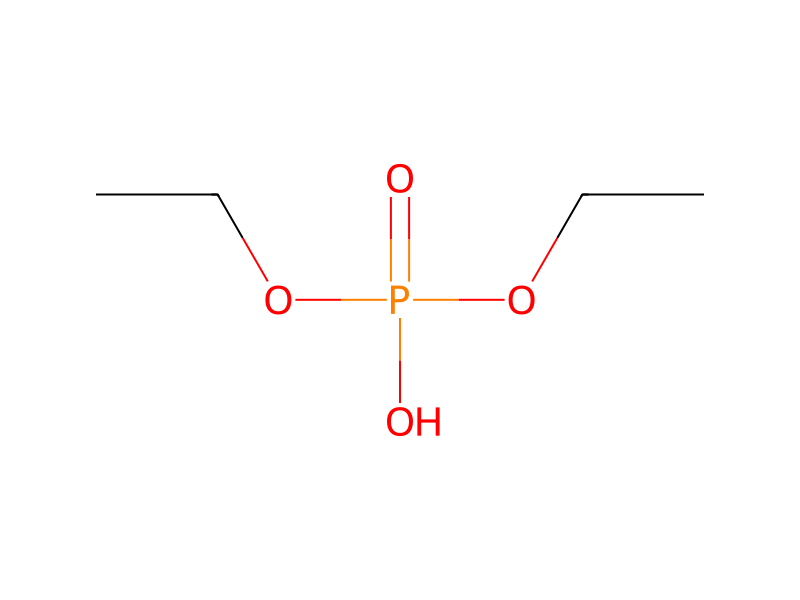
51501-07-6CCOP(=O)(O)OCCUCQFCFPECQILOL-UHFFFAOYSA-NDiethyl hydrogen phosphate is a dialkyl phosphate having ethyl as the alkyl group. It has a role as a mouse metabolite and a human xenobiotic metabolite. It is a conjugate acid of a diethylphosphate(1-).
51501-07-6、52932-96-4、53397-17-4、598-02-7DTXSID1044699CHEMBL1232324CHEBI:27708Other Classes -> Organophosphates, Other
Organophosphate diesters (OPDE)
Organophosphate
Liquid
Colorless clear liquid; [MSDSonline]
Solid
Safety information is for reference only and does not replace the supplier’s Safety Data Sheet (SDS), applicable regulations, or professional assessment.
This chemical does not meet GHS hazard criteria for 44% (37 of 84) of reports.
Warning
H315 (56%): Causes skin irritation [Warning Skin corrosion/irritation]
P261, P264, P264+P265, P271, P280, P302+P352, P304+P340, P305+P351+P338, P319, P321, P332+P317, P337+P317, P362+P364, P403+P233, P405, and P501 (click each P-code to see the statement)
Aggregated GHS information provided per 84 reports by companies from 6 notifications to the ECHA C&L Inventory. Each notification may be associated with multiple companies.
Hazard Traits - Developmental Toxicity; Neurotoxicity
Phosphoric acid, diethyl ester is listed on the EPA's Chemical Data Reporting (CDR) system. Manufacturers and importers of Phosphoric acid, diethyl ester are required to report information about their production and use of this chemical to the EPA under the Toxic Substances Control Act (TSCA). (40 eCFR Part 711)
S-Ethylisothiouronium diethylphosphate is a specific inhibitor of inducible NO synthase on hepatic NO production level. S-Ethylisothiouronium diethylphosphate affects systemic hemodynamic indices in the following way: the peripheral vascular resistance increases, the stroke volume and central blood volume increase, and the work of the left ventricle improves. (Wikipedia)
Diethyl phosphorothioate is a known human metabolite of Chlorpyrifos-oxon, Chlorpyrifos, and Diazoxon.
Metabolism of organophosphates occurs principally by oxidation, by hydrolysis via esterases and by reaction with glutathione. Demethylation and glucuronidation may also occur. Oxidation of organophosphorus pesticides may result in moderately toxic products. In general, phosphorothioates are not directly toxic but require oxidative metabolism to the proximal toxin. The glutathione transferase reactions produce products that are, in most cases, of low toxicity. Paraoxonase (PON1) is a key enzyme in the metabolism of organophosphates. PON1 can inactivate some organophosphates through hydrolysis. PON1 hydrolyzes the active metabolites in several organophosphates insecticides as well as, nerve agents such as soman, sarin, and VX. The presence of PON1 polymorphisms causes there to be different enzyme levels and catalytic efficiency of this esterase, which in turn suggests that different individuals may be more susceptible to the toxic effect of organophosphate exposure.
Paint and Coating Manufacturing
Phosphoric acid, diethyl ester: ACTIVE
UsesPhosphoric acid diethyl ester is an organophosphate that is usually found in pesticides and is known to induce changes in male hormone profile by decreasing serum testosterone and inhibin B levels. Phosphoric acid diethyl ester is also known to negatively affect the health of women and newborns living in agricultural communities.


DefinitionChEBI: A dialkyl phosphate having ethyl as the alkyl group.