
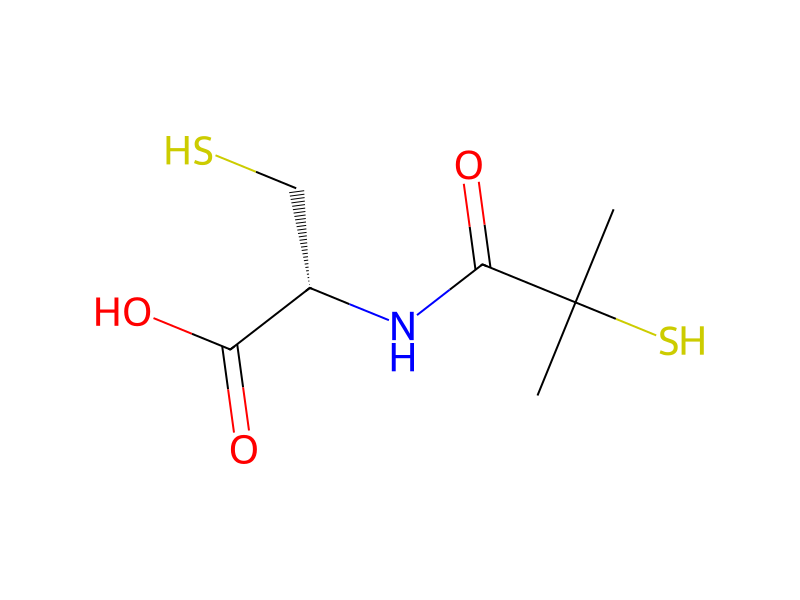
Basic information
- Standard SMILES
CC(C)(S)C(=O)N[C@@H](CS)C(=O)O- InChIKey
VUAFHZCUKUDDBC-BYPYZUCNSA-N- Molecular formula
- C7H13NO3S2
- Average molar mass
- 223.3 g/mol
- Monoisotopic mass
- 223.03368528
Overview
Bucillamine is an organic molecular entity.
Names & identifiers
- Preferred name
- Bucillamine
- IUPAC
- (2R)-2-[(2-methyl-2-sulfanylpropanoyl)amino]-3-sulfanylpropanoic acid
- English name
- Bucillamine
- Molecular formula
- C7H13NO3S2
- Molecular weight
- 223.31
Names & synonyms
bucillamine65002-17-7TiobutaritBucilantBucilaminaN-(2-Mercapto-2-methylpropionyl)-L-cysteineBucillaminumDTXSID2048587R80LRA5WTFSA-96DE019L-CYSTEINE, N-(2-MERCAPTO-2-METHYL-1-OXOPROPYL)-
Show more names
sa96de-019Bucillamine 95%BUCILLAMINE USP/EP/BPBucillamine, 10 mM in DMSON-(2-Mercaptoisobutyryl)cysteine
(2R)-2-(2-METHYL-2-SULFANYLPROPANAMIDO)-3-SULFANYLPROPANOIC ACIDDTXCID2028513RefChem:917687M01CC02(2R)-2-(2-Methyl-2-sulfanylpropanoylamino)-3-sulfanylpropanoic acid2-mercapto-2-methylpropanoyl-L-cysteineRimatilThiobutarit
Database identifiers
- CAS
65002-17-7- PubChem CID
- 656604
- DTXSID
DTXSID2048587- ChEMBL
CHEMBL80830- ChEBI
CHEBI:31312- UNII
- R80LRA5WTF
- Nikkaji
- J22.800A
Properties
Computed structural properties
- XLogP
- 0.4
- Topological polar surface area
- 68.4 Ų
- Hydrogen bond donors
- 4
- Hydrogen bond acceptors
- 5
- Rotatable bonds
- 4
- Heavy atoms
- 13
- Formal charge
- 0
- Complexity
- 218
Experimental & physicochemical properties
DrugsPharmaceuticals -> Listed in ZINC15
Physicochemical properties
- Melting point
- 119 · 119-123°C
- alpha
- 25 · D25 +32.3° (c = 1.0 in ethanol)
- Boiling point
- 438 · 438.0±45.0 °C(Predicted)
- Density
- 1.3934 · 1.3934 (rough estimate)
- refractive index
- 1.637 · 1.6370 (estimate)
- storage temp.
- -20 °C · Hygroscopic, -20°C Freezer, Under Inert Atmosphere
- solubility
- DMSO (Very Slightly), Ethanol (Slightly), Methanol (Slightly), Water (Slightly)
- pka
- 3.01 · 3.01±0.10(Predicted)
- form
- Solid
- color
- White to Pale Yellow
- Stability
- Air Sensitive, Hygroscopic, Unstable in Solution
- CAS DataBase Reference
- 65002 · 65002-17-7(CAS DataBase Reference)
- EWG's Food Scores
- 1 · 1
- FDA UNII
- 80 LRA5WTF · R80LRA5WTF
- ATC code
- 1 CC02 · M01CC02
- Symbol(GHS)
- 5 · GHS05,GHS07,GHS09
- Signal word
- Danger
- Hazard statements
- 302 · H302-H318-H410
- Precautionary statements
- 273 · P273-P280-P301+P312+P330-P305+P351+P338+P310
- Toxicity
- 50 in · LD50 in mice (mg/kg): 2285 i.p.; 989.6 i.v. (Fujita, 1981)
Safety & regulation
Toxicology
Drug Induced Liver Injury
Drug-Induced Liver Injury Severity and Toxicity (DILIst)
Bucillamine
DILI Positive
DOI:10.1016/j.drudis.2019.09.022
Safety data
- Toxicity
- LD50 in mice (mg/kg): 2285 i.p.; 989.6 i.v. (Fujita, 1981)
- Signal word
- Danger
- Symbol(GHS)
- GHS05,GHS07,GHS09
- Hazard statements
- H302-H318-H410
- Precautionary statements
- P273-P280-P301+P312+P330-P305+P351+P338+P310
Chemistry & industry
Pharmacology
ATC Code
M - Musculo-skeletal system
QM - Musculo-skeletal system
MeSH Pharmacological Classification
Anti-inflammatory agents that are non-steroidal in nature. In addition to anti-inflammatory actions, they have analgesic, antipyretic, and platelet-inhibitory actions. They act by blocking the synthesis of prostaglandins by inhibiting cyclooxygenase, which converts arachidonic acid to cyclic endoperoxides, precursors of prostaglandins. Inhibition of prostaglandin synthesis accounts for their analgesic, antipyretic, and platelet-inhibitory actions; other mechanisms may contribute to their anti-inflammatory effects.
Naturally occurring or synthetic substances that inhibit or retard oxidation reactions. They counteract the damaging effects of oxidation in animal tissues.
Applications
DescriptionBucillamine is an orally active immunomodulator useful in the treatment of rheumatoid arthritis. Its potencies in inhibiting collagenase activity and inactivating rheumatoid factor far exceed those of penicillamine. In man, bucillamine reportedly brings about significant improvements over placebo in erythrocyte sedimentation, grip power, joint swelling and duration of morning stiffness.
UsesAn antirheumatic agent.
Upstream & downstream products
Upstream raw materials
Suppliers50 total
武汉英诺医药科技有限公司+86-027-59232304 15387063101 · [email protected]
咸宁深蓝生物医药研发有限公司18171815831 · [email protected]
杭州品高化工有限公司0571-87658025 · [email protected]
INTATRADE GmbH+49 3493/605464 · [email protected]
陕西缔都化学有限公司029-029-81123119 17391733320 · [email protected]
爱斯特(成都)生物制药股份有限公司+86-28-85122536 85324413 · [email protected]
湖北科乐精细化工有限公司027-59101668 19945030958 · [email protected]
Dayang Chem (Hangzhou) Co.,Ltd.+86-0571-88938639 17705817739 · [email protected]
LGM Pharma1-(800)-881-8210 · [email protected]
上海迈瑞尔生化科技有限公司4006356688 18621169109 · [email protected]
武汉易泰科技有限公司上海分公司18930552037 · [email protected]
上海波以尔化工有限公司[email protected]
欧利希(湖北)医药科技有限公司17316404525 17316404525 · [email protected]
China Kouting Group Limited+86 (21) 5811-6473 5811-6475 · [email protected]
上海相辉医药科技有限公司13761987713; 13761987713 · [email protected]
銳迪國際科技有限公司18024082417 · [email protected]
南京维奥化工有限公司Please Send Email 18652950785 · [email protected]
成都零六生物科技有限公司400-1166-196 13458535857 · [email protected]
杭州杰恒化工有限公司0571-87396432 · [email protected]
江苏艾康生物医药研发有限公司025-66028182 17714375163 · [email protected]
上海孚一生物科技有限公司+86 (21) 61124340
凯试(上海)科技有限公司021-50135380 · [email protected]
上海蓓琅生物科技有限公司17764003753 · [email protected]
上海陶术生物科技股份有限公司+1-781-999-5354; +1-00000000000 · [email protected]
广东翁江化学试剂有限公司0751-2815987 13927875076 · [email protected]
武汉峰耀同辉化学制品有限公司027-87466205 15377579727 · [email protected]
艾吉析科技(上海)有限公司17721401538;17717235263 17721401538 · [email protected]
上海阿拉丁生化科技股份有限公司6206333 13167063860 · [email protected]
武汉多普乐生物医药有限公司+86-02787215551 19945035818 · [email protected]
启源(广东)医药化工有限公司18026564465 · [email protected]
风咏生物(AbMole)021-10000000 13000000000 · [email protected]
上海源叶生物科技有限公司13636370518 · [email protected]
武汉沃格达生物科技有限公司15071299552 · [email protected]
山东君瑞医药科技有限公司0539-5636807 15762008972 · [email protected]
广东翁江化学试剂有限公司0751-2886750 13927877953 · [email protected]
苏州爱玛特生物科技有限公司0512-56316828 400-867-5858;400-867-5858 · [email protected]
Shanghai Acmec Biochemical Technology Co., Ltd.+86-18621343501 · [email protected]
杭州洁汉化工有限公司+86-571-86217390; +8618058761490 · [email protected]
武汉峰耀同辉化学制品有限公司027-87466105 15377573527 · [email protected]
河南天孚化工有限公司+86-0371-55170693 +86-19937530512 · [email protected]
厦门盈融达化工有限公司+86-0592-6210733 · [email protected]
医恩医疗系统研发(上海)有限公司021-58958002 18930822973 · [email protected]
艾览(上海)化工科技有限公司400-668-9898 · [email protected]
Zjartspharm Co., Ltd15068876005 · [email protected]
career henan chemical co+86-0371-86658258 · [email protected]
深圳聚合生化科技有限公司+86-400-002-6226 · [email protected]
海蔚化学86-21-51086038 · [email protected]
Aladdin Scientific[email protected]
Wuhan Topule Biopharmaceutical Co., Ltd+86-18327326525 · [email protected]
TargetMol中国(陶术生物)4008200310 15002144251 · [email protected]
Additional notes
DefinitionChEBI: Bucillamine is an organic molecular entity.
Related reactions
7 records


Linked notes
Loading…