HomeMCPWorkbenchSkills
HomeWorkbenchNotificationsMe
llms.txt · MCP GuidePrivacy Policy · Terms of Service · Supportv1.8.3
  1. Home
  2. /Compound

Disulfide, bis(1,1-dimethylethyl)

HCID 66060
New reaction
Print
Basic informationNames & identifiersPropertiesSafety & regulationChemistry & industryRelated reactionsCompound notes
Substructure searchFind similar structures

Basic information

CAS
110-06-5
Standard SMILES
CC(C)(C)SSC(C)(C)C
InChIKey
BKCNDTDWDGQHSD-UHFFFAOYSA-N
Molecular formula
C8H18S2
Average molar mass
178.4 g/mol
Monoisotopic mass
178.08499292

Names & identifiers

Preferred name
Disulfide, bis(1,1-dimethylethyl)
IUPAC
2-(tert-butyldisulfanyl)-2-methylpropane
English name
Di-tert-butyl disulfide
Molecular formula
C8H18S2
Molecular weight
178.36

Names & synonyms

110-06-5Di-tert-butyl disulphideTert-butyl disulfideDisulfide, bis(1,1-dimethylethyl)2,2'-dithiobis(2-methylpropane)EINECS 203-734-1AI3-32576RefChem:589792203-734-1InChI=1/C8H18S2/c1-7(2,3)9-10-8(4,5)6/h1-6HDi-tert-butyl disulfide1,2-Di-tert-butyldisulfane
Show more names
(tert-C4H9S)2t-Butyldisulfideterc-Butyldisulfidedi-tert-butylsulfaneDI-TERT-BUTYL DISULDIDEDitert-butyl persulfide
2-(tert-Butyldisulfanyl)-2-methylpropanet-butyl disulfidedi-t-butyl disulfideMFCD000088382,2,5,5-Tetramethyl-3,4-dithiahexaneRTY9CM6498Bis(1,1-dimethylethyl) disulfideNSC-677434

Database identifiers

CAS
110-06-5
PubChem CID
66060
DTXSID
DTXSID0021913
ChEMBL
CHEMBL121077
UNII
RTY9CM6498
EC Number
203-734-1
Nikkaji
J79.448A

Properties

Computed structural properties

XLogP
2.9
Topological polar surface area
50.6 Ų
Hydrogen bond donors
0
Hydrogen bond acceptors
2
Rotatable bonds
3
Heavy atoms
10
Formal charge
0
Complexity
80.8

Experimental & physicochemical properties

SpringerMaterials PropertiesSurface tension

Physicochemical properties

Melting point
-5 °C · -5 °C
Boiling point
200 °C · 200 °C
Density
0.93 · 0.93
vapor density
5 · 5 (vs air)
vapor pressure
51.7 mm · 51.7 mm Hg ( 37.7 °C)
refractive index
1.49 · 1.49
Flash point
67 °C · 67 °C
storage temp.
Inert atmosphere,Room Temperature
solubility
Chloroform (Sparingly), Ethanol (Slightly)
form
clear liquid
color
Colorless to Light yellow to Light orange
Odor Threshold
0.0018 ppm · 0.0018ppm
explosive limit

Safety & regulation

Safety information is for reference only and does not replace the supplier’s Safety Data Sheet (SDS), applicable regulations, or professional assessment.

GHS classification

GHS Classification · 4 items

Danger

H227 (18%): Combustible liquid [Warning Flammable liquids]

P210, P261, P264+P265, P271, P273, P280, P301+P316, P304+P340, P305+P351+P338, P319, P331, P337+P317, P370+P378, P391, P403, P403+P233, P405, and P501 (click each P-code to see the statement)

Aggregated GHS information provided per 61 reports by companies from 6 notifications to the ECHA C&L Inventory. Each notification may be associated with multiple companies.

Hazard information

Regulatory Information · 2 items

Chemical: Disulfide, bis(1,1-dimethylethyl)

Disulfide, bis(1,1-dimethylethyl): Does not have an individual approval but may be used under an appropriate group standard

Hazard Classes and CategoriesFlam. Liq. 4 (18%)

Safety data

PPE
Eyeshields, Gloves, multi-purpose combination respirator cartridge (US)
wgk
2
tsca
TSCA listed
ridadr
UN 3082 9/PG 3
hs_code
2930909099
Toxicity
LD50 orally in Rabbit: 6200 mg/kg LD50 dermal Rabbit > 2000 mg/kg
risk_code
51/53-43-36/37/38
Signal word
Warning
Symbol(GHS)
GHS09
hazard_code
N
safety_code
61-37/39-26-24

Chemistry & industry

Uses & manufacturing

General Manufacturing InformationDisulfide, bis(1,1-dimethylethyl): ACTIVE
Applications · 4 items

DescriptionDi-tert-butyl disulfide is one of the important organic intermediates.It is an important raw material for the synthesis of disulfide bond-containing sulfinyl and oxythio compounds. It can be used as a vulcanizing agent for rubber and elastomers in industry. It is also a monomer for the synthesis of proteins and other biologically active molecules.

UsesDi-tert-butyl disulfide is used in the preparation of gold-supported thin film from symmetrical and mixed disulphide adsorbates. Mechanism of the oxidation of di-tert-butyl disulfide in the presence of H2O2 catalyzed by bis(acetylacetonato)oxovanadium and a chiral Schiff-base ligand has been investigated. Di-tert-butyl disulfide has been used in the preparation of gold-supported thin film from symmetrical and mixed disulphide adsorbates.

UsesDi-tert-Butyl Disulfide is a general reagent used in the synthesis of a novel neuropeptide Y (NPY) Y5 receptor antagonist Velneperit) used in the treatment of obesity.

General DescriptionMechanism of the oxidation of di-tert-butyl disulfide in the presence of H2O2 catalyzed by bis(acetylacetonato)oxovanadium and a chiral Schiff-base ligand has been investigated.

Upstream & downstream products

Upstream raw materials

t-Butyl trifluoroacetatetert-Butyl sulfide

Downstream products

(R)-(+)-2-Methyl-2-propanesulfinamide

Related reactions

6 records
New reaction record
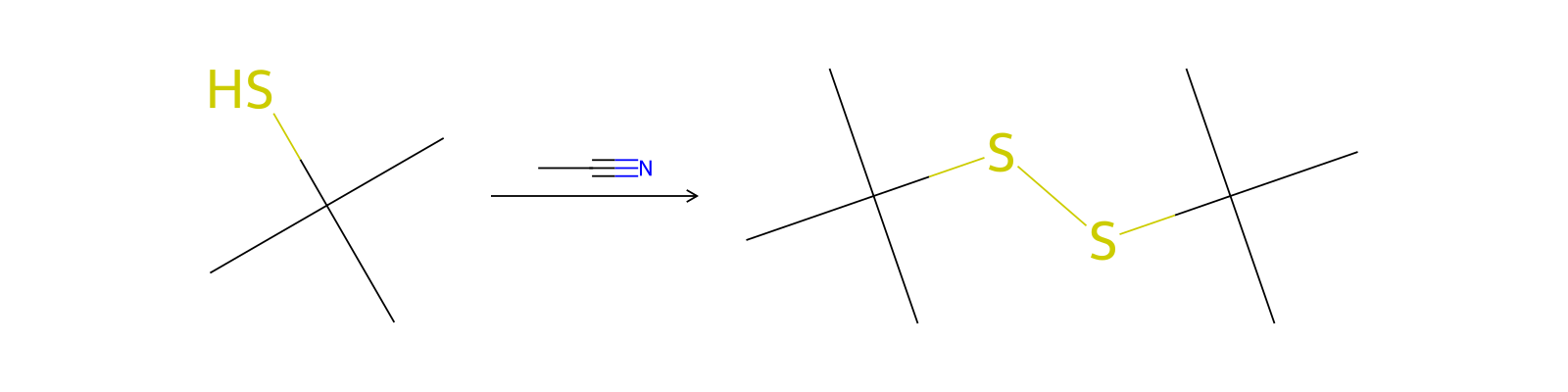
HRID 616061 reaction equation
HRID 616061As product
HRID 616062 reaction equation
HRID 616062As product
HRID 964721 reaction equation
HRID 964721As product
HRID 1277530 reaction equation
HRID 1277530As product
HRID 1452010 reaction equation
HRID 1452010As product
HRID 1482306 reaction equation
HRID 1482306As reactant

Compound notes

On this pageBasic informationNames & identifiersPropertiesSafety & regulationChemistry & industryRelated reactionsCompound notes
0.8 % · 0.8%(V)
BRN
1698170 · 1698170
InChI
1S/C8H18S2/c1-7(2,3)9-10-8(4,5)6/h1-6H3
InChIKey
BKCNDTDWDGQHSD-UHFFFAOYSA-N
SMILES
CC(C)(C)SSC(C)(C)C
LogP
4.698 · 4.698 (est)
CAS DataBase Reference
110 · 110-06-5(CAS DataBase Reference)
FDA UNII
9 CM6498 · RTY9CM6498
EPA Substance Registry System
Disulfide, bis(1,1-dimethylethyl) (110-06-5)
UNSPSC Code
12352100 · 12352100
NACRES
22 · NA.22
Symbol(GHS)
9 · GHS09
Signal word
Warning
Hazard statements
411 · H411
Precautionary statements
273 · P273-P391-P501
PPE
Eyeshields, Gloves, multi-purpose combination respirator cartridge (US)
Hazard Codes
N
Risk Statements
51 · 51/53-43-36/37/38
Safety Statements
61 · 61-37/39-26-24
RIDADR
3082 · UN 3082 9/PG 3
WGK Germany
2 · 2
TSCA
TSCA listed
HazardClass
6.1 · 6.1(b)
PackingGroup
III
HS Code
2930909099 · 2930909099
Storage Class
10 · 10 - Combustible liquids
Hazard Classifications
2 · Aquatic Chronic 2
Toxicity
50 orally · LD50 orally in Rabbit: 6200 mg/kg LD50 dermal Rabbit > 2000 mg/kg
Limited Quantities
5 L · 5.0 L (1.3 gallons) (liquid) or 5.0 kg (11 lbs) (solid)
Excepted Quantities
Max Inner Pack (30g or 30ml) and Max Outer Pack (1Kg or 1L)
hazard_class
6.1(b)
Storage Class
10 - Combustible liquids
packing_group
III
Hazard statements
H411
Limited Quantities
5.0 L (1.3 gallons) (liquid) or 5.0 kg (11 lbs) (solid)
Excepted Quantities
Max Inner Pack (30g or 30ml) and Max Outer Pack (1Kg or 1L)
Hazard Classifications
Aquatic Chronic 2
Precautionary statements
P273-P391-P501
2-Propanesulfinic acid,2-methyl-
(S)-tert-Butanethiosulfinate
(R)-tert-Butanethiosulfinate
Stannane, [(1,1-dimethylethyl)thio]trimethyl-