
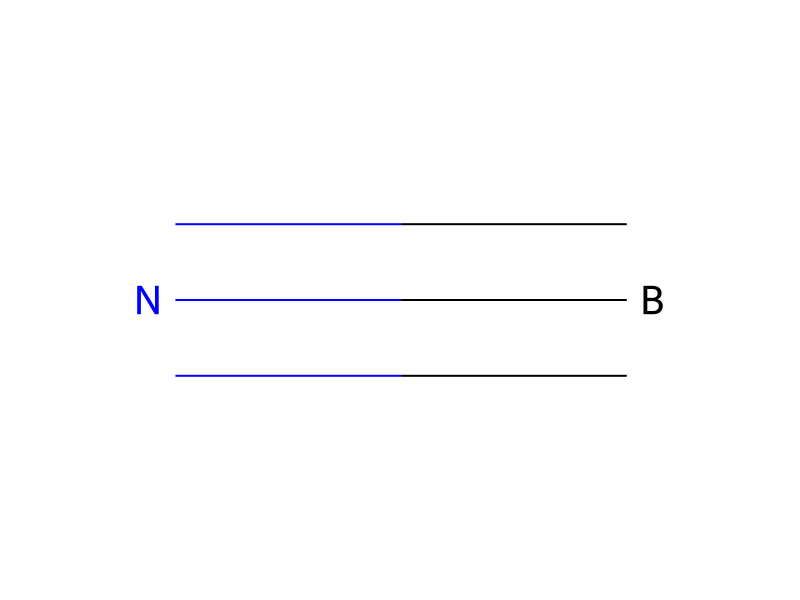
Basic information
- Standard SMILES
B#N- InChIKey
PZNSFCLAULLKQX-UHFFFAOYSA-N- Molecular formula
- BN
- Average molar mass
- 24.82 g/mol
- Monoisotopic mass
- 25.0123794
Overview
Boron nitride is a nitride.
Names & identifiers
- Preferred name
- Boron Nitride
- IUPAC
- azanylidyneborane
- English name
- Boron nitride
- Molecular formula
- BN
- Molecular weight
- 24.82
Names & synonyms
Boron nitride10043-11-5ElborBoron mononitrideBoron nitride (BN)BorazonElboronKubonitWurzinGeksanit RHexanite RHexanit R
Show more names
Hexagonal boron nitrideBoron nitride powderBoron nitriteCubic Boron nitrideBoron nitride nanopowder, APS 5-20nmBNNTNitriloboronboron mononiBORON NITRIDE NANOTUBE
Super mighty MKubonit KRDenka boron nitride GPElbor RDenka GPElbor RMSho BNSho BN HPS
Database identifiers
- CAS
10043-11-5、158535-02-5、174847-14-4- PubChem CID
- 66227
- DTXSID
DTXSID5051498- ChEBI
CHEBI:50883- EC Number
- 233-136-6
- Nikkaji
- J95.099H
Properties
Computed structural properties
- Topological polar surface area
- 23.8 Ų
- Hydrogen bond donors
- 0
- Hydrogen bond acceptors
- 1
- Rotatable bonds
- 0
- Heavy atoms
- 2
- Formal charge
- 0
- Complexity
- 10
Experimental & physicochemical properties
Chemical ClassesMetals -> Metalloid Compounds (Boron)
Cosmetics
Cosmetic ingredients (Boron Nitride) -> CIR (Cosmetic Ingredient Review)
Opacifying; Absorbent; Skin conditioning
SpringerMaterials Propertiesthermal expansion coefficient
Food Contact Substances
FCS -> FDA Cumulative Estimated Daily Intake (CEDI)
FCS -> FDA Inventory of Effective Food Contact Substance (FCS) Notifications
FCS -> FDA Inventory of Effective Food Contact Substance (FCS) Notifications
FCS -> FDA Inventory of Effective Food Contact Substance (FCS) Notifications
FCS -> FDA Inventory of Effective Food Contact Substance (FCS) Notifications
FCS -> FDA Inventory of Effective Food Contact Substance (FCS) Notifications
Physical Description
Dry Powder; Dry Powder; Liquid; Other Solid; Dry Powder; Other Solid
Solid; [Merck Index] Insoluble; [MSDSonline] Crystallizes into 3 forms: alpha (white and hexagonal), beta (high-pressure cubic), and gamma (high-pressure wurtzite structure); [Ullmann]
Physicochemical properties
- Melting point
- 2700 ℃ · 2700℃
- Boiling point
- 3000 ℃ · sublimes sl below 3000℃ [MER06]
- Density
- 0.9 · 0.9-1.1 g/mL at 25 °C
- bulk density
- 120 kg/m3 · 120kg/m3
- storage temp.
- no restrictions.
- solubility
- 2 O, · insoluble in H2O, acid solutions
- form
- Powder
- Specific Gravity
- 3.48 · 3.48
- color
- White
- PH
- 5 · 5-8 (100g/l, H2O, 20℃)(slurry)
- Viscosity
- 6 · 6-15cP (shear viscosity at 1000 s-125 °C)
- Resistivity
- 10 · 10*19 (ρ/μΩ.cm)
- Water Solubility
- 20 °C, · Soluble in water (slightly soluble) at 20°C, and water (soluble) at 95°C.
- Specific Heat Capacity
- 0.79 J/ · Cp(crystal): 0.79 J/(g·K); Cp(gas): 1.19 J/(g·K), at 25℃
- Sensitive
- Hygroscopic
- Crystal Structure
- Hexagonal
- Merck
- 14 · 14,1346
- Stability
- Stable. Incompatible with oxidizing agents, water.
- Cosmetics Ingredients Functions
- SLIP MODIFIERBULKING
- Cosmetic Ingredient Review (CIR)
- Boron nitride (10043-11-5)
- InChI
- 1S/BN/c1-2
- InChIKey
- PZNSFCLAULLKQX-UHFFFAOYSA-N
- SMILES
- B#N
- CAS DataBase Reference
- 10043 · 10043-11-5(CAS DataBase Reference)
- EWG's Food Scores
- 1 · 1
- FDA UNII
- 2 U4T60A6YD · 2U4T60A6YD
- NIST Chemistry Reference
- Boron nitride(10043-11-5)
- EPA Substance Registry System
- Boron nitride (BN) (10043-11-5)
- UNSPSC Code
- 12352302 · 12352302
- NACRES
- 24 · NA.24
- Symbol(GHS)
- 2 · GHS02,GHS05,GHS07
- Signal word
- Danger
- Hazard statements
- 226 · H226-H315-H318-H335
- Precautionary statements
- 210 · P210-P233-P240-P280-P303+P361+P353-P305+P351+P338
- Hazard Codes
- Xi
- Risk Statements
- 36 · 36/37
- Safety Statements
- 26 · 26-36
- RIDADR
- 1950 · UN1950
- WGK Germany
- 3 · 3
- RTECS
- 7800000 · ED7800000
- TSCA
- TSCA listed
- HS Code
- 2850 · 2850 00 20
- HazardClass
- 2.1 · 2.1
- Storage Class
- 13 · 13 - Non Combustible Solids
- Toxicity
- 50 orally · LD50 orally in Rabbit: > 2000 mg/kg LD50 dermal Rat > 2000 mg/kg
Safety & regulation
GHS classification
GHS Classification
This chemical does not meet GHS hazard criteria for 87.9% (422 of 480) of all reports.
Warning
H319 (11.7%): Causes serious eye irritation [Warning Serious eye damage/eye irritation]
P261, P264+P265, P271, P280, P304+P340, P305+P351+P338, P319, P337+P317, P403+P233, P405, and P501 (click each P-code to see the statement)
Aggregated GHS information provided per 480 reports by companies from 15 notifications to the ECHA C&L Inventory. Each notification may be associated with multiple companies.
Hazard information
Regulatory Information
Chemical: Boron nitride (BN)
Boron nitride (BN) is listed on the EPA's Chemical Data Reporting (CDR) system. Manufacturers and importers of Boron nitride (BN) are required to report information about their production and use of this chemical to the EPA under the Toxic Substances Control Act (TSCA). (40 eCFR Part 711)
Status: Active Update: 29-05-2018 https://echa.europa.eu/registration-dossier/-/registered-dossier/13555
Boron nitride (BN): Does not have an individual approval but may be used under an appropriate group standard
Other Safety InformationIMAP assessments - Boron nitride (BN): Environment tier I assessment
Hazards SummarySee NITRIDES.
Hazard Classes and CategoriesEye Irrit. 2 (11.7%)
Toxicology
Toxicity SummarySafe in the present practices of use and concentration. Ingredient, concentration, and use information are available in documents discoverable at https://cir-reports.cir-safety.org
Safety data
- wgk
- 3
- tsca
- TSCA listed
- rtecs
- ED7800000
- ridadr
- UN1950
- hs_code
- 2850 00 20
- Toxicity
- LD50 orally in Rabbit: > 2000 mg/kg LD50 dermal Rat > 2000 mg/kg
- risk_code
- 36/37
- Signal word
- Danger
- Symbol(GHS)
- GHS02,GHS05,GHS07
- hazard_code
- Xi
- safety_code
- 26-36
- hazard_class
- 2.1
- Storage Class
- 13 - Non Combustible Solids
- Hazard statements
- H226-H315-H318-H335
- Precautionary statements
- P210-P233-P240-P280-P303+P361+P353-P305+P351+P338
Chemistry & industry
Uses & manufacturing
Uses
CIR ingredient: Boron Nitride
Used to make alloys, semiconductors, nuclear reactors, and lubricants; [Merck Index] alpha-Boron films are used in microelectronics; beta-Boron nitride is used to make abrasive grit for grinding wheels and saws; [Ullmann]
Metal Preparation and Pouring [Category: Foundry]
U.S. Production2023: 850,000 - <1,000,000 lb
Consumer UsesNot Known or Reasonably Ascertainable
Industry UsesNot Known or Reasonably Ascertainable
Household ProductsInformation on 11 consumer products that contain Boron nitride in the following categories is provided:
Use ClassificationCosmetics -> Opacifying; Absorbent; Skin conditioning
General Manufacturing Information
Paint and Coating Manufacturing
Boron nitride (BN): ACTIVE
Applications
DescriptionBoron nitride is a material in which the extra electron of nitrogen (with respect to carbon) enables it to form structures that are isoelectronic with carbon allotropes.Boron nitride is an inorganic compound with a flat, hexagonal crystal similar to graphite, but with the carbon atoms replaced by boron and nitrogen atoms. The alternate boron and nitrogen atoms are linked to form interlocking hexagonal rings with three boron atoms and three nitrogen atoms, and the layers are held together by van der Waals forces. There is no boron-nitrogen bonding between the layers.The bond length is 1.466Å and the interlayer spacing is 3.331 Å. A spherical form (with a hexagonal crystal structure) is also available.Boron nitride can also be in cubic form in which alternately linked boron and nitrogen atoms form a tetrahedral bond network, similar to carbon atoms in diamond.
UsesBoron nitride used in the manufacture of high-temperature equipment parts due to its excellent thermal and chemical stability. It is used as a lubricant and an additive to cosmetics, paints, dental cements and pencil leads. It is also used to provide self lubricating properties to ceramics, alloys, resins, plastics and rubbers. In addition to this, it has many industrial applications such as xerographic process, laser printers, oxygen sensors and proton conductors. Cubic boron nitride is used as an abrasive material.
UsesBoron nitride is a material in which the extra electron of nitrogen (with respect to carbon) enables it to form structures that are isoelectronic with carbon allotropes. Also used in manufacture of alloys; in semiconductors, nuclear reactors, lubricants.Hexagonal boron nitride can be used as an electrical insulator; as thermocouple protection sheaths, crucibles and linings for reaction vessels; and as a coating for refractory molds used in glass forming and in superplastic forming of titanium. It can also be incorporated in ceramics, alloys, resins, plastics, and rubber to give them self-lubricating properties. Hexagonal boron nitride is used the formulation of coatings and paints for high temperature applications. It is also used as a substrate for semi-conductors, lens coatings, and transparent windows. https://www.cir-safety.org
Usesboron nitride is a synthetically manufactured white, talc-like powder that can reflect light, giving a product a sparkle effect. It is primarily used in color cosmetics to provide subtle shimmer; however, it can also be found in skin care formulations for enhancing product smoothness and slip.
General DescriptionBoron nitride in cubic form, known as Borazon, is a manufactured abrasive that was discovered by General Electric Co. Laboratories in 1957. Unlike manufactured diamond, Borazon does not have a natural counterpart. It is produced under temperatures and pressures similar to those required for diamond manufacture. Additionally, cubic boron nitride exhibits greater thermal stability compared to diamond. It remains stable at temperatures exceeding 1,371°C, while diamond reverts to graphite at temperatures above 816°C. Borazon has a Knoop hardness (K100) of 7800, which is higher than ordinary abrasives but lower than diamond.
Preparation methods
PreparationBoron nitride is prepared by heating boric oxide with ammonia: B2O3 + 2NH3 → 2BN + 3H2O Alternatively, the compound can be prepared by heating boric oxide or boric acid with ammonium chloride or an alkali metal cyanide. Purified product can be obtained by high temperature reaction of boron halide with ammonia: BCl3 + NH3 → BN + 3HCl Boron nitride can also be made from the elements by heating boron and nitrogen at red heat.
Upstream & downstream products
Upstream raw materials
Downstream products
Suppliers50 total
国药集团化学试剂有限公司86-21-63210123 · [email protected]
北京华美互利生物化工010-56205725 · [email protected]
上海阿拉丁生化科技股份有限公司400-6206333 13167063860 · [email protected]
INTATRADE GmbH+49 3493/605464 · [email protected]
河北创海生物科技有限公司+86-86-13131129325 · [email protected]
Baoji Guokang Healthchem co.,ltd+8615604608665 15604608665 · [email protected]
Dayang Chem (Hangzhou) Co.,Ltd.+86-0571-88938639 17705817739 · [email protected]
上海迈瑞尔生化科技有限公司4006356688 18621169109 · [email protected]
阿法埃莎(中国)化学有限公司400-6106006 · [email protected]
安耐吉化学&3A(安徽泽升科技股份有限公司)400-0056266 · [email protected]
北京绿百草科技发展有限公司010-61136123 · [email protected]
雨木(宁波)新材料有限公司13116661121
上海景颜化工科技有限公司13817811078 · [email protected]
上海肖晃纳米科技有限公司021-34781353 17702143778 · [email protected]
上海杳田新材料科技有限公司021-64110338 18939791287 · [email protected]
武汉丰泰威远科技有限公司027-87465837 19945049750 · [email protected]
山东西亚化学有限公司13355009207 13355009207 · [email protected]
玛雅试剂+86 (573) 82222445 (0)18006601000 452520369 · [email protected]
四川库利南科技有限公司400-1166-196 18981987031 · [email protected]
Xiamen AmoyChem Co., Ltd+86-86-5926051114 · [email protected]
南京化学试剂股份有限公司025-58369808 17895012682 · [email protected]
武汉吉业升化工有限公司027-13545242311 13545242311 · [email protected]
河南多贝化工有限公司0370-2785118 17550508557 · [email protected]
艾科试剂4008-755-333 18080918076 · [email protected]
南京先丰纳米材料科技有限公司400-025-3200 15261867733 · [email protected]
上海将来实业股份有限公司400-0066400 13621662912 · [email protected]
上海将来实业股份有限公司021-61552785 · [email protected]
福斯曼科技(北京)有限公司64646565 18210196513 · [email protected]
上海石洋化工有限公司021-56795766 · [email protected]
成都零六生物科技有限公司400-1166-196 13458535857 · [email protected]
上海麦克林生化科技股份有限公司15221275939 15221275939 · [email protected]
杭州杰恒化工有限公司0571-87396432 · [email protected]
上海兴鲁化工科技有限公司02120970332 · [email protected]
成都润泽本土化工有限公司13096311329 028-88469284 616445927 · [email protected]
湖北巨胜科技有限公司027-59599241 18871490274 · [email protected]
池州凯隆进出口贸易有限公司[email protected]
Sigma-Aldrich西格玛奥德里奇(上海)贸易有限公司021-61415566 800-8193336 · [email protected]
大连易得瑞化工有限公司15141125520 15141125520 · [email protected]
九鼎化学(上海)科技有限公司4009209199 · [email protected]
Henan Alfa Chemical Co., Ltd+8618339805032 · [email protected]
厦门志信化学有限公司+86-5922680277 +86-13806087780 · [email protected]
Alfa Chemistry+1-5166625404 · [email protected]
成都润泽本土化工有限公司028-88469284 18000562381 · [email protected]
上海思言生物科技有限公司021-50908862,442785678,326799392 18721037013 · [email protected]
浙江亚美纳米科技有限公司400-8200386 13456373028 · [email protected]
北京华威锐科化工科技有限公司89508211 18501085097 · [email protected]
上海西陇生化科技有限公司021-52907766-8042
上海源叶生物科技有限公司13636370518 · [email protected]
山东西亚化学有限公司4009903999 13395398332 · [email protected]
成都华纯科技有限公司400-1166-196 15982826727 · [email protected]
Additional notes
Definitionboron nitride: A solid, BN, insolublein cold water and slowly decomposedby hot water; r.d. 2.25 (hexagonal);sublimes above 3000°C. Boronnitride is manufactured by heatingboron oxide to 800°C on an acid-solublecarrier, such as calcium phosphate,in the presence of nitrogen orammonia. It is isoelectronic with carbonand, like carbon, it has a veryhard cubic form (borazon) and asofter hexagonal form; unlikegraphite this is a nonconductor. It isused in the electrical industrieswhere its high thermal conductivityand high resistance are of especialvalue.
Related reactions
1 records
Linked notes
Loading…