Reaction equation

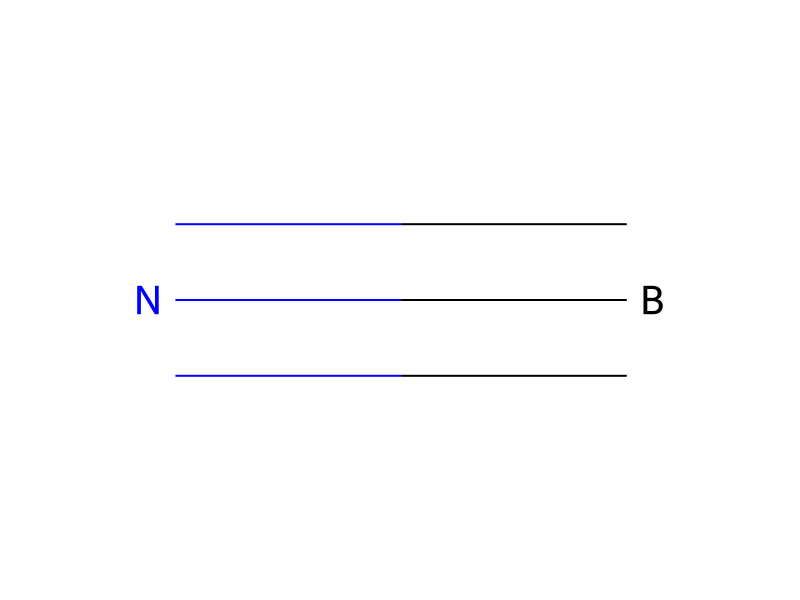
[B:1].B#[N:3].[B:4]12[B:7]3[B:8]4[B:5]1[C:6]234>>[B:4].[B:4]12[B:7]3[B:8]4[B:5]1[C:6]234.[B:1]#[N:3].[B:4]12[B:7]3[B:8]4[B:5]1[C:6]234.[B:4].[B:1]#[N:3].[B:4]12[B:7]3[B:8]4[B:5]1[C:6]234Participants


Procedure
It has thus been shown that this invention involves the fabrication of multilayer structures from thin films or coatings of boron, boron nitride, and boron carbide to form multilayer films or coatings of boron/boron carbide, boron nitride/boron carbide, and boron/boron nitride/boron carbide and involves processes which utilizes dc and rf magnetron sputtering, and simply changing the type of sputtering gas. The boron/boron carbide multilayers, are produced in an inert atmosphere, such as argon, helium, neon, krypton, and xenon, with argon being preferred; and the cubic boron nitride/boron carbide multilayers are produced in an alternating reactive and inert atmosphere with reactive gases such as nitrogen, ammonia, ammonia-nitrogen-argon, with nitrogen preferred, or a mixture of nitrogen with argon. The cubic boron nitride/boron carbide multilayers require alternate rf (c-BN) and dc (B4C) magnetron sputtering. The atmosphere may be varied during the processing to produce diffused (blended or graded) layers.
Sources & evidence
- ORD record
- ord-43c7600af66a445f94efe180531a0f2b
- Source dataset
- uspto-grants-1997_09
- Patent number
- US05670252
Linked notes
Loading…