HomeMCPWorkbenchSkills
HomeWorkbenchNotificationsMe
llms.txt · MCP GuidePrivacy Policy · Terms of Service · Supportv1.8.3
  1. Home
  2. /Compound

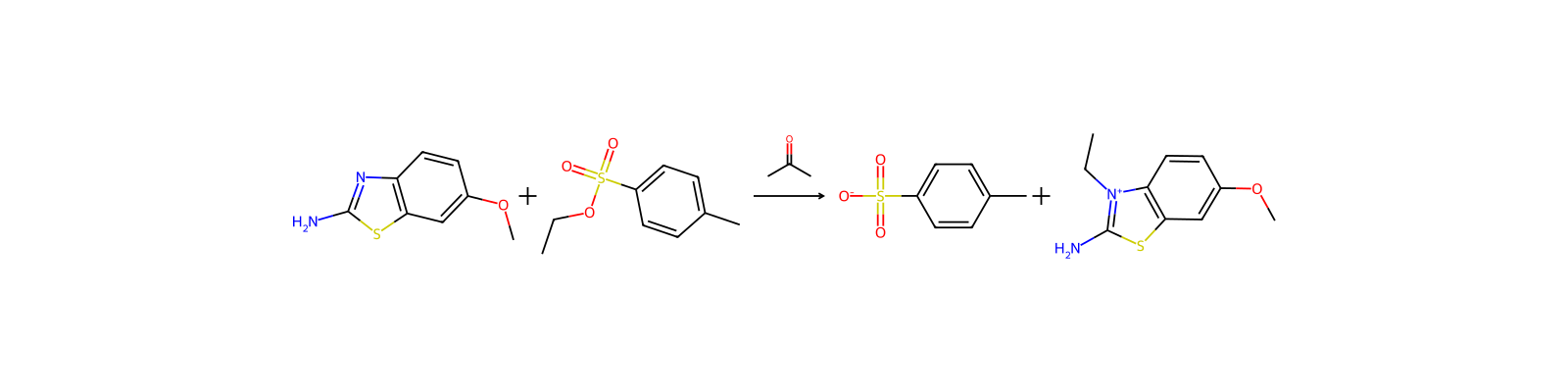
Ethyl p-methylbenzenesulfonate

HCID 6638
New reaction
Print
Basic informationNames & identifiersPropertiesSafety & regulationChemistry & industryRelated reactionsCompound notes
Substructure searchFind similar structures

Basic information

CAS
80-40-0
Standard SMILES
CCOS(=O)(=O)c1ccc(C)cc1
InChIKey
VRZVPALEJCLXPR-UHFFFAOYSA-N
Molecular formula
C9H12O3S
Average molar mass
200.26 g/mol
Monoisotopic mass
200.05071541

Names & identifiers

Preferred name
Ethyl p-methylbenzenesulfonate
IUPAC
ethyl 4-methylbenzenesulfonate
English name
Ethyl p-toluenesulfonate
Molecular formula
C9H12O3S
Molecular weight
200.25

Names & synonyms

Ethyl p-toluenesulfonate80-40-0Ethyl 4-methylbenzenesulfonateEthyl tosylateEthyl p-tosylateEthyl p-TSETHYL P-METHYLBENZENESULFONATEBenzenesulfonic acid, 4-methyl-, ethyl esterp-Toluenesulfonic acid, ethyl esterEthyl 4-toluenesulfonateEthyl-p-toluenesulfonateEthyl PTS
Show more names
Ethyl para-toluenesulfonateMittel AEP4-METHYLBENZENESULFONIC ACID, ETHYL ESTERethylpts
p-Toluolsulfonsaeure aethyl estertoluene-4-sulfonic acid ethyl esterNSC 8887Ethyl p-methyl benzenesulfonateCCRIS 10284-Methylbenzenesulfonic acid ethyl esterHSDB 5235EINECS 201-276-7

Database identifiers

CAS
80-40-0
PubChem CID
6638
DTXSID
DTXSID2058833
UNII
2160N0YURF
EC Number
201-276-7
Nikkaji
J3.853I

Properties

Computed structural properties

XLogP
1.8
Topological polar surface area
51.8 Ų
Hydrogen bond donors
0
Hydrogen bond acceptors
3
Rotatable bonds
3
Heavy atoms
13
Formal charge
0
Complexity
232

Experimental & physicochemical properties

Chemical ClassesOther Classes -> Benzenesulfonic Acid Derivatives
SpringerMaterials PropertiesDiamagnetic susceptibility
LogP · 2 items

Log kow = 1.81

1.81

Density1.17
Color/Form · 2 items

MONOCLINIC CRYSTALS

MONOCLINIC PRISMS FROM ACETIC ACID, ETHYL ACETATE

Solubility · 2 items

INSOL IN WATER; SOL IN ALC, ETHER, HOT ACETIC ACID

SOL IN HOT ETHYL ACETATE

Flash Point316 °F
Boiling Point173 °C @ 15 MM HG
Melting Point33 °C
Vapor Pressure0.000241 [mmHg]

Safety & regulation

Safety information is for reference only and does not replace the supplier’s Safety Data Sheet (SDS), applicable regulations, or professional assessment.

GHS classification

GHS Classification · 5 items

This chemical does not meet GHS hazard criteria for 0.6% (1 of 169) of reports.

Danger

H301 (65.1%): Toxic if swallowed [Danger Acute toxicity, oral]

P261, P264, P264+P265, P270, P271, P280, P301+P316, P302+P352, P304+P340, P305+P351+P338, P319, P321, P330, P332+P317, P337+P317, P362+P364, P403+P233, P405, and P501 (click each P-code to see the statement)

Aggregated GHS information provided per 169 reports by companies from 15 notifications to the ECHA C&L Inventory. Each notification may be associated with multiple companies.

Hazard information

Regulatory Information · 2 items

Chemical: Benzenesulfonic acid, 4-methyl-, ethyl ester

Benzenesulfonic acid, 4-methyl-, ethyl ester: Does not have an individual approval but may be used as a component in a product covered by a group standard. It is not approved for use as a chemical in its own right.

Hazards SummaryAn irritant; [MSDSonline]
Hazard Classes and CategoriesAcute Tox. 3 (65.1%)

Safety & protection

Disposal Methods · 1 item

SRP: At the time of review, criteria for land treatment or burial (sanitary landfill) disposal practices are subject to significant revision. Prior to implementing land disposal of waste residue (including waste sludge), consult with environmental regulatory agencies for guidance on acceptable disposal practices.

Toxicology

Chemistry & industry

Uses & manufacturing

Uses · 2 items

Used as plasticizer for cellulose acetate and as an ethylating agent; [Hawley]

PLASTICIZER FOR CELLULOSE ACETATE; ETHYLATING AGENT

General Manufacturing InformationBenzenesulfonic acid, 4-methyl-, ethyl ester: ACTIVE
Applications · 4 items

UsesEthyl p-toluenesulfonate was used to develop an extraction method for methyl and ethyl esters of various sulfonic acids in active pharmaceutical ingredients using solid-phase micro extraction coupled to GC/MS in the selected ion monitoring mode. It was used in a study to develop a fast and accurate method for determination of residues of some common alkylating agents employed in drug synthesis by in situ derivatization-headspace-gas chromatography-mass spectrometry.

UsesEthyl p-toluenesulfonate can be used in the manufacture of organic synthesis, and also can be used as intermediate of methylation reagent and sensitive material. It also is flexibilizer of cellulose acetate.

UsesFor ethylation.

General DescriptionEthyl p-toluenesulfonate (EPTS), used as a potent alkylating agent in the modern pharmaceutical industry, is classified as a potential genotoxic impurity. It is an alkyl sulfonate formed by the reaction of ethanol with p-toluenesulfonic acid during the production of active pharmaceutical ingredients. Because EPTS has the ability to alkylate DNA, it may pose risks such as carcinogenicity and teratogenicity; therefore, its content must be strictly controlled[1].

Upstream & downstream products

Upstream raw materials

Tosyl chloride

Downstream products

ethyl salicylate

Related reactions

39 records
New reaction record
HRID 5507 reaction equation
HRID 5507As reactant
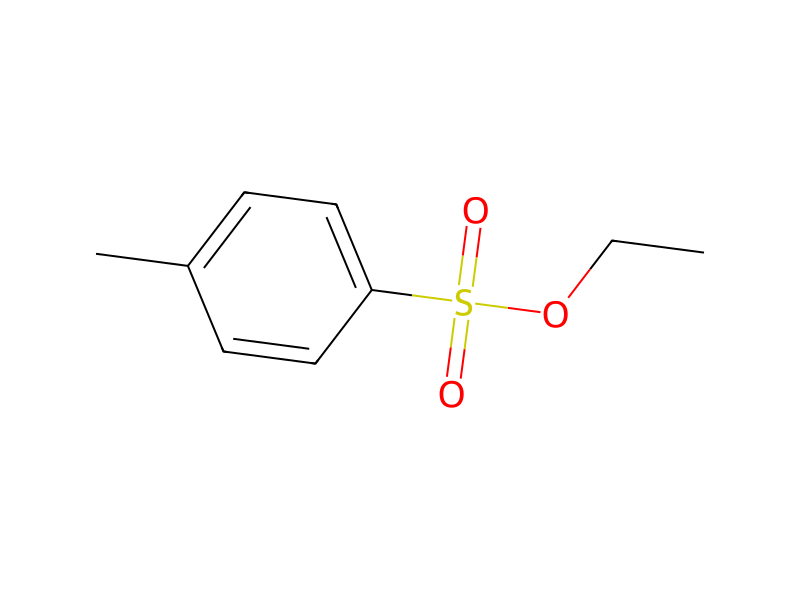
HRID 53232 reaction equation
HRID 53232As reactant
HRID 223754 reaction equation
HRID 223754As reactant
HRID 223755 reaction equation
HRID 223755As reactant
HRID 277039 reaction equation
HRID 277039As reactant
HRID 277055 reaction equation
HRID 277055As reactant
HRID 344993 reaction equation
HRID 344993As reactant
HRID 345194 reaction equation
HRID 345194As reactant
PreviousPage 1 of 5

Compound notes

On this pageBasic informationNames & identifiersPropertiesSafety & regulationChemistry & industryRelated reactionsCompound notes
Physical Description
Unstable solid; mp = 33 deg C; [Hawley] White solid; mp = 32-34 deg C; [MSDSonline]
Stability/Shelf LifeUNSTABLE SOLID

Physicochemical properties

Melting point
29 · 29-33 °C(lit.)
Boiling point
158 · 158-162 °C10 mm Hg(lit.)
Density
1.174 g/mL · 1.174 g/mL at 25 °C(lit.)
vapor pressure
0.6 hPa · 0.6 hPa (14 °C)
refractive index
20 · n20/D 1.511(lit.)
Flash point
316 °F · 316 °F
storage temp.
2 · 2-8°C
solubility
1.24 g/l · 1.24g/l
form
Liquid After Melting
color
Clear colorless to pale brown
Water Solubility
Insoluble
Sensitive
Moisture Sensitive
Merck
14 · 14,3858
BRN
611213 · 611213
InChI
1S/C9H12O3S/c1-3-12-13(10,11)9-6-4-8(2)5-7-9/h4-7H,3H2,1-2H3
InChIKey
VRZVPALEJCLXPR-UHFFFAOYSA-N
SMILES
CCOS(=O)(=O)c1ccc(C)cc1
CAS DataBase Reference
80 · 80-40-0(CAS DataBase Reference)
FDA UNII
2160 N0YURF · 2160N0YURF
NIST Chemistry Reference
4 · Benzenesulfonic acid, 4-methyl-, ethyl ester(80-40-0)
EPA Substance Registry System
4 · Benzenesulfonic acid, 4-methyl-, ethyl ester (80-40-0)
UNSPSC Code
41116107 · 41116107
NACRES
24 · NA.24
Symbol(GHS)
7 · GHS07
Signal word
Warning
Hazard statements
315 · H315-H319-H335
Precautionary statements
261 · P261-P264-P271-P280-P302+P352-P305+P351+P338
target organs
Respiratory system
PPE
95 · dust mask type N95 (US), Eyeshields, Gloves
Hazard Codes
Xi,Xn
Risk Statements
36 · 36/37/38-40-22
Safety Statements
26 · 26-45-36/37/39
RIDADR
2811 · UN2811
WGK Germany
3 · 3
RTECS
6825000 · XT6825000
F
21 · 21
Autoignition Temperature
500 °C · 500 °C
TSCA
TSCA listed
HazardClass
6.1 · 6.1
PackingGroup
III
HS Code
2904100000 · 2904100000
Storage Class
11 · 11 - Combustible Solids
Hazard Classifications
2 Skin · Eye Irrit. 2Skin Irrit. 2STOT SE 3
Hazardous Substances Data
80 · 80-40-0(Hazardous Substances Data)
Non-Human Toxicity Excerpts · 4 items

MUTAGENICITY: MUTATION RESEARCH 87: 211 (1981). DNA REPAIR-DEFICIENT BACTERIAL TESTS: POSITIVE.

65 MG/KG ADMIN SC TO BD RATS WEEKLY FOR 50 WK; 3/11 DEVELOPED LOCAL SARCOMAS AFTER 600 DAYS. /FROM TABLE/

Several direct acting mutagens were tested for mutagenic activity in adult Drosophila melanogaster when administered in feeding or as an injected dose. An inhibitor or cytochrome p450, 1-phenylimidazole, administered at concentrations of 2.5, 4 and 10 mmol, was not mutagenic in Drosophila. Methyl-p-toluenesulfonate applied orally was a weak mutagen. When administered simultaneously with 1-phenylimidazole, a concentration dependent increase was noted in mutagenic activity of methyl-p-toluenesulfonate. Following injection, mutagenesis by methyl-p-toluenesulfonate was considerable. Ethyl-p-toluenesulfonate demonstrated marginal mutagenesis in Drosophila when orally applied but was decidedly mutagenic on injection. Simultaneous treatment with 4 mmol 1-phenylimidazole and 1 mmole of ethyl-p-toluenesulfonate did not alter mutagenesis nor did treatment with diethylmaleate (glutathione depletion). Combined treatment with 2 mmol ethyl-p-toluenesulfonate and 2 mmol 1-phenylimidazole produced a statistically significant increase in mutagenesis. /It was concluded/ that weak mutagenesis by p-toluenesulfonates after feeding experiments compared to considerable effects after injection suggests metabolic deactivation in the gut.

The cancerogenic activity of 12 direct alkylating substances was tested in 535 BD rats. Local sarcomas were produced by the subcutaneous injections once a week of p-toluene sulfonic acid methylester. Only a jew tumors were observed following treatment with p-toluene sulfonic acid ethylester and p-toluenesulfonic acid butylester were not cancerogenic.

Safety data

F
21
PPE
dust mask type N95 (US), Eyeshields, Gloves
wgk
3
tsca
TSCA listed
rtecs
XT6825000
ridadr
UN2811
hs_code
2904100000
risk_code
36/37/38-40-22
Signal word
Warning
Symbol(GHS)
GHS07
hazard_code
Xi,Xn
safety_code
26-45-36/37/39
hazard_class
6.1
Storage Class
11 - Combustible Solids
packing_group
III
target organs
Respiratory system
Hazard statements
H315-H319-H335
Hazard Classifications
Eye Irrit. 2Skin Irrit. 2STOT SE 3
Autoignition Temperature
500 °C
Precautionary statements
P261-P264-P271-P280-P302+P352-P305+P351+P338
Hazardous Substances Data
80-40-0(Hazardous Substances Data)
Ethylthiocyanate
3-Fluorophenetole
5-Chloro-3-ethyl-2-methylbenzothiazolium p-toluenesulfonate
N-Ethyl-3-ethyl piperidinecarboxylate