HomeMCPWorkbenchSkills
HomeWorkbenchNotificationsMe
llms.txt · MCP GuidePrivacy Policy · Terms of Service · Supportv1.8.0
  1. Home
  2. /Compound

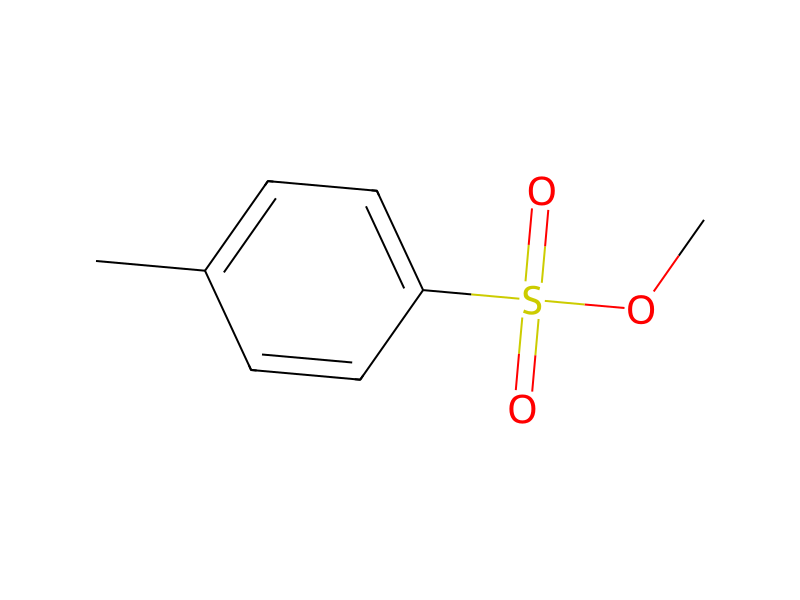
Methyl p-toluenesulfonate

HCID 6645
New noteNew reactionRequest quotes
Print preview

Completing data — refresh the page later to see the latest
Basic informationNames & identifiersPropertiesSafety & regulationChemistry & industryRelated reactionsCompound notes
Substructure searchFind similar structures

Basic information

CAS
80-48-8
Standard SMILES
COS(=O)(=O)c1ccc(C)cc1
InChIKey
VUQUOGPMUUJORT-UHFFFAOYSA-N
Molecular formula
C8H10O3S
Average molar mass
186.23 g/mol
Monoisotopic mass
186.03506535

Names & identifiers

Preferred name
Methyl p-toluenesulfonate
IUPAC
methyl 4-methylbenzenesulfonate
English name
Methyl p-toluenesulfonate
Molecular formula
C8H10O3S
Molecular weight
186.23

Names & synonyms

Methyl p-toluenesulfonate80-48-8Methyl 4-methylbenzenesulfonateMethyl tosylateMethyl toluene-4-sulfonateMethyl-p-toluenesulfonateMethyl p-tosylateMethyl toluenesulfonateMethyl toluene-4-sulphonateBenzenesulfonic acid, 4-methyl-, methyl esterp-Toluenesulfonic acid, methyl esterMethyl toluene sulfonate
Show more names
MPTSPTSMEMETHYL 4-TOLUENESULFONATEMETHYL P-TOLUENESULPHONATEMethyl para-toluenesulfonate4-TOLUENESULFONIC ACID METHYL ESTER
p-Methylbenzenesulfonate methyl esterMETHYL P-METHYLBENZENESULFONATEp-Toluolsulfonsaeure methyl esterMethyl 4-toluene sulfonate4-Toluenesulfonic acid, methyl esterMethylester kyseliny p-toluensulfonoveDTXSID40525504SU69KI68L

Database identifiers

CAS
80-48-8
PubChem CID
6645
DTXSID
DTXSID4052550
ChEMBL
CHEMBL5189891
UNII
4SU69KI68L
EC Number
201-283-5
Nikkaji
J54.424H

Properties

Computed structural propertiesFilling in

XLogP
2.2
Topological polar surface area
51.8 Ų
Hydrogen bond donors
0
Hydrogen bond acceptors
3
Rotatable bonds
2
Heavy atoms
12
Formal charge
0
Complexity
219

Experimental & physicochemical properties

Density · 2 items

1.230 @ 25 DEG/25 °C

1.230-1.238 @25 °C

Color/Form · 3 items

MONOCLINIC LEAFLETS OR PRISMS FROM ETHER-PETROLEUM ETHER

LIGHT BROWN CRYSTALS

WHITE DAMP CRYSTALS

SolubilityINSOL IN WATER; SLIGHTLY SOL IN PETROLEUM ETHER; SOL IN ETHER; VERY SOL IN ALCOHOL, BENZENE, CHLOROFORM
Flash Point306 °F (152 °C) (open cup)
Boiling Point292 °C @ 760 MM HG
Melting Point28-29 °C
Vapor Density6.45 (AIR= 1)
Physical Description · 2 items

Liquid

White vesicant solid; Solidifies at 24 deg C; [Hawley] White or light brown solid; mp = 28-29 deg C; [HSDB] Off-white low melting solid or clear liquid; mp = 27-28 deg C; [MSDSonline]

Other Experimental Properties

Safety & regulation

Safety information is for reference only and does not replace the supplier’s Safety Data Sheet (SDS), applicable regulations, or professional assessment.

GHS classification

GHS Classification · 6 items

Danger

H302 (100%): Harmful if swallowed [Warning Acute toxicity, oral];H311 (29.9%): Toxic in contact with skin [Danger Acute toxicity, dermal];H314 (22.8%): Causes severe skin burns and eye damage [Danger Skin corrosion/irritation];H315 (76.9%): Causes skin irritation [Warning Skin corrosion/irritation];H317 (97.2%): May cause an allergic skin reaction [Warning Sensitization, Skin];H319 (35%): Causes serious eye irritation [Warning Serious eye damage/eye irritation];H335 (26.2%): May cause respiratory irritation [Warning Specific target organ toxicity, single exposure; Respiratory tract irritation];H411 (29.6%): Toxic to aquatic life with long lasting effects [Hazardous to the aquatic environment, long-term hazard]

P260, P261, P262, P264, P264+P265, P270, P271, P272, P273, P280, P301+P317, P301+P330+P331, P302+P352, P302+P361+P354, P304+P340, P305+P351+P338, P305+P354+P338, P316, P319, P321, P330, P332+P317, P333+P317, P337+P317, P361+P364, P362+P364, P363, P391, P403+P233, P405, and P501 (click each P-code to see the statement)

Aggregated GHS information provided per 351 reports by companies from 26 notifications to the ECHA C&L Inventory. Each notification may be associated with multiple companies.;Information may vary between notifications depending on impurities, additives, and other factors. The percentage value in parenthesis indicates the notified classification ratio from companies that provide hazard codes. Only hazard codes with percentage values above 10% are shown. For more detailed information, please visit ECHA C&L website.

Hazard information

Regulatory Information · 4 items

Chemical: Benzenesulfonic acid, 4-methyl-, methyl ester

Benzenesulfonic acid, 4-methyl-, methyl ester is listed on the EPA's Chemical Data Reporting (CDR) system. Manufacturers and importers of Benzenesulfonic acid, 4-methyl-, methyl ester are required to report information about their production and use of this chemical to the EPA under the Toxic Substances Control Act (TSCA). (40 eCFR Part 711)

Chemistry & industry

Uses & manufacturing

Uses · 4 items

Used as methylating agent in organic synthesis and as a catalyst for alkyd resins; [HSDB]

METHYLATING AGENT IN ORGANIC SYNTHESIS

ACCELERATOR; CATALYST FOR ALKYD RESINS

CHEM INT FOR BASIC DYE C.I. 46000

U.S. Imports · 2 items

(1977) 1.35X10+7 GRAMS (PRINCPL CUSTMS DISTS)

(1979) 7.99X10+6 GRAMS (PRINCPL CUSTMS DISTS)

U.S. Production · 3 items

2022: 119,181 lb;2021: 54,718 lb;2020: 31,482 lb

(1977) NOT PRODUCED COMMERCIALLY IN US

(1979) NOT PRODUCED COMMERCIALLY IN US

Industry UsesCorrosion inhibitor
Methods of ManufacturingPROBABLY BY REACTION OF P-TOLUENESULFONYL CHLORIDE WITH METHYL ALCOHOL
Formulations/PreparationsGRADE: 97% MIN
General Manufacturing Information · 2 items

Fabricated Metal Product Manufacturing

Benzenesulfonic acid, 4-methyl-, methyl ester: ACTIVE

Applications · 4 items

UsesMethyl p-toluenesulfonate is used as a methylating agent in organic synthesis. It acts as a catalyst for alkyd resins. It is also employed in selective 1-substitution reaction of tetrazole. Further, it is used in the preparation of dyes.

UsesMethyl p-Toluenesulfonate can be used in the manufacture of dyes and organic synthesis, and also is the raw materials of methylation.

General DescriptionMethyl p-toluenesulfonate is sulfonate ester present as potentially genotoxic impurity in drug substances. Kinetics of reactions of methyl p-toluenesulfonate with N,N-dimethylaniline has been investigated. It participates in selective 1-substitution reaction of tetrazole.

Related reactions

446 records
New reaction record
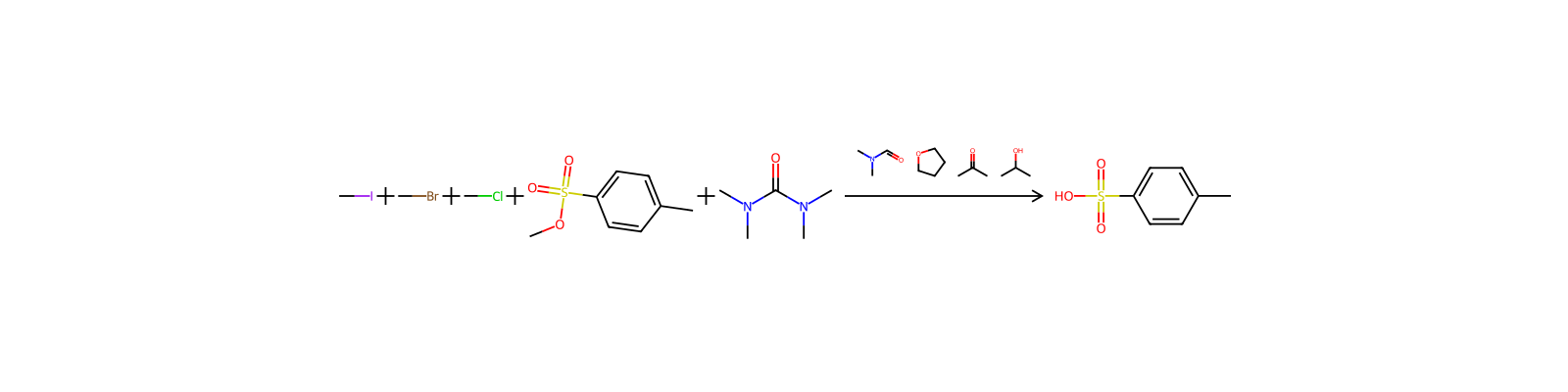
HRID 6971 reaction equation
HRID 6971As reactantuspto-grants-2006_08
HRID 6989 reaction equation
HRID 6989As reactantuspto-grants-2006_08
HRID 7199 reaction equation
HRID 7199As reactantuspto-grants-2006_08
HRID 7280 reaction equation
HRID 7280As reactantuspto-grants-2006_08
HRID 13923 reaction equation
HRID 13923As reactantuspto-grants-2010_06
HRID 13930 reaction equation
HRID 13930As reactantuspto-grants-2010_06
HRID 13941 reaction equation
HRID 13941As reactantuspto-grants-2010_06
HRID 13942 reaction equation
HRID 13942As reactantuspto-grants-2010_06
Page 1 of 56

Compound notes

Loading…

On this pageBasic informationNames & identifiersPropertiesSafety & regulationChemistry & industryRelated reactionsCompound notes
More actions
New noteNew reactionRequest quotes
· 2 items

LOW-MELTING SOLID OR LIQUID

DECOMP @ 262 °C

Physicochemical properties

Melting point
25 · 25-28 °C(lit.)
Boiling point
144 · 144-145 °C5 mm Hg(lit.)
Density
1.234 g/mL · 1.234 g/mL at 25 °C(lit.)
vapor density
6.45 · 6.45 (vs air)
vapor pressure
1 mm · 1 mm Hg ( 20 °C)
refractive index
20 · n20/D 1.5172(lit.)
Flash point
230 °F · >230 °F
storage temp.
2 · 2-8°C
solubility
Chloroform (Slightly), Methanol (Slightly)
form
Liquid or Low Melting Solid
color
White to yellow
Water Solubility
Insoluble
Sensitive
Moisture Sensitive
BRN
609209 · 609209
InChI
1S/C8H10O3S/c1-7-3-5-8(6-4-7)12(9,10)11-2/h3-6H,1-2H3
InChIKey
VUQUOGPMUUJORT-UHFFFAOYSA-N
SMILES
COS(=O)(=O)c1ccc(C)cc1
LogP
1.88 at · 1.88 at 25℃
CAS DataBase Reference
80 · 80-48-8(CAS DataBase Reference)
FDA UNII
4 SU69KI68L · 4SU69KI68L
NIST Chemistry Reference
4 · Benzenesulfonic acid, 4-methyl-, methyl ester(80-48-8)
EPA Substance Registry System
4 · Benzenesulfonic acid, 4-methyl-, methyl ester (80-48-8)
UNSPSC Code
12352108 · 12352108
NACRES
22 · NA.22
Symbol(GHS)
5 · GHS05,GHS07
Signal word
Danger
Hazard statements
302 · H302-H314-H317
Precautionary statements
260 · P260-P270-P280-P301+P312-P303+P361+P353-P305+P351+P338
PPE
3 · Eyeshields, Faceshields, Gloves, type P3 (EN 143) respirator cartridges
Hazard Codes
C,Xn
Risk Statements
22 · 22-34-43-40-36/37/38
Safety Statements
26 · 26-36/37/39-45-24
RIDADR
3261 · UN 3261 8/PG 2
WGK Germany
3 · 3
RTECS
7000000 · XT7000000
F
21 · 21
Autoignition Temperature
896 °F · 896 °F
TSCA
TSCA listed
HazardClass
8 · 8
PackingGroup
III
HS Code
29051900 · 29051900
Storage Class
8 A · 8A - Combustible corrosive hazardous materials
Hazard Classifications
4 OralEye · Acute Tox. 4 OralEye Dam. 1Skin Corr. 1BSkin Sens. 1B
Hazardous Substances Data
80 · 80-48-8(Hazardous Substances Data)
Toxicity
50 orally · LD50 orally in Rabbit: 341 mg/kg
REACH Registrations
Active

Status: Active Update: 22-02-2022 https://echa.europa.eu/registration-dossier/-/registered-dossier/21794;Status: Active Update: 11-12-2019 https://echa.europa.eu/registration-dossier/-/registered-dossier/18934

Methyl 4-toluenesulphonate: Does not have an individual approval but may be used under an appropriate group standard

Hazards Summary · 1 item

A strong skin and eye irritant; [Hawley] Urticaria and skin sensitization have been reported; [HSDB] A corrosive substance that can cause injury to the skin, eyes, and respiratory tract; Inhalation may cause chemical pneumonitis; May cause skin sensitization; [MSDSonline]

NFPA Hazard Classification · 4 items

2 - Materials that, under emergency conditions, can cause temporary incapacitation or residual injury.

1 - Materials that must be preheated before ignition can occur. Materials require considerable preheating, under all ambient temperature conditions, before ignition and combustion can occur.

0 - Materials that in themselves are normally stable, even under fire conditions.

Hazard Classes and Categories · 3 items

Acute Tox. 4 (100%);Acute Tox. 3 (29.9%);Skin Corr. 1B (22.8%);Skin Irrit. 2 (76.9%);Skin Sens. 1B (97.2%);Eye Irrit. 2 (35%);STOT SE 3 (26.2%);Aquatic Chronic 2 (29.6%)

Skin corrosion/irritation - Category 2;Serious eye damage/eye irritation - Category 2

Skin corrosion/irritation - Category 1C;Serious eye damage/eye irritation - Category 1

Skin, Eye, and Respiratory IrritationsHIGHLY TOXIC BY INHALATION; STRONG IRRITANT TO SKIN & EYES.

Safety & protection

Fire Fighting ProceduresWATER OR FOAM MAY CAUSE FROTHING.
Cleanup Methods...DECONTAMINATION OF FLOORS & EQUIPMENT MAY BE EFFECTED BY FLUSHING WITH DILUTE ALKALI OR AMMONIA.
Disposal Methods · 1 item

SRP: At the time of review, criteria for land treatment or burial (sanitary landfill) disposal practices are subject to significant revision. Prior to implementing land disposal of waste residue (including waste sludge), consult with environmental regulatory agencies for guidance on acceptable disposal practices.

Preventive Measures · 1 item

SRP: The scientific literature for the use of contact lenses in industry is conflicting. The benefit or detrimental effects of wearing contact lenses depend not only upon the substance, but also on factors including the form of the substance, characteristics and duration of the exposure, the uses of other eye protection equipment, and the hygiene of the lenses. However, there may be individual substances whose irritating or corrosive properties are such that the wearing of contact lenses would be harmful to the eye. In those specific cases, contact lenses should not be worn. In any event, the usual eye protection equipment should be worn even when contact lenses are in place.

Protective Action Criteria (PAC) · 3 items

1.0 [mg/m3]

11 [mg/m3]

68 [mg/m3]

Personal Protective Equipment (PPE)CONTAMINATED AREAS SHOULD BE ENTERED ONLY BY TRAINED PERSONNEL WITH IMPERVIOUS CLOTHING & AIR-SUPPLIED RESPIRATORS.

Toxicology

Adverse EffectsDermatotoxin - Skin burns.;Skin Sensitizer - An agent that can induce an allergic reaction in the skin.;Toxic Pneumonitis - Inflammation of the lungs induced by inhalation of metal fumes or toxic gases and vapors.
Human Toxicity Excerpts · 4 items

...CONTACT WITH SOLN OR SOLID MAY GIVE RISE TO NO SYMPTOMS FOR SEVERAL HR. ... /THEN/ THERE MAY BE...VESICATION AT SITE OF CONTACT, FREQUENTLY WITH LITTLE... PAIN. VERY LARGE BULLAE MAY BE FORMED... GENERALIZED TOXIC SYMPTOMS DO NOT SEEM TO OCCUR AND...BURNS HEAL USUALLY WITH SOME PIGMENTATION...

...THERE HAVE BEEN FEW INSTANCES OF PULMONARY IRRITATION. ...ONE INSTANCE WAS NOTED OF URTICARIAL REACTION FROM HEATED VAPOR; SKIN SENSITIZATION ALSO OCCURS.

...STRONG IRRITANT TO...EYES.

HIGHLY TOXIC BY INHALATION; STRONG IRRITANT TO SKIN & EYES.

Non-Human Toxicity Excerpts · 3 items

BD RATS RECEIVING SC 15 WEEKLY X 53 MG/KG FOR 470 DAYS: 7/10 HAD LOCAL SARCOMA, 1 BRONCHIAL, 1 MAMMARY & 1 OVARIAN CARCINOMA. /FROM TABLE/

Several direct acting mutagens were tested for mutagenic activity in adult Drosophila melanogaster when administered in feeding or as an injected dose. An inhibitor or cytochrome p450, 1-phenylimidazole, administered at concentrations of 2.5, 4 and 10 mmol, was not mutagenic in Drosophila. Methyl-p-toluenesulfonate applied orally was a weak mutagen. When administered simultaneously with 1-phenylimidazole, a concentration dependent increase was noted in mutagenic activity of methyl-p-toluenesulfonate. Following injection, mutagenesis by methyl-p-toluenesulfonate was considerable. Ethyl-p-toluenesulfonate demonstrated marginal mutagenesis in Drosophila when orally applied but was decidedly mutagenic on injection. Simultaneous treatment with 4 mmol 1-phenylimidazole and 1 mmole of ethyl-p-toluenesulfonate did not alter mutagenesis nor did treatment with diethylmaleate (glutathione depletion). Combined treatment with 2 mmol ethyl-p-toluenesulfonate and 2 mmol 1-phenylimidazole produced a statistically significant increase in mutagenesis. /It was concluded/ that weak mutagenesis by p-toluenesulfonates after feeding experiments compared to considerable effects after injection suggests metabolic deactivation in the gut.

The carcinogenic activity of 12 direct alkylating substances was tested in 535 BD rats. Local sarcomas were produced by the subcutaneous injections once a week of p-toluene sulfonic acid methylester. Only a jew tumors were observed following treatment with p-toluene sulfonic acid ethylester and p-toluenesulfonic acid butylester were not carcinogenic.

Antidote and Emergency TreatmentFIRST AID TREATMENT: CONTACT...WITH SKIN OR EYES IS INDICATION FOR RAPID AND PROLONGED IRRIGATION OF AREA WITH LARGE VOL OF WATER.

Regulatory information

Regulatory Information · 4 items

Chemical: Benzenesulfonic acid, 4-methyl-, methyl ester

Benzenesulfonic acid, 4-methyl-, methyl ester is listed on the EPA's Chemical Data Reporting (CDR) system. Manufacturers and importers of Benzenesulfonic acid, 4-methyl-, methyl ester are required to report information about their production and use of this chemical to the EPA under the Toxic Substances Control Act (TSCA). (40 eCFR Part 711)

Status: Active Update: 22-02-2022 https://echa.europa.eu/registration-dossier/-/registered-dossier/21794;Status: Active Update: 11-12-2019 https://echa.europa.eu/registration-dossier/-/registered-dossier/18934

Methyl 4-toluenesulphonate: Does not have an individual approval but may be used under an appropriate group standard

Safety data

F
21
PPE
Eyeshields, Faceshields, Gloves, type P3 (EN 143) respirator cartridges
wgk
3
tsca
TSCA listed
rtecs
XT7000000
ridadr
UN 3261 8/PG 2
hs_code
29051900
Toxicity
LD50 orally in Rabbit: 341 mg/kg
risk_code
22-34-43-40-36/37/38
Signal word
Danger
Symbol(GHS)
GHS05,GHS07
hazard_code
C,Xn
safety_code
26-36/37/39-45-24
hazard_class
8
Storage Class
8A - Combustible corrosive hazardous materials
packing_group
III
Hazard statements
H302-H314-H317
REACH Registrations
Active
Hazard Classifications
Acute Tox. 4 OralEye Dam. 1Skin Corr. 1BSkin Sens. 1B
Autoignition Temperature
896 °F
Precautionary statements
P260-P270-P280-P301+P312-P303+P361+P353-P305+P351+P338
Hazardous Substances Data
80-48-8(Hazardous Substances Data)

General DescriptionMethyl p-toluenesulfonate is a solid or liquid with a low melting point. Its melting point is 25–28°C, and it undergoes a phase transition between liquid and solid at room temperature depending on the season. Caking occurs when temperatures are low, which is a normal physical phenomenon. It is hygroscopic, so care must be taken to protect it from moisture during storage.

Preparation methods · 1 item

PreparationMethyl p-toluenesulfonate was synthesized by the reaction of p-toluenesulfonyl chloride with methanol. Mix p-toluenesulfonyl chloride and methanol, slowly add 25% sodium hydroxide solution, control the temperature below 25 °C, stop adding alkali when the pH is 9, continue stirring for 2 hours, and leave overnight. The lower layer of reactant was taken, the upper layer was extracted with benzene, the extract was recovered with benzene and then combined with the lower layer, washed with water and 5% potassium carbonate solution in turn, dried and distilled under reduced pressure to obtain the finished product of methyl p-toluenesulfonate.

Upstream & downstream products

Upstream raw materials

Tosyl chloride4-methylbenzenediazonium tetrafluoroborateTetrabutylammonium 4-toluenesulfonate[Hydroxy(tosyloxy)iodo]benzene4-Toluenesulfonyl bromide2,2,2-Trifluoroethyl methyl etherDimethylzincTrimethyl orthoacetate

Downstream products

1,3,3-Trimethyl-2-methyleneindoline5-Bromo-1,2-dimethyl-1H-imidazole2,5-diphenylthiazole3,5-Bis(2-cyanoprop-2-yl)toluene1-methyl-4-[(4-methylphenyl)sulfonyloxymethoxysulfonyl]benzene2-NonyneMethyl fluorideMethyl 3,5-dimethylbenzoate2-Chloro-1-methylpyridinium p-toluenesulfonateEthyl methyl ether3,6-diamino-2,7,10-trimethylacridinium chlorideBasic Orange 5