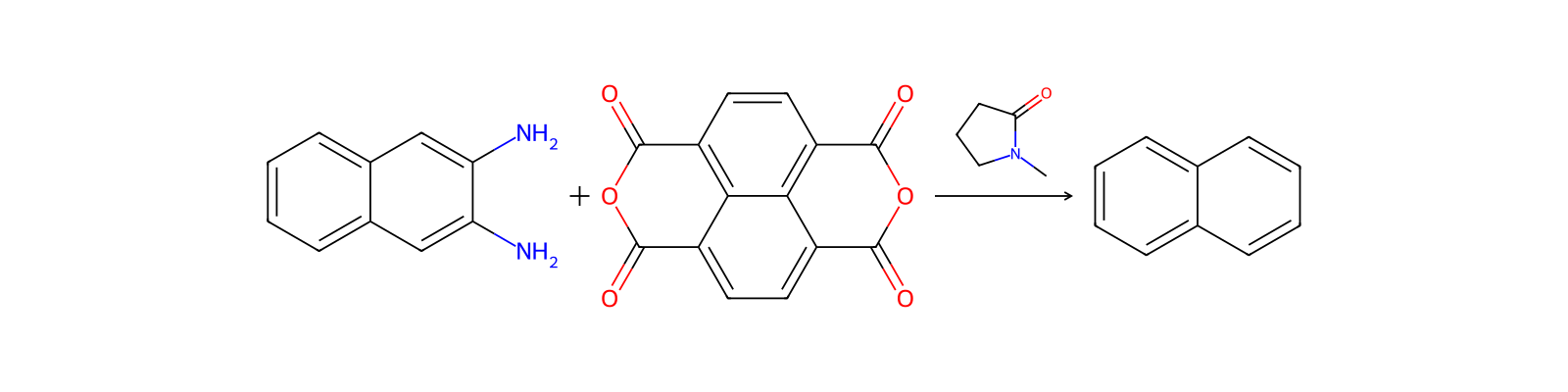
HRID 486232As reactant

81-30-1O=C1OC(=O)c2ccc3c4c(ccc1c24)C(=O)OC3=OYTVNOVQHSGMMOV-UHFFFAOYSA-Nstructure in first source
81-30-1Safety information is for reference only and does not replace the supplier’s Safety Data Sheet (SDS), applicable regulations, or professional assessment.
Warning
H315 (100%): Causes skin irritation [Warning Skin corrosion/irritation]
P261, P264, P264+P265, P271, P280, P302+P352, P304+P340, P305+P351+P338, P319, P321, P332+P317, P337+P317, P362+P364, P403+P233, P405, and P501 (click each P-code to see the statement)
Aggregated GHS information provided per 48 reports by companies from 7 notifications to the ECHA C&L Inventory. Each notification may be associated with multiple companies.
Uses1,4,5,8-Naphthalenetetracarboxylic Dianhydride is used as a reagent in the preparation of novel fluorescent markers for hypoxic cells of naphthalimides with two heterocyclic side chains for bioreductive binding.
Description1,4,5,8-Naphthalenetetracarboxylic dianhydride (NTCDA) has a naphthalene core with four carboxylic acids at the 1, 4, 5, and 8 positions, with each adjacent carboxylic acid forming an anhydride. NTCDA is aromatic, stable, planar, and highly symmetric chemically, and also possesses favourable electrical properties. Due to the electron-deficient nature of the carboxyl group, NTCDA is known to be a strong electron acceptor molecule with an electron affinity as high as 4.0 eV. It has been demonstrated that NTCDA significantly improves the electrical conductivity of co-deposited thin films of NTCDA and a wide range of metals including indium, magnesium and aluminium. The high electron conductivity of co-deposited NTCDA/In films also strongly suggests that co-deposited NTCDA/In films are excellent electron transport layers for organic light emitting diodes and photovoltaic devices.
Uses1,4,5,8-Naphthalenetetracarboxylic Dianhydride is used as a reagent in the preparation of novel fluorescent markers for hypoxic cells of naphthalimides with two heterocyclic side chains for bioreductive binding.
UsesNTCDA can be used in the fabrication of a variety of devices such as fuel cells, thin film transistors (OTFTs), lithium ion batteries, and organic photovoltaics (OPV).
General Description1,4,5,8-Naphthalenetetracarboxylic dianhydride (NTCDA) is a tetrafunctional monomer that can be used as an electron transporting material in organic electronics.
DTXSID4052554