HomeMCPWorkbenchSkills
HomeWorkbenchNotificationsMe
llms.txt · MCP GuidePrivacy Policy · Terms of Service · Supportv1.8.3
  1. Home
  2. /Compound

Trifluoromethanesulfonic anhydride

HCID 67749
New reaction
Print
Basic informationOverviewNames & identifiersPropertiesSafety & regulationChemistry & industryRelated reactionsCompound notes
Substructure searchFind similar structures

Basic information

CAS
358-23-6
Standard SMILES
O=S(=O)(OS(=O)(=O)C(F)(F)F)C(F)(F)F
InChIKey
WJKHJLXJJJATHN-UHFFFAOYSA-N
Molecular formula
C2F6O5S2
Average molar mass
282.14 g/mol
Monoisotopic mass
281.90913442

Overview

Triflic anhydride is an organosulfonic anhydride. It is functionally related to a triflic acid.

Names & identifiers

Preferred name
Trifluoromethanesulfonic anhydride
IUPAC
trifluoromethylsulfonyl trifluoromethanesulfonate
English name
Trifluoromethanesulfonic anhydride
Molecular formula
C2F6O5S2
Molecular weight
282.14

Names & synonyms

Trifluoromethanesulfonic anhydride358-23-6Triflic anhydrideTrifluoromethanesulphonic anhydride8W034LHG1UTRIFLATE ANHYDRIDEMethanesulfonic acid, 1,1,1-trifluoro-, 1,1'-anhydrideCHEBI:48509DTXSID501014629RefChem:191596DTXCID101437174206-616-8
Show more names
Trifluoromethylsulfonic anhydrideTFO2(trifluoroMethane)sulfonyl trifluoroMethanesulfonateTRIFLUOROMETHANESULFONYL ANHYDRIDE
trifluoromethanesulfonic acid anhydridetrifluoromethylsulfonyl trifluoromethanesulfonateMethanesulfonic acid, trifluoro-, anhydridetrifluoromethanesulphonic acid anhydrideTF2Otrifluoromethanesulfonyl trifluoromethanesulfonatetriflic acid anhydrideMFCD00000408

Database identifiers

CAS
358-23-6
PubChem CID
67749
DTXSID
DTXSID501014629
ChEBI
CHEBI:48509
UNII
8W034LHG1U
EC Number
206-616-8
Nikkaji
J39F

Properties

Computed structural properties

XLogP
1.6
Topological polar surface area
94.3 Ų
Hydrogen bond donors
0
Hydrogen bond acceptors
11
Rotatable bonds
2
Heavy atoms
15
Formal charge
0
Complexity
370

Experimental & physicochemical properties

Chemical ClassesOther Classes -> Acid Anhydrides, Other
PFAS · 2 items

PFAS -> PFAS identified in REACH Regulation EC No. 1272/2008

PFAS -> Suspected persistent, mobile, toxic (PMT) PFAS or PFAS-like compounds

SpringerMaterials PropertiesSchoenflies notation
Density1.677 @25 °C
Vapor Pressure · 2 items

8.0 [mmHg]

8 [mm Hg] @20 °C

Physical DescriptionColorless hygroscopic liquid; [Merck Index] Clear colorless liquid; [Sigma-Aldrich MSDS]

Physicochemical properties

Melting point
-80 °C · -80 °C
Boiling point
82 °C · 82 °C (180 °F; 355 K)
Density
1.677 g/mL · 1.6770 g/mL
vapor density
5.2 · 5.2 (vs air)
vapor pressure
8 mm · 8 mm Hg ( 20 °C)
RTECS
2772000 · PB2772000
refractive index
1.32 · 1.32
Flash point
not determined
storage temp.
30 °C · Store below +30°C.
solubility
Miscible with dichloromethane. Immiscible with hydrocarbons.
form
liquid
color
colourless
Specific Gravity
1.677 · 1.677
Water Solubility
reacts violently with water
Sensitive
Moisture Sensitive
BRN
1813600 · 1813600
Stability
Hygroscopic, Moisture Sensitive
InChI
1S/C2F6O5S2/c3-1(4,5)14(9,10)13-15(11,12)2(6,7)8
InChIKey
WJKHJLXJJJATHN-UHFFFAOYSA-N
SMILES
FC(F)(F)S(=O)(=O)OS(=O)(=O)C(F)(F)F
LogP
0.3 at · 0.3 at 25℃
CAS DataBase Reference
358 · 358-23-6(CAS DataBase Reference)
EWG's Food Scores
1 · 1
FDA UNII
8 W034LHG1U · 8W034LHG1U
NIST Chemistry Reference
Trifluoromethanesulfonic anhydride(358-23-6)
EPA Substance Registry System
Methanesulfonic acid, trifluoro-, anhydride (358-23-6)
UNSPSC Code
12352106 · 12352106
NACRES
22 · NA.22
Symbol(GHS)
3 · GHS03,GHS05,GHS07
Signal word
Danger
Hazard statements
272 · H272-H302-H314-H335
Precautionary statements
210 · P210-P220-P280-P301+P312-P303+P361+P353-P305+P351+P338
target organs
Respiratory system
PPE
Faceshields, Gloves, Goggles, type ABEK (EN14387) respirator filter
Hazard Codes
C
Risk Statements
14 · 14-21/22-34-35-22-40
Safety Statements
26 · 26-36/37/39-43-45-8
RIDADR
3265 · UN 3265 8/PG 2
WGK Germany
3 · 3
F
10 · 10-21
Hazard Note
Corrosive
TSCA
TSCA listed
HazardClass
8 · 8
PackingGroup
I
HS Code
2904990090 · 2904990090
Storage Class
5.1 B · 5.1B - Oxidizing hazardous materials
Hazard Classifications
4 OralEye · Acute Tox. 4 OralEye Dam. 1Ox. Liq. 2Skin Corr. 1BSTOT SE 3
Toxicity
50 orally · LD50 orally in Rabbit: 1012 mg/kg
REACH Registrations
Active
Limited Quantities
1 L · 1.0 L (0.3 gallons) (liquid) or 1 Kg (2.2 lbs) (solid)
Excepted Quantities
Max Inner Pack (30g or 30ml) and Max Outer Pack (500g or 500ml)

Safety & regulation

Safety information is for reference only and does not replace the supplier’s Safety Data Sheet (SDS), applicable regulations, or professional assessment.

GHS classification

GHS Classification · 4 items

Danger

H272 (51.1%): May intensify fire; oxidizer [Danger Oxidizing liquids; Oxidizing solids]

P210, P220, P260, P261, P264, P264+P265, P270, P271, P280, P301+P317, P301+P330+P331, P302+P361+P354, P304+P340, P305+P354+P338, P316, P317, P319, P321, P330, P363, P370+P378, P403+P233, P405, and P501 (click each P-code to see the statement)

Aggregated GHS information provided per 227 reports by companies from 22 notifications to the ECHA C&L Inventory. Each notification may be associated with multiple companies.

Hazard information

Regulatory Information · 3 items

Chemical: Methanesulfonic acid, trifluoro-, anhydride

REACH registered substance: Trifluoromethanesulphonic anhydride (EC: 206-616-8)

Trifluoromethanesulphonic anhydride: HSNO Approval: HSR004747 Approved with controls

Hazards Summary · 1 item

Reacts violently with water; Corrosive; [Merck Index] Reacts violently with water; Causes burns; Inhalation may cause corrosive injuries to upper respiratory tract and lungs; Harmful by ingestion; [Sigma-Aldrich MSDS] See Trifluoromethanesulfonic acid.

Hazard Classes and CategoriesOx. Liq. 2 (51.1%)
CSL Reaction Information · 6 items

CSL00005

TETRAHYDROFURAN + Triflic anhydride

Can polymerize, large exotherm. Avoid combination on larger scale.

User-Reported

6/29/18

10/2/17

Safety & protection

Protective Action Criteria (PAC) · 3 items

3.0 [mg/m3]

33 [mg/m3]

200 [mg/m3]

Toxicology

Adverse EffectsDermatotoxin - Skin burns.

Safety data

F
10-21
PPE
Faceshields, Gloves, Goggles, type ABEK (EN14387) respirator filter
wgk
3
tsca
TSCA listed
ridadr
UN 3265 8/PG 2
hs_code
2904990090
Toxicity
LD50 orally in Rabbit: 1012 mg/kg
risk_code
14-21/22-34-35-22-40
Signal word
Danger
Symbol(GHS)
GHS03,GHS05,GHS07
hazard_code
C
hazard_note
Corrosive
safety_code
26-36/37/39-43-45-8
hazard_class
8
Storage Class
5.1B - Oxidizing hazardous materials
packing_group
I
target organs
Respiratory system
Hazard statements
H272-H302-H314-H335
Limited Quantities
1.0 L (0.3 gallons) (liquid) or 1 Kg (2.2 lbs) (solid)
Excepted Quantities
Max Inner Pack (30g or 30ml) and Max Outer Pack (500g or 500ml)
REACH Registrations
Active
Hazard Classifications
Acute Tox. 4 OralEye Dam. 1Ox. Liq. 2Skin Corr. 1BSTOT SE 3
Precautionary statements
P210-P220-P280-P301+P312-P303+P361+P353-P305+P351+P338

Chemistry & industry

Uses & manufacturing

UsesUsed as a reagent in synthetic organic chemistry; [Merck Index]
General Manufacturing InformationMethanesulfonic acid, 1,1,1-trifluoro-, 1,1'-anhydride: ACTIVE
Applications · 3 items

DescriptionTrifluoromethanesulfonic anhydride, also known as triflic anhydride, has proven to be an extraordinary reagent for a broad range of transformations. As a commercially and readily available reagent, It has been widely used in synthetic chemistry due to its high electrophilicity. Given its high affinity towards O-nucleophiles, reaction with alcohols, carbonyls, sulfur phosphorus- and iodine oxides towards the formation of the corresponding triflates is strongly favored. As one of the premier leaving groups in organic chemistry, the generated triflates then open the door to various downstream transformations, including (but not limited to) substitution reactions, cross-coupling processes, redox reactions, and rearrangements[1-2].

UsesTrifluoromethanesulfonic Anhydride is a strong electrophile used in chemical synthesis for introducing the triflyl group.

UsesTrifluoromethanesulfonic anhydride is used to convert phenols and imine into triflic ester and NTf group. It is a strong electrophile used for the introduction of triflyl group in chemical synthesis. It serves as a reagent in the preparation of alkyl and vinyl triflates, and for the stereoselective synthesis of mannosazide methyl uronate donors. It acts as a catalyst for glycosylation with anomeric hydroxy sugars to prepare polysaccharides.

Upstream & downstream products

Upstream raw materials

Trifluoromethanesulfonic acidPhosphorus pentoxideBenzenesulfonic acid, 4-methyl-, anhydride with trifluoromethanesulfonic acid (9CI)bromine trifluoromethanesulfonateFluorotribromomethaneTrifluoromethanesulfonic acid trifluoromethyl ester

Downstream products

5-Amino-1,2,3-thiadiazole-4-carboxylic acid ethyl ester(S)-(-)-2,2'-Bis(di-p-tolylphosphino)-1,1'-binaphthylTroglitazone1-Fluoro-4-(trifluoromethylthio)benzene(S)-(-)-7,7'-Bis[di(3,5-dimethylphenyl)phosphino]-2,2',3,3'-tetrahydro-1,1'-spirobiindane(S)-7,7'-Bis[di(p-methylphenyl)phosphino]-1,1'-spirobiindane ,97%(R)-(+)-7,7'-Bis[di(4-methylphenyl)phosphino]-2,2',3,3'-tetrahydro-1,1'-spirobiindane(S)-(-)-2,2'-Bis(diphenylphosphino)-1,1'-binaphthyl3,5-Dimethylisoxazol-4-yl isocyanate(R)-(+)-7,7'-Bis(diphenylphosphino)-2,2',3,3'-tetrahydro-1,1'-spirobiindaneN-Phenyl-bis(trifluoromethanesulfonimide)2-(Trimethylsilyl)phenyl trifluoromethanesulfonate(R)-(+)-TolBINAP1-(3-Amino-pyridin-2-yl)-ethanone(R)-7,7'-Bis(diphenylphosphino)-1,1'-spirobiindane

Additional notes

DefinitionChEBI: Triflic anhydride is an organosulfonic anhydride. It is functionally related to a triflic acid.

Related reactions

2,071 records
New reaction record
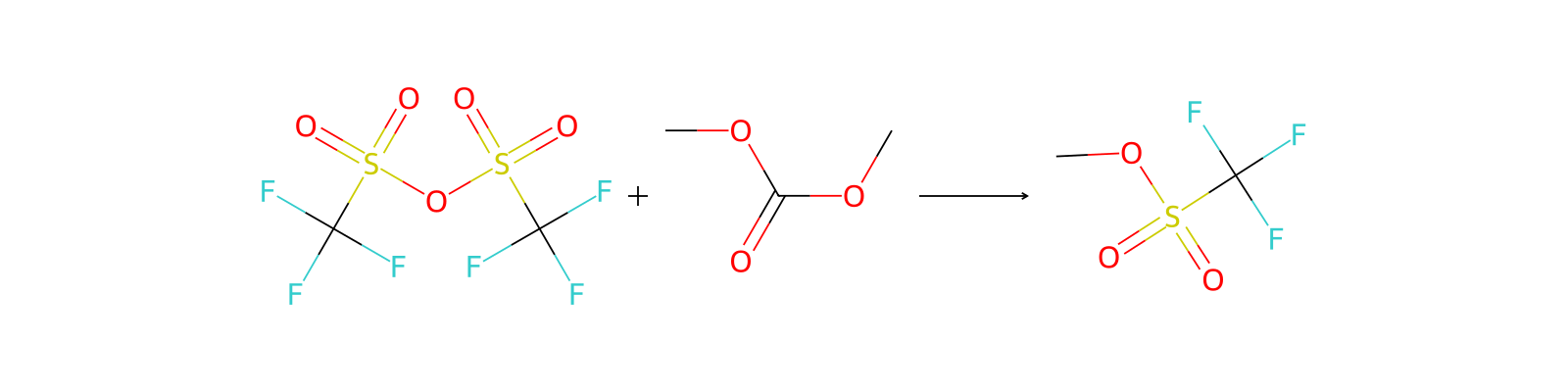
HRID 6479 reaction equation
HRID 6479As reactant
HRID 6486 reaction equation
HRID 6486As reactant
HRID 7222 reaction equation
HRID 7222As reactant
HRID 8216 reaction equation
HRID 8216As reactant
HRID 9117 reaction equation
HRID 9117As reactant
HRID 14467 reaction equation
HRID 14467As reactant
HRID 15351 reaction equation
HRID 15351As reactant
HRID 17265 reaction equation
HRID 17265As reactant
PreviousPage 1 of 259

Compound notes

On this pageBasic informationOverviewNames & identifiersPropertiesSafety & regulationChemistry & industryRelated reactionsCompound notes