
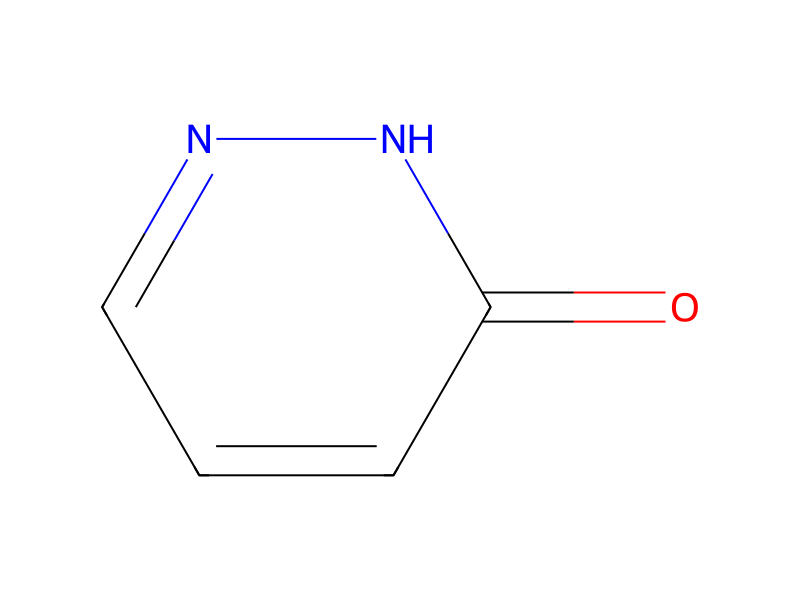
Basic information
- Standard SMILES
O=c1cccn[nH]1- InChIKey
AAILEWXSEQLMNI-UHFFFAOYSA-N- Molecular formula
- C4H4N2O
- Average molar mass
- 96.09 g/mol
- Monoisotopic mass
- 96.03236276
Names & identifiers
- Preferred name
- 3(2H)-Pyridazinone
- IUPAC
- 1H-pyridazin-6-one
- English name
- 3(2H)-Pyridazinone
- Molecular formula
- C4H4N2O
- Molecular weight
- 96.09
Names & synonyms
3(2H)-Pyridazinone504-30-3Pyridazin-3(2H)-one3-Pyridazinone6-PyridazinonePyridazine, 3-hydroxy-DTXSID90198440NSC 21411RefChem:90545DTXCID20120931628-659-5AAILEWXSEQLMNI-UHFFFAOYSA-N
Show more names
3-azineonePyridazine-3-ol3-hydropyridazine
2H-Pyridazin-3-onepyridazin-3-ol3-Hydroxypyridazine1H-pyridazin-6-one3-Pyridazinol2,3-dihydropyridazin-3-onePyridazinoneMFCD00099605
Database identifiers
- CAS
504-30-3- PubChem CID
- 68153
- DTXSID
DTXSID90198440- ChEMBL
CHEMBL3228881- UNII
- UZ5DP4K4YQ
- EC Number
- 628-659-5
- Nikkaji
- J100.657F
Properties
Computed structural properties
- XLogP
- -0.7
- Topological polar surface area
- 41.5 Ų
- Hydrogen bond donors
- 1
- Hydrogen bond acceptors
- 2
- Rotatable bonds
- 0
- Heavy atoms
- 7
- Formal charge
- 0
- Complexity
- 137
Physicochemical properties
- Melting point
- 98 · 98-104 °C
- Boiling point
- 101 °C/1.5mmHg · 101°C/1.5mmHg(lit.)
- Density
- 1.478 g/cm3 · 1.478 g/cm3
- storage temp.
- Keep in dark place,Sealed in dry,Room Temperature
- solubility
- DMSO (Slightly), Methanol (Slightly)
- form
- Solid
- pka
- 11.47 · 11.47±0.20(Predicted)
- color
- Light Red to Light Brown
- λmax
- 290 nm · 290nm(EtOH)(lit.)
- BRN
- 106974 · 106974
- InChI
- InChI=1S/C4H4N2O/c7-4-2-1-3-5-6-4/h1-3H,(H,6,7)
- InChIKey
- AAILEWXSEQLMNI-UHFFFAOYSA-N
- SMILES
- C1(=O)NN=CC=C1
- CAS DataBase Reference
- 504 · 504-30-3(CAS DataBase Reference)
- FDA UNII
- 5 DP4K4YQ · UZ5DP4K4YQ
- NIST Chemistry Reference
- 3 · 3(2H)-pyridazinone(504-30-3)
- UNSPSC Code
- 12352100 · 12352100
- NACRES
- 22 · NA.22
- Symbol(GHS)
- 7 · GHS07
- Signal word
- Warning
- Hazard statements
- 315 · H315-H319-H335
- Precautionary statements
- 261 · P261-P305+P351+P338-P280a-P304+P340-P405-P501a
- target organs
- Respiratory system
- PPE
- 95 · dust mask type N95 (US), Eyeshields, Gloves
- Hazard Codes
- Xi
- Risk Statements
- 36 · 36/37/38
- Safety Statements
- 26 · 26-36/37
- WGK Germany
- 3 · 3
- HS Code
- 29339900 · 29339900
- Storage Class
- 11 · 11 - Combustible Solids
- Hazard Classifications
- 2 Skin · Eye Irrit. 2Skin Irrit. 2STOT SE 3
Safety & regulation
GHS classification
GHS Classification
Warning
H315 (100%): Causes skin irritation [Warning Skin corrosion/irritation];H319 (100%): Causes serious eye irritation [Warning Serious eye damage/eye irritation];H335 (97.7%): May cause respiratory irritation [Warning Specific target organ toxicity, single exposure; Respiratory tract irritation]
P261, P264, P264+P265, P271, P280, P302+P352, P304+P340, P305+P351+P338, P319, P321, P332+P317, P337+P317, P362+P364, P403+P233, P405, and P501 (click each P-code to see the statement)
Aggregated GHS information provided per 43 reports by companies from 5 notifications to the ECHA C&L Inventory. Each notification may be associated with multiple companies.;Information may vary between notifications depending on impurities, additives, and other factors. The percentage value in parenthesis indicates the notified classification ratio from companies that provide hazard codes. Only hazard codes with percentage values above 10% are shown. For more detailed information, please visit ECHA C&L website.
Hazard information
Regulatory InformationCommission Regulation No 844/2012
Hazard Classes and CategoriesSkin Irrit. 2 (100%);Eye Irrit. 2 (100%);STOT SE 3 (97.7%)
Regulatory information
Regulatory InformationCommission Regulation No 844/2012
Safety data
- PPE
- dust mask type N95 (US), Eyeshields, Gloves
- wgk
- 3
- hs_code
- 29339900
- risk_code
- 36/37/38
- Signal word
- Warning
- Symbol(GHS)
- GHS07
- hazard_code
- Xi
- safety_code
- 26-36/37
- Storage Class
- 11 - Combustible Solids
- target organs
- Respiratory system
- Hazard statements
- H315-H319-H335
- Hazard Classifications
- Eye Irrit. 2Skin Irrit. 2STOT SE 3
- Precautionary statements
- P261-P305+P351+P338-P280a-P304+P340-P405-P501a
Chemistry & industry
Applications
UsesPyridazin-3(2H)-one can be used for anti-inflammatory and analgesic drug discovery.
Upstream & downstream products
Upstream raw materials
Downstream products
Suppliers50 total
梯希爱(上海)化成工业发展有限公司021-67121386 · [email protected]
上海阿拉丁生化科技股份有限公司400-6206333 13167063860 · [email protected]
合肥翰刚医药科技有限公司+8618062405514 · [email protected]
INTATRADE GmbH+49 3493/605464 · [email protected]
Dayang Chem (Hangzhou) Co.,Ltd.+86-0571-88938639 17705817739 · [email protected]
Hebei Yanxi Chemical Co., Ltd.+86-17531190177 · [email protected]
北京安司莫森技术有限公司010-82954736 13391601435 · [email protected]
南京凯天化工有限公司+86 (25) 5860-8846 · [email protected]
上海迈瑞尔生化科技有限公司4006356688 18621169109 · [email protected]
南部县诚信科技有限公司0838-5675166 15883665058 · [email protected]
阿法埃莎(中国)化学有限公司400-6106006 · [email protected]
安耐吉化学&3A(安徽泽升科技股份有限公司)400-0056266 · [email protected]
武汉凯威斯科技有限公司86-027-67849912 · [email protected]
上海瀚鸿科技股份有限公司021-54306202 13764082696 · [email protected]
上海萃森医药科技有限公司13472757003
嘉兴市艾森化工有限公司0573-85285100 18627885956 · [email protected]
上海泰坦科技股份有限公司400-6009262 15618770481 · [email protected]
杭州东帆化学有限公司86-0571-85151182
苏州施亚生物科技有限公司86(512)5235 8471 17715136450 · [email protected]
天津希恩思生化科技有限公司400 638 7771 · [email protected]
南京斯贝源医药科技有限公司+86-25-68710855, +86-25-68710897 · [email protected]
南京维奥化工有限公司Please Send Email 18652950785 · [email protected]
成都海品信医药科技有限公司85114309 18982182443 · [email protected]
上海健超生物科技有限公司150-2103-5486 18017383231 · [email protected]
TCI AMERICA800-4238616 · [email protected]
TOKYO CHEMICAL INDUSTRY CO., LTD.03-36680489 · [email protected]
深圳康特腾科技有限公司86-0755-86635001 · [email protected]
越林试剂021-62960152 · [email protected]
上海倍卓生物科技有限公司021-61119791,13386096464 · [email protected]
上海贺康生物技术有限公司17721021104 18939837085 · [email protected]
上海将来实业股份有限公司021-61552785 · [email protected]
Labnetwork lnc.+86-27-50766799 +86-18062016861 · [email protected]
成都零六生物科技有限公司400-1166-196 13458535857 · [email protected]
上海御略医药科技有限公司021-60345187 13671753212 · [email protected]
南京一番化成生物科技有限公司025-025-52700520 18914499889
杭州杰恒化工有限公司0571-87396432 · [email protected]
上海嵩爰化工科技有限公司010-1234567 18521000990 · [email protected]
江苏艾康生物医药研发有限公司025-66028182 17714375163 · [email protected]
上海拓目化工有限公司13391076197 · [email protected]
Sigma-Aldrich西格玛奥德里奇(上海)贸易有限公司021-61415566 800-8193336 · [email protected]
AN PharmaTech Co Ltd86(21)68097365 · [email protected]
天津詹士顿医药科技有限公司022-60131465 18920720807 · [email protected]
南京益冉生物医药科技有限公司13770809694 · [email protected]
成都赛诺宁科技有限公司28-87999436 02887999436 · [email protected]
上海皓之翔生物科技有限公司(原上海拓青化工有限公司)526763801 13301653310 · [email protected]
诺尔凯立科技有限公司86-(0)21-31261262 373522135 · [email protected]
上海创拓生物科技有限公司021-64301660 18121334283;17717080373 · [email protected]
九鼎化学(上海)科技有限公司4009209199 · [email protected]
北京禾兴源科技有限公司18511709189 · [email protected]
厦门志信化学有限公司+86-5922680277 +86-13806087780 · [email protected]
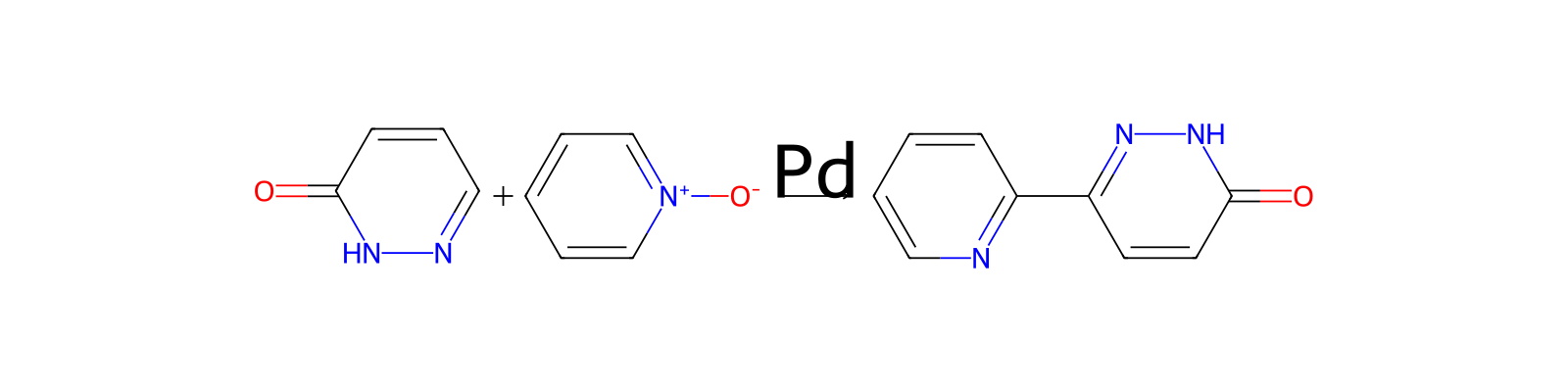
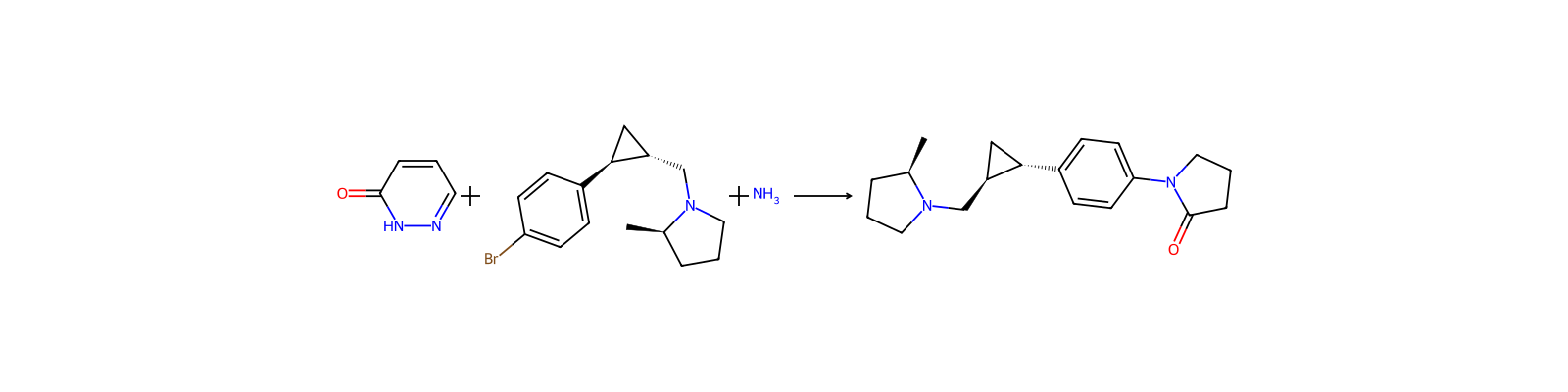
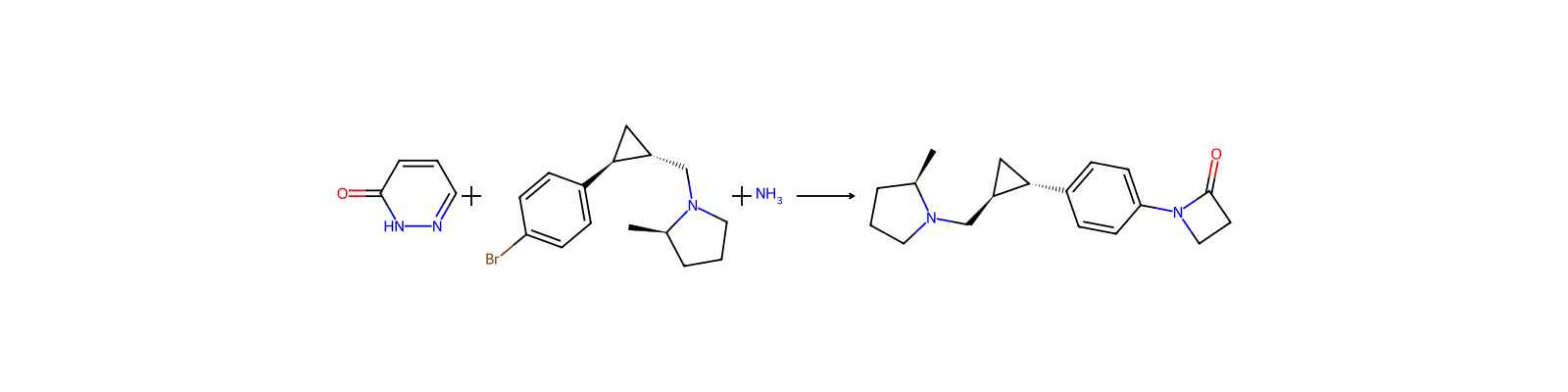
Related reactions
127 records




Linked notes
Loading…