
N-Acetyl-L-tyrosine
Completing data — refresh the page later to see the latest
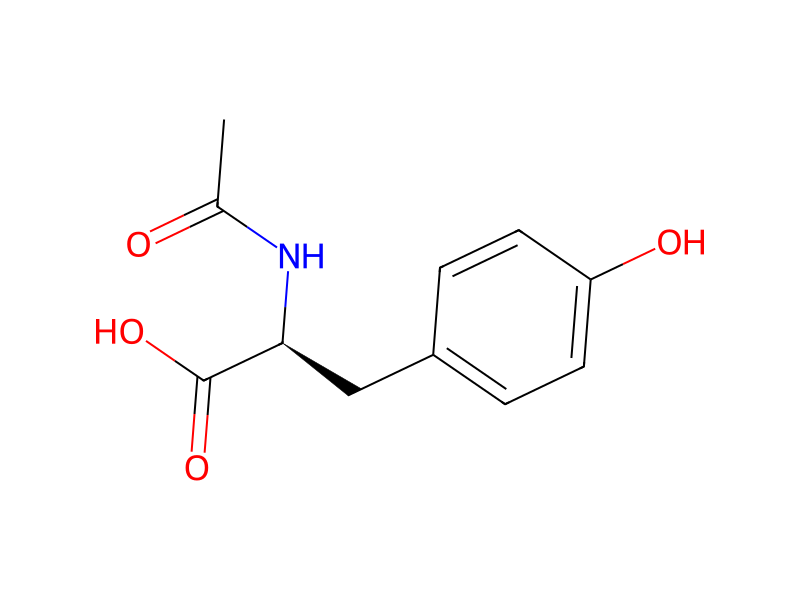
Basic information
- CAS
537-55-3- Standard SMILES
CC(=O)N[C@@H](Cc1ccc(O)cc1)C(=O)O- InChIKey
CAHKINHBCWCHCF-JTQLQIEISA-N- Molecular formula
- C11H13NO4
- Average molar mass
- 223.22 g/mol
- Monoisotopic mass
- 223.0844579
Overview
N-acetyl-L-tyrosine is an N-acetyltyrosine in which the chiral centre has L configuration. It has a role as a biomarker, an EC 2.1.1.4 (acetylserotonin O-methyltransferase) inhibitor and a human urinary metabolite. It is a N-acetyltyrosine and a N-acyl-L-tyrosine. It is a conjugate acid of a N-acetyl-L-tyrosinate.
Names & identifiers
- Preferred name
- N-Acetyl-L-tyrosine
- IUPAC
- (2S)-2-acetamido-3-(4-hydroxyphenyl)propanoic acid
- English name
- N-Acetyl-L-tyrosine
- Molecular formula
- C11H13NO4
- Molecular weight
- 223.23
Names & synonyms
N-Acetyl-L-tyrosineN-AcetyltyrosineAcetyl tyrosineL-Tyrosine, N-acetyl-L-Tyrosine, acetyl-DTXSID7046045N-Acetyltyrosine (VAN)UNII-DA8G610ZO5L-N-acetyl-TyrosineTANOGEN HBTYR-EXCELACETYL L-TYROSINE
Show more names
AC-TYR-OHACETYL-L-TYROSINEACETYLTYROSINEN-ACEYL-L-TYROSINEn-acetyl-l-tyrosin-tyrosineN-Acetyl-Thiazolidine-4-carboxylic acid amino acidN-Ac-TyrN-AC-L-TYR
EINECS 208-671-3NSC 10853Tyrosine, N-acetyl-, L-L-TYROSINE, N-ACETYLDTXCID5026045N-ACETYL-L-TYROSINE [USP-RS]N-ACETYLTYROSINE [EP MONOGRAPH](2S)-2-(acetylamino)-3-(4-hydroxyphenyl)propanoic acid
Database identifiers
- CAS
537-55-3- PubChem CID
- 68310
- DTXSID
Properties
Computed structural propertiesFilling in
- XLogP
- -0.2
- Topological polar surface area
- 86.6 Ų
- Hydrogen bond donors
- 3
- Hydrogen bond acceptors
- 4
- Rotatable bonds
- 4
- Heavy atoms
- 16
- Formal charge
- 0
- Complexity
- 259
Experimental & physicochemical properties
DrugsPharmaceuticals -> Listed in ZINC15
Cosmetics
Cosmetic ingredients (Acetyl Tyrosine) -> CIR (Cosmetic Ingredient Review)
Tanning
LogP1.320
Solubility297 mg/mL
Boiling Point530.00 to 533.00 °C. @ 760.00 mm Hg
Melting Point
149-152
149 - 152 °C
Physical DescriptionSolid
Collision Cross Section154.5 Ų [M+Na]+ [CCS Type: DT; Method: single field calibrated with Agilent tune mix (Agilent)]
Physicochemical properties
- Melting point
- 149 · 149-152 °C(lit.)
Safety & regulation
Safety information is for reference only and does not replace the supplier’s Safety Data Sheet (SDS), applicable regulations, or professional assessment.
GHS classification
GHS Classification
This chemical does not meet GHS hazard criteria for 15.5% (61 of 394) of reports.
Danger
H318 (84.3%): Causes serious eye damage [Danger Serious eye damage/eye irritation]
P264+P265, P280, P305+P354+P338, and P317 (click each P-code to see the statement)
Aggregated GHS information provided per 394 reports by companies from 4 notifications to the ECHA C&L Inventory.
Hazard information
Regulatory Information
Chemical: L-Tyrosine, N-acetyl-
L-Tyrosine, N-acetyl-: Does not have an individual approval but may be used under an appropriate group standard
Other Safety InformationEvaluation - Chemicals that are unlikely to require further regulation to manage risks to environment
Hazard Classes and CategoriesEye Dam. 1 (84.3%)
Toxicology
Toxicity Summary
The panel concluded that the 115 amino acid alkyl amides listed below are safe in the present practices of use and concentration in cosmetics, when formulated to be non-irritating...Acetyl Tyrosine
Safe for use in cosmetics, with qualifications
Safety data
- F
- 10
- wgk
- 3
- tsca
- TSCA listed
- hs_code
- 29242995
Chemistry & industry
Pharmacology
PharmacodynamicsN-acetyltyrosine is used as a high solubility precursor to [DB00135] used due to [DB00135]'s poor solubility. It is deacetylated to form [DB00135].
Mechanism of ActionUsed as a source of [DB00135]. See [DB00135] for more information on its role and pharmacology.
Absorption, Distribution and Excretion
N-acetyltyrosine is eliminated in the urine. The extent of urinary elimination versus utilization in the tissues appears to be related to the rapidity of infusion. When infused slowly in standard doses as in the clinical setting, about 35% is excreted unchanged in the urine. When larger doses are infused rapidly, much higher amounts are excreted reaching values up to 56%. In rat studies it was found that of the drug eliminated in the urine about 74% is present as unchanged N-acetyltyrosine and 23% is present as tyrosine.
Cellular LocationsCytoplasm
Uses & manufacturing
UsesCIR ingredient: Acetyl Tyrosine
Use ClassificationCosmetics -> Tanning
General Manufacturing InformationL-Tyrosine, N-acetyl-: ACTIVE
Applications
UsesN-Acetyl-L-tyrosine is involved in catecholamine production. It can be used as a cell culture media component in the commercial biomanufacture of therapeutic recombinant proteins and monoclonal antibodies.
Upstream & downstream products
Upstream raw materials
Related reactions
6 records


Compound notes
Loading…