
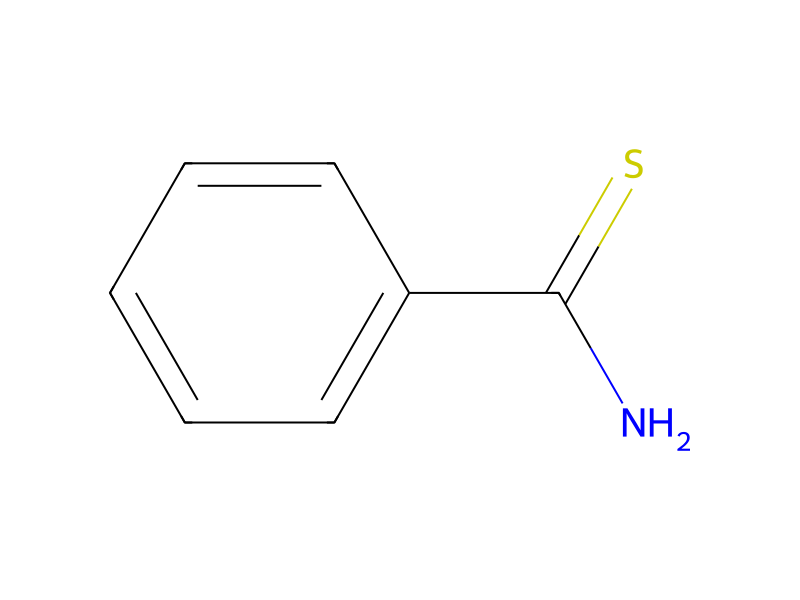
Basic information
- Standard SMILES
NC(=S)c1ccccc1- InChIKey
QIOZLISABUUKJY-UHFFFAOYSA-N- Molecular formula
- C7H7NS
- Average molar mass
- 137.2 g/mol
- Monoisotopic mass
- 137.0299204
Names & identifiers
- Preferred name
- Thiobenzamide
- IUPAC
- benzenecarbothioamide
- English name
- Thiobenzamide
- Molecular formula
- C7H7NS
- Molecular weight
- 137.2
Names & synonyms
THIOBENZAMIDEBenzenecarbothioamideBenzothioamide2227-79-48799VM9SXCDTXSID8062280RefChem:189418DTXCID3036654218-765-6Benzamide, thio-BenzothiamideTiobenzamide
Show more names
thio-benzamidCompound Fr13716Thiobenzamide,95%
MFCD00008060CHEMBL3739883aminophenylmethane-1-thionePhenylthioamideTiobenzamide [Italian]EINECS 218-765-6UNII-8799VM9SXCthio-benzamide
Database identifiers
- CAS
2227-79-4- PubChem CID
- 683563
- DTXSID
DTXSID8062280- ChEMBL
CHEMBL3739883- ChEBI
CHEBI:80418- UNII
- 8799VM9SXC
- EC Number
- 218-765-6
- Nikkaji
- J29.488H
Properties
Computed structural properties
- XLogP
- 1.5
- Topological polar surface area
- 58.1 Ų
- Hydrogen bond donors
- 1
- Hydrogen bond acceptors
- 1
- Rotatable bonds
- 1
- Heavy atoms
- 9
- Formal charge
- 0
- Complexity
- 105
Physicochemical properties
- Melting point
- 113 · 113-117 °C (lit.)
- Boiling point
- 180 °C · 180 °C
- Density
- 1.1364 · 1.1364 (rough estimate)
- refractive index
- 1.55 · 1.5500 (estimate)
- Flash point
- 120 °C · 120°C
- storage temp.
- Sealed in dry,Room Temperature
- form
- Crystalline Powder
- pka
- 12.68 · 12.68±0.29(Predicted)
- color
- yellow
- Water Solubility
- Slightly soluble in water.
- BRN
- 606021 · 606021
- InChI
- InChI=1S/C7H7NS/c8-7(9)6-4-2-1-3-5-6/h1-5H,(H2,8,9)
- InChIKey
- QIOZLISABUUKJY-UHFFFAOYSA-N
- SMILES
- C1(C(N)=S)=CC=CC=C1
- CAS DataBase Reference
- 2227 · 2227-79-4(CAS DataBase Reference)
- EWG's Food Scores
- 1 · 1
- FDA UNII
- 8799 VM9SXC · 8799VM9SXC
- EPA Substance Registry System
- Benzenecarbothioamide (2227-79-4)
- UNSPSC Code
- 12352100 · 12352100
- NACRES
- 22 · NA.22
- Symbol(GHS)
- 6 · GHS06
- Signal word
- Danger
- Hazard statements
- 301 · H301
- Precautionary statements
- 264 · P264-P270-P301+P310-P405-P501
- PPE
- 2 · Eyeshields, Faceshields, Gloves, type P2 (EN 143) respirator cartridges
- Hazard Codes
- T
- Risk Statements
- 25 · 25
- Safety Statements
- 45 · 45-24/25
- RIDADR
- 2811 · UN 2811 6.1/PG 3
- WGK Germany
- 3 · 3
- RTECS
- 5860000 · CV5860000
- TSCA
- TSCA listed
- HazardClass
- 6.1 · 6.1
- PackingGroup
- III
- HS Code
- 29309090 · 29309090
- Storage Class
- 6.1 C · 6.1C - Combustible acute toxic Cat.3toxic compounds or compounds which causing chronic effects
- Hazard Classifications
- 3 Oral · Acute Tox. 3 Oral
- Toxicity
- 180 mmol/kg · mnt-mus-orl 180 mmol/kg MUREAV 192,141,87
- Limited Quantities
- 5 kg · 5.0 kg (11 lbs) (solid)
- Excepted Quantities
- Max Inner Pack (30g or 30ml) and Max Outer Pack (1Kg or 1L)
Safety & regulation
GHS classification
GHS Classification
Danger
H301 (100%): Toxic if swallowed [Danger Acute toxicity, oral]
P264, P270, P301+P316, P321, P330, P405, and P501 (click each P-code to see the statement)
Aggregated GHS information provided per 48 reports by companies from 3 notifications to the ECHA C&L Inventory.;Information may vary between notifications depending on impurities, additives, and other factors. The percentage value in parenthesis indicates the notified classification ratio from companies that provide hazard codes. Only hazard codes with percentage values above 10% are shown. For more detailed information, please visit ECHA C&L website.
Hazard information
Regulatory InformationBenzenecarbothioamide: Does not have an individual approval but may be used under an appropriate group standard
Hazard Classes and CategoriesAcute Tox. 3 (100%)
Regulatory information
Regulatory InformationBenzenecarbothioamide: Does not have an individual approval but may be used under an appropriate group standard
Safety data
- PPE
- Eyeshields, Faceshields, Gloves, type P2 (EN 143) respirator cartridges
- wgk
- 3
- tsca
- TSCA listed
- rtecs
- CV5860000
- ridadr
- UN 2811 6.1/PG 3
- hs_code
- 29309090
- Toxicity
- mnt-mus-orl 180 mmol/kg MUREAV 192,141,87
- risk_code
- 25
- Signal word
- Danger
- Symbol(GHS)
- GHS06
- hazard_code
- T
- safety_code
- 45-24/25
- hazard_class
- 6.1
- Storage Class
- 6.1C - Combustible acute toxic Cat.3toxic compounds or compounds which causing chronic effects
- packing_group
- III
- Hazard statements
- H301
- Limited Quantities
- 5.0 kg (11 lbs) (solid)
- Excepted Quantities
- Max Inner Pack (30g or 30ml) and Max Outer Pack (1Kg or 1L)
- Hazard Classifications
- Acute Tox. 3 Oral
- Precautionary statements
- P264-P270-P301+P310-P405-P501
Chemistry & industry
Pharmacology
MeSH Pharmacological Classification
Drugs used in the treatment of tuberculosis. They are divided into two main classes: first-line agents, those with the greatest efficacy and acceptable degrees of toxicity used successfully in the great majority of cases; and second-line drugs used in drug-resistant cases or those in which some other patient-related condition has compromised the effectiveness of primary therapy.
Uses & manufacturing
General Manufacturing InformationBenzenecarbothioamide: ACTIVE
Applications
UsesThiobenzamide is useful for the preparation of amide and amidine adducts. It is also used to prepare 4-oxo-4H-chromene-3-carbothioic acid N-phenylamides. Further, it acts as a raw material in organic synthesis.
UsesThiobenzamide was used to prepare amide and amidine adducts. It was also used in the synthesis of 4-oxo-4H-chromene-3-carbothioic acid N-phenylamides.
Upstream & downstream products
Upstream raw materials
Downstream products
Suppliers50 total
国药集团化学试剂有限公司86-21-63210123 · [email protected]
梯希爱(上海)化成工业发展有限公司021-67121386 · [email protected]
上海阿拉丁生化科技股份有限公司400-6206333 13167063860 · [email protected]
南通润丰石油化工有限公司66017690 19952660367 · [email protected]
盐城通铭生物科技有限公司15195160625 · [email protected]
天津瑞德法莫科技有限公司13821803402 · [email protected]
河北创海生物科技有限公司+86-86-13131129325 · [email protected]
上海瀚麟生物科技有限公司183-0212-4410 18302124410 · [email protected]
Dayang Chem (Hangzhou) Co.,Ltd.+86-0571-88938639 17705817739 · [email protected]
科瑞迪化学400-821-5857 021-64326257 · [email protected]
毕佳索(上海毕得医药科技股份有限公司)400-6005915 · [email protected]
Syntechem Co.,Ltd[email protected]
上海迈瑞尔生化科技有限公司4006356688 18621169109 · [email protected]
北京华威锐科化工有限公司0757-86329057 18934348241 · [email protected]
阿法埃莎(中国)化学有限公司400-6106006 · [email protected]
安耐吉化学&3A(安徽泽升科技股份有限公司)400-0056266 · [email protected]
武汉卡诺斯科技有限公司027-83238443 15327105076 · [email protected]
上海瀚鸿科技股份有限公司021-54306202 13764082696 · [email protected]
南京圣亿来化工有限公司19951936396 · [email protected]
上海相辉医药科技有限公司13761987713 · [email protected]
Pure Chemistry Scientific Inc.001-857-928-2050 or 1-888-588-9418 · [email protected]
郑州研德生物科技有限公司0371-63682289 15538176268 · [email protected]
武汉丰泰威远科技有限公司+86-27-8746-5837 +86-18627785180 · [email protected]
玛雅试剂+86 (573) 82222445 (0)18006601000 452520369 · [email protected]
四川库利南科技有限公司400-1166-196 18981987031 · [email protected]
天津希恩思生化科技有限公司400 638 7771 · [email protected]
南京化学试剂股份有限公司025-58369808 17895012682 · [email protected]
艾科试剂4008-755-333 18080918076 · [email protected]
上海思域化工科技有限公司86-21-34053660 · [email protected]
赛默飞世尔科技(中国)有限公司800-810-5118 · [email protected]
北京伊诺凯科技有限公司400-810-7969 010-59572699 · [email protected]
上海遐瑞医药科技有限公司+86 21 61551611
南京诺利斯医药科技有限公司13901585132 · [email protected]
上海健超生物科技有限公司150-2103-5486 18017383231 · [email protected]
TOKYO CHEMICAL INDUSTRY CO., LTD.03-36680489 · [email protected]
深圳振强药物研发有限公司0755-66853366 13670046396 · [email protected]
上海昶衍化工科技有限公司021-20242659 18930833303 · [email protected]
北京环宇世纪化学科技有限公司hysj_bj.com
上海将来实业股份有限公司021-61552785 · [email protected]
安徽科迪达化工有限公司0554-2106669 · [email protected]
HBCChem, Inc.+1-510-219-6317 · [email protected]
雷丁试剂0510-85629785 18013409632 · [email protected]
北京福源坊科技有限公司010-57903446 15869909019 · [email protected]
杭州杰恒化工有限公司0571-87396432 · [email protected]
Sigma-Aldrich西格玛奥德里奇(上海)贸易有限公司021-61415566 800-8193336 · [email protected]
九鼎化学(上海)科技有限公司4009209199 · [email protected]
杭州凯邦生物科技有限公司0571-88937695 88937835 13606537248 · [email protected]
上海珈得尔化学技术有限公司021-4007787-550 400-7787-550 · [email protected]
sgtlifesciences pvt ltd+91-8790379245 · [email protected]
成都润泽本土化工有限公司028-88469284 18000562381 · [email protected]
Additional notes
DefinitionChEBI: Thiobenzamide is a member of benzenes.
Related reactions
134 records


Linked notes
Loading…