
HRID 1514003As reactant
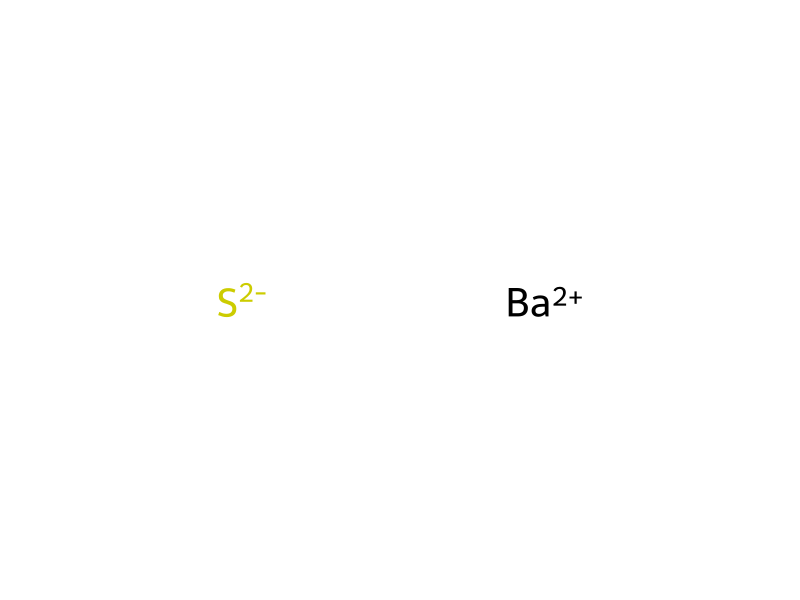
21109-95-5[Ba+2].[S-2]CJDPJFRMHVXWPT-UHFFFAOYSA-NBarium sulfide is a sulfide salt and a barium salt.
21109-95-5、50864-67-0、8011-62-9DTXSID30892157CHEBI:32590Dry Powder
Water-soluble, gray powder; [Hawley] Smells like rotten eggs; Hydrolyzes in water; [MSDSonline]
Safety information is for reference only and does not replace the supplier’s Safety Data Sheet (SDS), applicable regulations, or professional assessment.
Warning
H302: Harmful if swallowed [Warning Acute toxicity, oral]
P261, P264, P270, P271, P273, P301+P317, P304+P340, P317, P330, P391, and P501 (click each P-code to see the statement)
Danger
H290 (82.7%): May be corrosive to metals [Warning Corrosive to Metals]
P234, P260, P261, P264, P270, P271, P273, P280, P301+P316, P301+P317, P301+P330+P331, P302+P361+P354, P304+P340, P305+P354+P338, P316, P317, P321, P330, P363, P390, P391, P405, P406, and P501 (click each P-code to see the statement)
Chemical: Barium sulfide (BaS)
Barium sulfide (BaS) is listed on the EPA's Chemical Data Reporting (CDR) system. Manufacturers and importers of Barium sulfide (BaS) are required to report information about their production and use of this chemical to the EPA under the Toxic Substances Control Act (TSCA). (40 eCFR Part 711)
REACH registered substance: Barium sulphide (EC: 244-214-4)
Met. Corr. 1 (82.7%)
Hazardous to the aquatic environment (acute) - category 1
Acute toxicity (Oral) - Category 4
Acute Tox. 4 *
Barium compounds are absorbed via ingestion and inhalation, the extent of which depends on the individual compound. In the body, the majority of the barium is found in the bone, while small amounts exists in the muscle, adipose, skin, and connective tissue. Barium is not metabolized in the body, but it may be transported or incorporated into complexes or tissues. Barium is excreted in the urine and faeces. (L214)
Used to remove hair and to make luminous paints, lithopone, and vulcanized rubber; [Merck Index] Used for dehiding, flame retarding, and as a paint additive; [Hawley] Used in metallic patinas; [www.ci.tucson.az.us/arthazards/medium.html]
Painting (Pigments, Binders, and Biocides) [Category: Paint]
Applying metallic patinas [Category: Hobbies]
Barium sulfide is the precursor to barium carbonate and the pigment lithopone. (L211)
All Other Basic Inorganic Chemical Manufacturing
Barium sulfide (BaS): ACTIVE
DescriptionBarium sulfide (BaS) belongs to the inorganic compound that possesses different characters, which allows it to be applied in a variety of fields. It is primarily used as an important precursor to produce other barium compounds, such as barium carbonate as well as the pigment lithopone (ZnS•BaSO4). Similar to other chalcogenides of the alkaline earth metals, barium sulfide can be employed as a short short wavelength emitter for electronic displays and used in electronics, paint pigments, dehairing hides, flame retardant, luminous paints, and producing pure hydrogen sulfide. Besides, barium sulfide is effective to deviate X-rays and helps to give clearly image of the soft tissue.
The health effects of the different barium compounds depend on how well the compound dissolves in water or the stomach contents. At low doses, barium acts as a muscle stimulant, while higher doses affect the nervous system, causing cardiac irregularities, tremors, weakness, anxiety, dyspnea, paralysisand possibly death. Barium may also cause gastrointestinal disturbances, damage the kidneys and cause decreases in body weight. (L214)
Barium is a competitive potassium channel antagonist that blocks the passive efflux of intracellular potassium, resulting in a shift of potassium from extracellular to intracellular compartments. The intracellular translocation of potassium results in a decreased resting membrane potential, making the muscle fibers electrically unexcitable and causing paralysis. Some of these barium's effects may also be due to barium induced neuromuscular blockade and membrane depolarization. (L214)
Ingesting excess barium may cause vomiting, abdominal cramps, diarrhea, difficulties in breathing, increased or decreased blood pressure, numbness around the face, and muscle weakness. High levels may result in changes in heart rhythm or paralysis and possibly death. (L214)
OccurrenceBarium sulfide occurs in the form of black ash, which is a gray to black impure product obtained from high temperature carbonaceous reduction of barite. It is the starting material in the manufacture of most barium compounds including barium chloride and barium carbonate. It is used in luminous paints; for dehairing hides; as a flame retardant; and for generating H2S.
UsesBarium sulfide has different characters, so it is used in a variety of ways, such as in electronics, paint pigments, dehairing hides, flame retardant, luminous paints, and generating pure hydrogen sulfide. Barium sulfide can deviate X-rays and helps to give clearly image of the soft tissue. Barium sulfide is a precursor to other barium compounds and also used as a short wavelength emitters for electronic displays.
UsesAs depilatory; in luminous paints; manufacture of lithopone; vulcanizing rubber, generating H2S.
General DescriptionBarium sulfide (BaS) is an inorganic compound that is used as a precursor in the production of barium compounds. These compounds can be used in a variety of applications, such as ceramics, luminous paints, additives, and flame retardants.
PreparationBarium sulfide can be prepared by the direct reaction of the elements, calcined in an inert atmosphere, at a 1:1.05 molecular ratio: Ba+S+heat→BaS Barium sulfide is prepared commercially by heating barite (BaO) with coal or petroleum coke in a rotary kiln at 1000°C to 1250°C in an oxygen-free atmosphere. The product, black ash, is a gray or black powder containing carbonaceous impurities and unreacted barite. Barium sulfide is separated from impurities by extraction with hot water and filtration. Barium sulfide may also be made by high temperature reduction of barium sulfate with methane.