Diethyl (ethoxymethylene)malonate
Completing data — refresh the page later to see the latest

Basic information
- CAS
87-13-8- Standard SMILES
CCOC=C(C(=O)OCC)C(=O)OCC- InChIKey
LTMHNWPUDSTBKD-UHFFFAOYSA-N- Molecular formula
- C10H16O5
- Average molar mass
- 216.23 g/mol
- Monoisotopic mass
- 216.09977361
Names & identifiers
- Preferred name
- Diethyl (ethoxymethylene)malonate
- IUPAC
- diethyl 2-(ethoxymethylidene)propanedioate
- English name
- Diethyl ethoxymethylenemalonate
- Molecular formula
- C10H16O5
- Molecular weight
- 216.23
Names & synonyms
Diethyl ethoxymethylenemalonate87-13-8Diethyl (ethoxymethylene)malonateEthoxymethylenemalonic acid diethyl esterDiethyl EMMEPropanedioic acid, (ethoxymethylene)-, diethyl esterDTXSID5052591NSC-9068MALONIC ACID, (ETHOXYMETHYLENE)-, DIETHYL ESTER6KF8220SZ8NSC-62117DTXCID2031164
Show more names
EMMEDEEMMDiethyl 2-(ethoxymethylene)propanedioatediethyl (ethoxymethylidene)propanedioate2-Ethoxymethylene-malonic acid diethyl esteronatetl1483enemaL
Propanedioic acid, 2-(ethoxymethylene)-, 1,3-diethyl esterRefChem:133377Propanedioic acid, 2-(ethoxymethylene)-, diethyl ester201-725-7Diethyl 2-(ethoxymethylene)malonateDiethyl Ethoxymethylidenemalonate1,3-diethyl 2-(ethoxymethylidene)propanedioateMFCD00009148
Database identifiers
- CAS
87-13-8- PubChem CID
- 6871
- DTXSID
DTXSID5052591- UNII
- 6KF8220SZ8
- EC Number
- 201-725-7
- Nikkaji
- J61.661C
Properties
Computed structural propertiesFilling in
- XLogP
- 1.5
- Topological polar surface area
- 61.8 Ų
- Hydrogen bond donors
- 0
- Hydrogen bond acceptors
- 5
- Rotatable bonds
- 8
- Heavy atoms
- 15
- Formal charge
- 0
- Complexity
- 224
Experimental & physicochemical properties
Chemical Classes
Other Classes -> Esters, Other
Industrial compound
Physical DescriptionColorless liquid; [Alfa Aesar MSDS]
Ionization Efficiency
Positive
2.1
2.7
Agilent XCT
Electrospray ionization
formic acid (5.3nM)
Collision Cross Section146.8 Ų [M+Na]+ [CCS Type: DT; Buffer gas: N2; Ionization: ESI+; Dataset: TOXCAST; Source Identifier: DTXSID5052591]
Physicochemical properties
- Melting point
- -33 °C · -33°C
- Boiling point
- 279 · 279-283 °C(lit.)
- Density
- 1.08 g/mL · 1.080 g/mL at 20 °C(lit.)
- vapor pressure
- 0.1 hPa · <0.1 hPa
- refractive index
- 20 · n20/D 1.463
- Flash point
Safety & regulation
Safety information is for reference only and does not replace the supplier’s Safety Data Sheet (SDS), applicable regulations, or professional assessment.
GHS classification
GHS Classification
Danger
H302 (99.1%): Harmful if swallowed [Warning Acute toxicity, oral]
P260, P261, P264, P264+P265, P270, P271, P272, P280, P301+P317, P301+P330+P331, P302+P352, P302+P361+P354, P304+P340, P305+P351+P338, P305+P354+P338, P316, P317, P319, P321, P330, P332+P317, P333+P317, P337+P317, P362+P364, P363, P403+P233, P405, and P501 (click each P-code to see the statement)
Aggregated GHS information provided per 111 reports by companies from 14 notifications to the ECHA C&L Inventory. Each notification may be associated with multiple companies.
Hazard information
Regulatory Information
Status: Active Update: 29-03-2018 https://echa.europa.eu/registration-dossier/-/registered-dossier/12518
Diethyl ethoxymethylenemalonate: Does not have an individual approval but may be used under an appropriate group standard
Hazards Summary
A moderate skin irritant; Causes somnolence and gastrointestinal changes in oral lethal-dose studies of rats; [RTECS] An irritant; May cause skin and respiratory sensitization; Harmful by ingestion; [Alfa Aesar MSDS] Search for (87-13-8[EC/RN Number]) AND (allergic OR dermatitis OR asthma OR sensitizer OR sensitization): no results; [PubMed]
Peroxide Forming Chemical
Diethyl ethoxymethylenemalonate
D: Other compounds that may form peroxides
Kelly
Hazard Classes and CategoriesAcute Tox. 4 (99.1%)
Toxicology
Toxicity Data
Chemistry & industry
Uses & manufacturing
UsesUsed to make fine chemicals; [ExPub: ECHA REACH Registrations]
General Manufacturing InformationPropanedioic acid, 2-(ethoxymethylene)-, 1,3-diethyl ester: ACTIVE
Applications
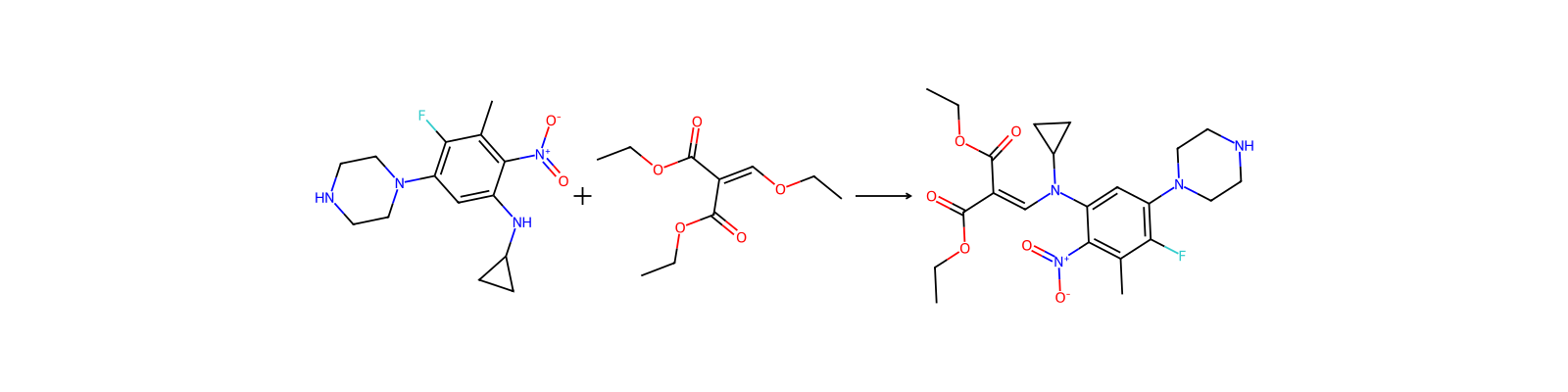
UsesDiethyl ethoxymethylenemalonate is used for synthesis of pyrido[3,2-e]pyrimido[1,2-c]pyrimidines. Initially, it was used to monitor lysine decarboxylase activity. It is useful in the determination of amino acids by precolumn derivatization by using reversed-phase high-performance liquid chromatography (HPLC). It plays an important role in the Gould-Jacobs reaction to prepare quinolines. For example, anile reacts with this reagent to give 4-hydroxyquinoline. It acts as an intermediate in the production of flumequine, which is a fluoroquinolone antibiotic.
Upstream & downstream products
Upstream raw materials
Downstream products
Related reactions
918 records




Compound notes
Loading…