HomeMCPWorkbenchSkills
HomeWorkbenchNotificationsMe
llms.txt · MCP GuidePrivacy Policy · Terms of Service · Supportv1.8.0
  1. Home
  2. /Compound

Ethyl 2-aminobenzoate

HCID 6877
New noteNew reactionRequest quotes
Print preview

Completing data — refresh the page later to see the latest
Basic informationOverviewNames & identifiersPropertiesSafety & regulationChemistry & industryRelated reactionsCompound notes
Substructure searchFind similar structures

Basic information

CAS
87-25-2
Standard SMILES
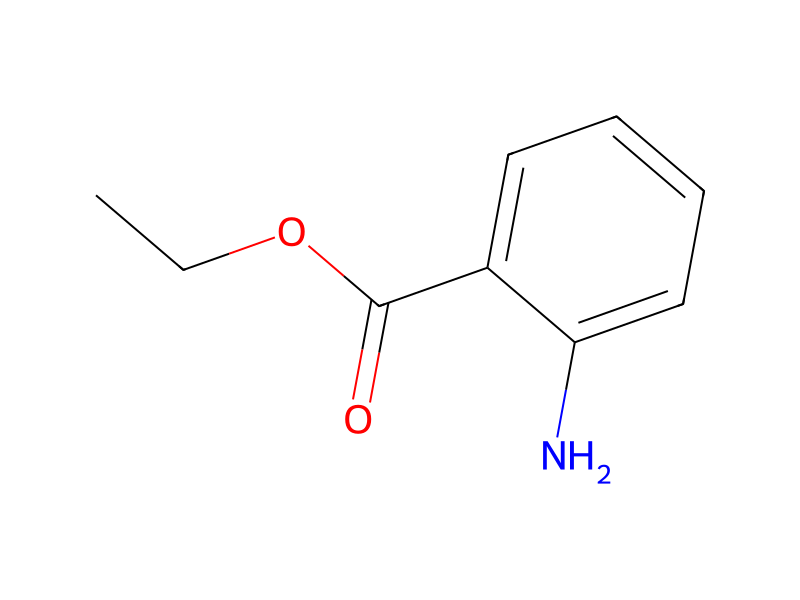
CCOC(=O)c1ccccc1N
InChIKey
TWLLPUMZVVGILS-UHFFFAOYSA-N
Molecular formula
C9H11NO2
Average molar mass
165.19 g/mol
Monoisotopic mass
165.07897859

Overview

Ethyl anthranilate is a colorless liquid with a fruity odor. Insoluble in water. (NTP, 1992)

Names & identifiers

Preferred name
Ethyl 2-aminobenzoate
IUPAC
ethyl 2-aminobenzoate
English name
Ethyl anthranilate
Molecular formula
C9H11NO2
Molecular weight
165.19

Names & synonyms

ETHYL ANTHRANILATEEthyl 2-aminobenzoate87-25-2Ethyl o-aminobenzoate2-Aminobenzoic acid ethyl esterAnthranilic acid, ethyl ester2-Carboethoxyanilineo-(Ethoxycarbonyl)anilineBenzoic acid, o-amino-, ethyl esterBenzoic acid, 2-amino-, ethyl ester2-(Ethoxycarbonyl)anilineFEMA No. 2421
Show more names
FEMA 2421ethyl-o-aminoANTHRANILIC ACID ETHYL ESTEREthylanthranilatEthylanthranilate,98+%
DTXSID602527238Y050IUE4NSC-4146DTXCID805272RefChem:138879201-735-1Benzocaine EP Impurity D1333-08-0

Database identifiers

CAS
87-25-2
PubChem CID
6877
DTXSID
DTXSID6025272
ChEMBL
CHEMBL1332922
ChEBI
CHEBI:173741
UNII
38Y050IUE4
EC Number
201-735-1
Nikkaji
J4.276E

Properties

Computed structural propertiesFilling in

XLogP
2.6
Topological polar surface area
52.3 Ų
Hydrogen bond donors
1
Hydrogen bond acceptors
3
Rotatable bonds
3
Heavy atoms
12
Formal charge
0
Complexity
159

Experimental & physicochemical properties

Chemical ClassesNitrogen Compounds -> Aminobenzoic Acids
SpringerMaterials PropertiesBoiling point
FragrancesFragrance Ingredient (Ethyl anthranilate) -> IFRA transparency List
LogP · 2 items

log Kow = 2.57

2.57

Odor · 2 items

Fruity odor

FAINT ORANGE-FLOWERS ODOR

TasteFAINT ORANGE-FLOWERS TASTE
Food AdditivesFLAVORING AGENT OR ADJUVANT -> FDA Substance added to food
Density · 3 items

1.117 at 68 °F (NTP, 1992) - Denser than water; will sink

1.1174 at 20 °C/4 °C

1.115-1.120

Flavoring AgentsEU Flavoring substances
Color/Form

Safety & regulation

Safety information is for reference only and does not replace the supplier’s Safety Data Sheet (SDS), applicable regulations, or professional assessment.

GHS classification

GHS Classification · 5 items

This chemical does not meet GHS hazard criteria for 84.7% (261 of 308) of all reports.

Warning

H315 (15.3%): Causes skin irritation [Warning Skin corrosion/irritation]

P264, P264+P265, P280, P302+P352, P305+P351+P338, P321, P332+P317, P337+P317, and P362+P364 (click each P-code to see the statement)

Aggregated GHS information provided per 308 reports by companies from 5 notifications to the ECHA C&L Inventory. Each notification may be associated with multiple companies.

Hazard information

Regulatory Information · 4 items

Chemical: Benzoic acid, 2-amino-, ethyl ester

Commission Regulation (EC) No 1565/2000 (Repealed by Com. Implementing Reg. (EU) No 872/2012)

Status: No longer Valid Update: 29-03-2018 https://echa.europa.eu/registration-dossier/-/registered-dossier/23487

Benzoic acid, 2-amino-, ethyl ester: Does not have an individual approval but may be used under an appropriate group standard

Other Safety InformationIMAP assessments - Benzoic acid, 2-amino-, ethyl ester: Human health tier I assessment
Fire HazardsFlash point data for this chemical are not available. It is probably combustible. (NTP, 1992)
Health HazardsSYMPTOMS: Symptoms of exposure to this compound may include local irritation of skin, eye and mucous membranes and dermatitis.
Hazards SummaryEmergency treatment: Irritants; [HSDB] May irritate skin, eyes, and mucous membranes; [CAMEO] Safe when used as a flavoring agent in food; [JECFA] Moderate skin irritant; [RTECS]
FDA Requirements · 1 item

Chemistry & industry

Pharmacology

Cellular LocationsMembrane

Uses & manufacturing

Uses · 6 items

Found in grapes; Used in perfumery, flavoring, and as an inert ingredient in pesticides; [HSDB]

Farming (Pesticides) [Category: Industry]

FLAVOR ADDITIVE IN BAKERY PRODUCTS, GELATIN & PUDDINGS, FROZEN MILK DESSERTS, FLAVORED BEVERAGES, CANDY TOPPINGS, CHEWING GUM

Perfumery and flavors, similar to methyl anthranilate.

Reported uses (ppm): (FEMA, 1994)

Anthranilic acid, ethyl ester is a List 3: Inerts of unknown toxicity (other) Pesticide Ingredient.

U.S. Exports · 2 items

(1972) No Data

(1975) No Data

U.S. Imports · 2 items

(1972) No Data

(1975) No Data

U.S. Production · 2 items

(1972) PROBABLY GREATER THAN 4.54X10+5 GRAMS

(1975) PROBABLY GREATER THAN 4.54X10+5 GRAMS

Methods of Manufacturing · 2 items

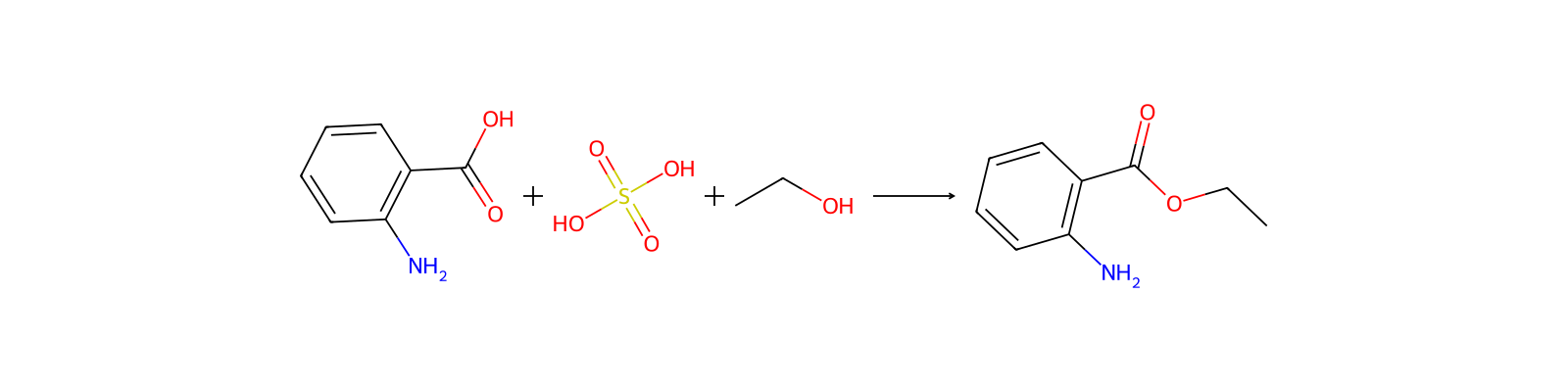
REACTION OF ANTHRANILIC ACID & ETHANOL IN THE PRESENCE OF ACID CATALYSTS

BY ESTERIFICATION OF ANTHRANILIC ACID WITH ETHANOL IN PRESENCE OF ACID CATALYSTS; BY REACTING SODIUM HYPOCHLORITE WITH AN ALKALINE ALCOHOLIC SOLN OF PHTHALIMIDE.

Formulations/PreparationsGRADES: TECHNICAL: FCC
Use Classification · 4 items

Fragrance Ingredients

Flavouring Agent -> FLAVOURING_AGENT -> JECFA Functional Classes

Flavoring Agents -> JECFA Flavorings Index

Flavouring Agent -> FLAVOURING_AGENT -> JECFA Functional Classes

General Manufacturing Information

Related reactions

85 records
New reaction record
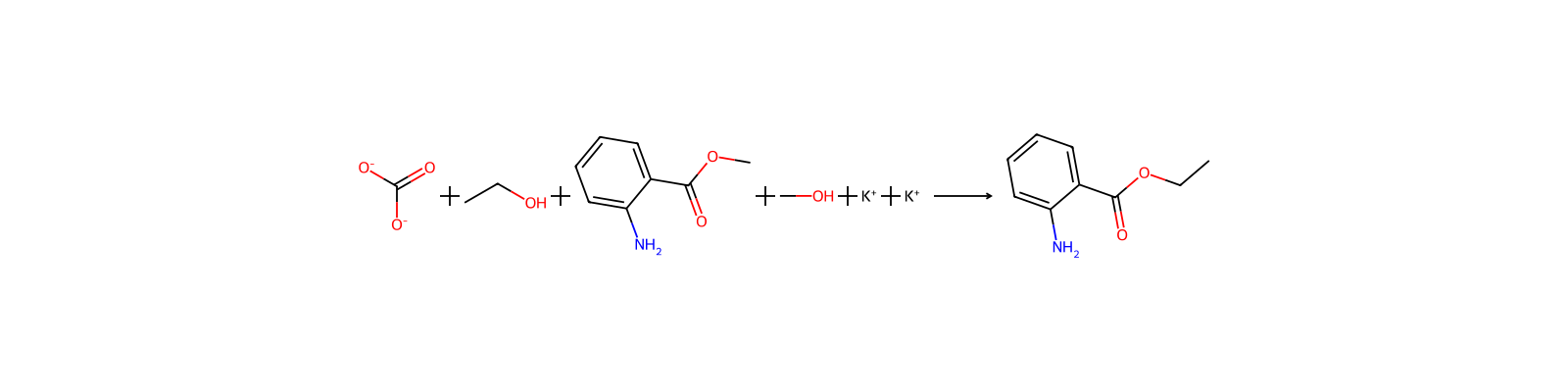
HRID 42036 reaction equation
HRID 42036As productuspto-grants-2013_09
HRID 42070 reaction equation
HRID 42070As reactantuspto-grants-2013_09
HRID 52503 reaction equation
HRID 52503As reactantuspto-grants-1997_04
HRID 52537 reaction equation
HRID 52537As reactantuspto-grants-1997_04
HRID 88232 reaction equation
HRID 88232As reactantTraining data from https://doi.org/10.1039/C8SC04228D (2/10)
HRID 96684 reaction equation
HRID 96684As reactantTraining data from https://doi.org/10.1039/C8SC04228D (2/10)
HRID 114600 reaction equation
HRID 114600As productTraining data from https://doi.org/10.1039/C8SC04228D (2/10)
HRID 125865 reaction equation
HRID 125865As reactantTraining data from https://doi.org/10.1039/C8SC04228D (2/10)
Page 1 of 11

Compound notes

Loading…

On this pageBasic informationOverviewNames & identifiersPropertiesSafety & regulationChemistry & industryRelated reactionsCompound notes
More actions
New noteNew reactionRequest quotes
Colorless liquid
Solubility · 6 items

Insoluble (NTP, 1992)

Very soluble in ether, alcohol

Soluble in propylene glycol

SOLUBILITY IN 60% ALCOHOL: 1:7; 70% ALC: 1:2

Slightly soluble in water; Soluble in propylene glycol and fixed oils

Soluble (in ethanol)

Boiling Point · 4 items

514 °F at 760 mmHg (NTP, 1992)

268 °C at 760 mm Hg

129.00 to 130.00 °C. @ 9.00 mm Hg

267 °C

Physicochemical properties

Melting point
15 °C · 15 °C
Boiling point
268 °C · 268 °C
Density
1.12 · 1.12
vapor density
5.7 · 5.7 (vs air)
FEMA
2421 · 2421 | ETHYL ANTHRANILATE
refractive index
1.56 · 1.56
FLAVIS Number
9.716 · 09.716 | Ethyl anthranilate
Flash point
138 °C · 138 °C
storage temp.
Keep in dark place,Inert atmosphere,Room temperature
solubility
Insoluble in water but soluble in organic solvents
pka
2.2 · 2.20±0.10(Predicted)
form
clear liquid
color
Colorless to Light orange to Yellow
Specific Gravity
1.117 · 1.1170
Odor
100 % · at 100.00 %. sweet floral grape orangeblossom wintergreen
Odor Type
floral
biological source
synthetic
JECFA Number
1535 · 1535
BRN
878874 · 878874
Henry's Law Constant
6.2 · 6.2×102 mol/(m3Pa) at 25℃, HSDB (2015)
Stability
Stable. Combustible. Incompatible with acids, bases, oxidizing agents.
Cosmetics Ingredients Functions
PERFUMING
InChI
1S/C9H11NO2/c1-2-12-9(11)7-5-3-4-6-8(7)10/h3-6H,2,10H2,1H3
InChIKey
TWLLPUMZVVGILS-UHFFFAOYSA-N
SMILES
CCOC(=O)c1ccccc1N
LogP
2.57 · 2.57
Surface tension
39.3 mN/m · 39.3 mN/m at 22°
CAS DataBase Reference
87 · 87-25-2(CAS DataBase Reference)
Substances Added to Food (formerly EAFUS)
ETHYL ANTHRANILATE
FDA 21 CFR
172.515 · 172.515
EWG's Food Scores
1 · 1
FDA UNII
38 Y050IUE4 · 38Y050IUE4
EPA Substance Registry System
Ethyl anthranilate (87-25-2)
UNSPSC Code
41116107 · 41116107
NACRES
24 · NA.24
Symbol(GHS)
7 · GHS07
Signal word
Warning
Hazard statements
315 · H315-H319-H303-H335
Precautionary statements
264 · P264-P280-P302+P352+P332+P313+P362+P364-P305+P351+P338+P337+P313-P261-P280a-P304+P340-P305+P351+P338-P405-P501a
PPE
Eyeshields, Gloves, type ABEK (EN14387) respirator filter
Hazard Codes
Xi
Risk Statements
36 · 36/38
Safety Statements
26 · 26-36
WGK Germany
2 · 2
RTECS
2448000 · DG2448000
Hazard Note
Irritant
TSCA
TSCA listed
HS Code
2922499990 · 2922499990
Storage Class
10 · 10 - Combustible liquids
Hazardous Substances Data
87 · 87-25-2(Hazardous Substances Data)
Toxicity
50 value · The acute oral LD50 value in rats was reported as 3.75 g/kg (3.32-4.18 g/kg) and the acute dermal LD50 value in rabbits exceeded 5 g/kg (Moreno, 1975).
REACH Registrations
Inactive

Ethyl anthranilate is a food additive permitted for direct addition to food for human consumption as a synthetic flavoring substance and adjuvant in accordance with the following conditions: a) they are used in the minimum quantity required to produce their intended effect, and otherwise in accordance with all the principles of good manufacturing practice, and 2) they consist of one or more of the following, used alone or in combination with flavoring substances and adjuvants generally recognized as safe in food, prior-sanctioned for such use, or regulated by an appropriate section in this part.

Reactive GroupEsters, Sulfate Esters, Phosphate Esters, Thiophosphate Esters, and Borate Esters
Special ReportsREVIEW: FRAGRANCE RAW MATERIALS.[OPDYKE DL J; MONOGRAPHS ON FRAGRANCE RAW MATERIALS; ETHYL ANTHRANILATE. FOOD COSMET TOXICOL 14 SUPPL, 759 (1976)]
Reactivity ProfileETHYL ANTHRANILATE may hydrolyze under acidic and basic conditions. (NTP, 1992)
Air and Water ReactionsThis compound should be protected from air and light. Insoluble in water.
Hazard Classes and CategoriesSkin Irrit. 2 (15.3%)

Safety & protection

Fire Fighting · 1 item

This compound is not very flammable but any fire involving this compound may produce dangerous vapors. You should evacuate the area. All firefighters should wear full-body protective clothing and use self-contained breathing apparatuses. You should extinguish any fires involving this chemical with a dry chemical, carbon dioxide, foam, or halon extinguisher. (NTP, 1992)

First Aid · 1 item

EYES: First check the victim for contact lenses and remove if present. Flush victim's eyes with water or normal saline solution for 20 to 30 minutes while simultaneously calling a hospital or poison control center. Do not put any ointments, oils, or medication in the victim's eyes without specific instructions from a physician. IMMEDIATELY transport the victim after flushing eyes to a hospital even if no symptoms (such as redness or irritation) develop.

Fire Fighting Procedures · 3 items

Use water spray, carbon dioxide, dry chemical, or "alcohol" foam. Use water to keep fire-exposed containers cool. If leak or spill has not ignited, use water spray to disperse vapors and to protect men attempting to stop leak.

Water spray may be used to flush spills away from exposures and to dilute spills to nonflammable mixtures.

Personnel protection: Wear self-contained breathing apparatus.

Storage ConditionsProtect against physical damage. Store in cool, well-ventilated location, away from any area where the fire hazard is acute. Outside or detached storage is preferred. Separate from oxidizing materials.
Nonfire Spill Response · 1 item

SMALL SPILLS AND LEAKAGE: If you spill this chemical, use absorbent paper to pick up all liquid spill material. Your contaminated clothing and absorbent paper should be sealed in a vapor-tight plastic bag for eventual disposal. Solvent wash all contaminated surfaces with alcohol followed by washing with a strong soap and water solution. Do not reenter the contaminated area until the Safety Officer (or other responsible person) has verified that the area has been properly cleaned.

Disposal Methods · 1 item

SRP: The most favorable course of action is to use an alternative chemical product with less inherent propensity for occupational exposure or environmental contamination. Recycle any unused portion of the material for its approved use or return it to the manufacturer or supplier. Ultimate disposal of the chemical must consider: the material's impact on air quality; potential migration in soil or water; effects on animal, aquatic, and plant life; and conformance with environmental and public health regulations.

Personal Protective Equipment (PPE) · 1 item

RECOMMENDED RESPIRATOR: Where the neat test chemical is weighed and diluted, wear a NIOSH-approved half face respirator equipped with an organic vapor/acid gas cartridge (specific for organic vapors, HCl, acid gas and SO2) with a dust/mist filter. (NTP, 1992)

Toxicology

Environmental Fate · 3 items

TERRESTRIAL FATE: Based on a classification scheme(1), an estimated Koc value of 600(SRC), determined from a log Kow of 2.57(2) and a regression-derived equation(3), indicates that ethyl anthranilate is expected to have low mobility in soil(SRC). Volatilization of ethyl anthranilate from moist soil surfaces is not expected to be an important fate process(SRC) given an estimated Henry's Law constant of 1.6X10⁻⁸ atm-cu m/mole(SRC), using a fragment constant estimation method(4). Ethyl anthranilate is not expected to volatilize from dry soil surfaces(SRC) based upon an estimated vapor pressure of 2.3X10⁻³ mm Hg(SRC), determined from a fragment constant method(5). Biodegradation data were not available(SRC, 2007).

AQUATIC FATE: Based on a classification scheme(1), an estimated Koc value of 600(SRC), determined from a log Kow of 2.57(2) and a regression-derived equation(3), indicates that ethyl anthranilate is expected to adsorb to suspended solids and sediment(SRC). Volatilization from water surfaces is not expected(3) based upon an estimated Henry's Law constant of 1.6X10⁻⁸ atm-cu m/mole(SRC), developed using a fragment constant estimation method(4). Hydrolysis is expected to be a slow environmental fate process; estimated second order hydrolysis half-lives are 5.8 years and 210 days at pH values of 7 and 8, respectively(5). According to a classification scheme(6), an estimated BCF of 19(SRC), from its log Kow(2) and a regression-derived equation(7), suggests the potential for bioconcentration in aquatic organisms is low(SRC). Biodegradation data were not available(SRC, 2007).

ATMOSPHERIC FATE: According to a model of gas/particle partitioning of semivolatile organic compounds in the atmosphere(1), ethyl anthranilate, which has an estimated vapor pressure of 2.3X10⁻³mm Hg at 25 °C(SRC), determined from a fragment constant method(2), is expected to exist solely as a vapor in the ambient atmosphere. Vapor-phase ethyl anthranilate is degraded in the atmosphere by reaction with photochemically-produced hydroxyl radicals(SRC); the half-life for this reaction in air is estimated to be 11 hours(SRC), calculated from its rate constant of 3.6X10⁻¹¹ cu cm/molecule-sec at 25 °C(SRC) that was derived using a structure estimation method(3). Ethyl anthranilate does absorb light at UV max of 330 nm(4) and therefore may be susceptible to direct photolysis by sunlight.

Soil Adsorption/Mobility · 1 item

The Koc of ethyl anthranilate is estimated as 600(SRC), using a log Kow of 2.57(1) and a regression-derived equation(2). According to a classification scheme(3), this estimated Koc value suggests that ethyl anthranilate is expected to have low mobility in soil.

Natural Pollution SourcesIN GRAPES
Artificial Pollution SourcesEthyl anthranilate's production and use as a perfume and flavor additive(1) may result in its release to the environment through various waste streams.
Environmental Bioconcentration · 1 item

An estimated BCF of 19 was calculated in fish for ethyl anthranilate(SRC), using a log Kow of 2.57(1) and a regression-derived equation(2). According to a classification scheme(3), this BCF suggests the potential for bioconcentration in aquatic organisms is low(SRC).

Volatilization from Water/Soil · 1 item

The Henry's Law constant for ethyl anthranilate is estimated as 1.6X10⁻⁸ atm-cu m/mole(SRC) using a fragment constant estimation method(1). This Henry's Law constant indicates that ethyl anthranilate is expected to be essentially nonvolatile from water surfaces(2). Ethyl anthranilate's Henry's Law constant indicates that volatilization from moist soil surfaces may not occur(SRC). Ethyl anthranilate is not expected to volatilize from dry soil surfaces(SRC) based upon an estimated vapor pressure of 2.3X10⁻³ mm Hg(SRC), determined from a fragment constant method(3).

Non-Human Toxicity Excerpts · 2 items

/GENOTOXICITY/ Ethyl anthranilate was tested for mutagenicity in the Salmonella/ microsome preincubation assay using the standard protocol approved by the National Toxicology Program. Ethyl anthranilate was tested at doses of 0.01, 0.033, 0.10, 0.33, 0.50, and 0.80 mg/plate in as many as 5 Salmonella typhimurium strains (TA 1535, TA 1537, TA 97, TA 98, and TA 100) in the presence and absence of rat or hamster liver S-9. Ethyl anthranilate was negative in these tests and the highest ineffective dose tested without significant toxicity in any S. typhimurium strain was 0.33 mg/plate. Total clearing of the background bacterial lawn occurred in nearly all cultures tested at doses above this level.

/OTHER TOXICITY INFORMATION/ Listed in FDA's Food Additive Database as a chemical for which fully up-to-date toxicology information has been sought.

Environmental Abiotic Degradation · 1 item

The rate constant for the vapor-phase reaction of ethyl anthranilate with photochemically-produced hydroxyl radicals has been estimated as 3.6X10⁻¹¹ cu cm/molecule-sec at 25 °C(SRC) using a structure estimation method(1). This corresponds to an atmospheric half-life of about 11 hours at an atmospheric concentration of 5X10+5 hydroxyl radicals per cu cm(1). A base-catalyzed second-order hydrolysis rate constant of 3.8X10⁻² L/mole-sec(SRC) was estimated using a structure estimation method(2); this corresponds to half-lives of 5.8 years and 210 days at pH values of 7 and 8, respectively(2). Ethyl anthranilate does absorb light at UV max of 330 nm(3) and therefore may be susceptible to direct photolysis by sunlight.

Probable Routes of Human Exposure · 1 item

Occupational exposure to ethyl anthranilate may occur through dermal contact with this compound at workplaces where ethyl anthranilate is produced or used. Use data suggest the general population may be exposed to ethyl anthranilate via ingestion of food, and dermal contact with this compound and other products containing ethyl anthranilate. (SRC)

Environmental Fate/Exposure Summary · 1 item

Ethyl anthranilate's production and use as a perfume and flavor additive may result in its release to the environment through various waste streams. If released to air, an estimated vapor pressure of 2.3X10⁻³ mm Hg at 25 °C indicates ethyl anthranilate will exist solely as a vapor in the atmosphere. Vapor-phase ethyl anthranilate will be degraded in the atmosphere by reaction with photochemically-produced hydroxyl radicals; the half-life for this reaction in air is estimated to be 11 hours. Ethyl anthranilate does absorb light at UV max of 330 nm and therefore may be susceptible to direct photolysis by sunlight. If released to soil, ethyl anthranilate is expected to have low mobility based upon an estimated Koc of 600. Volatilization from moist soil surfaces is not expected to be an important fate process based upon an estimated Henry's Law constant of 1.6X10⁻⁸ atm-cu m/mole. Biodegradation data were not available. If released into water, ethyl anthranilate is expected to adsorb to suspended solids and sediment based upon the estimated Koc. Volatilization from water surfaces is not expected to be an important fate process based upon this compound's estimated Henry's Law constant. An estimated BCF of 19 suggests the potential for bioconcentration in aquatic organisms is low. Hydrolysis is expected to be a slow environmental fate process; estimated second order hydrolysis half-lives are 5.8 years and 210 days at pH values of 7 and 8, respectively. Occupational exposure to ethyl anthranilate may occur through dermal contact with this compound at workplaces where ethyl anthranilate is produced or used. Use data suggest the general population may be exposed to ethyl anthranilate via ingestion of food, and dermal contact with this compound and other products containing ethyl anthranilate. (SRC)

Antidote and Emergency Treatment · 2 items

Basic treatment: Establish a patent airway (oropharyngeal or nasopharyngeal airway, if needed). Suction if necessary. Watch for signs of respiratory insufficiency and assist respirations if necessary. Administer oxygen by nonrebreather mask at 10 to 15 L/min. Monitor for pulmonary edema and treat if necessary ... . Monitor for shock and treat if necessary ... . For eye contamination, flush eyes immediately with water. Irrigate each eye continuously with 0.9% saline (NS) during transport ... . Do not use emetics. For ingestion, rinse mouth and administer 5 mL/kg up to 200 mL of water for dilution if the patient can swallow, has a strong gag reflex, and does not drool. Activated charcoal is not effective ... . Do not attempt to neutralize because of exothermic reaction. Cover skin burns with dry, sterile dressings after decontamination ... . /Organic acids and related compounds/

Advanced treatment: Consider orotracheal or nasotracheal intubation for airway control in the patient who is unconscious, has severe pulmonary edema, or is in severe respiratory distress. Early intubation, at the first sign of upper airway obstruction, may be necessary. Positive-pressure ventilation techniques with a bag valve mask device may be beneficial. Consider drug therapy for pulmonary edema ... . Consider administering a beta agonist such as albuterol for severe bronchospasm ... . Monitor cardiac rhythm and treat arrhythmias as necessary ... . Start IV administration of D5W /SRP: "To keep open", minimal flow rate/. Use 0.9% saline (NS) or lactated Ringer's (LR) if signs of hypovolemia are present. For hypotension with signs of hypovolemia, administer fluid cautiously. Consider vasopressors if patient is hypotensive with a normal fluid volume. Watch for signs of fluid overload ... . Use proparacaine hydrochloride to assist eye irrigation ... . /Organic acids and related compounds/

Non-Human Toxicity ValuesLD50 Rat oral 3750 mg/kg

Regulatory information

FDA Requirements · 1 item

Ethyl anthranilate is a food additive permitted for direct addition to food for human consumption as a synthetic flavoring substance and adjuvant in accordance with the following conditions: a) they are used in the minimum quantity required to produce their intended effect, and otherwise in accordance with all the principles of good manufacturing practice, and 2) they consist of one or more of the following, used alone or in combination with flavoring substances and adjuvants generally recognized as safe in food, prior-sanctioned for such use, or regulated by an appropriate section in this part.

Safety data

PPE
Eyeshields, Gloves, type ABEK (EN14387) respirator filter
wgk
2
tsca
TSCA listed
rtecs
DG2448000
hs_code
2922499990
Toxicity
The acute oral LD50 value in rats was reported as 3.75 g/kg (3.32-4.18 g/kg) and the acute dermal LD50 value in rabbits exceeded 5 g/kg (Moreno, 1975).
risk_code
36/38
Signal word
Warning
Symbol(GHS)
GHS07
hazard_code
Xi
hazard_note
Irritant
safety_code
26-36
Storage Class
10 - Combustible liquids
Hazard statements
H315-H319-H303-H335
REACH Registrations
Inactive
Precautionary statements
P264-P280-P302+P352+P332+P313+P362+P364-P305+P351+P338+P337+P313-P261-P280a-P304+P340-P305+P351+P338-P405-P501a
Hazardous Substances Data
87-25-2(Hazardous Substances Data)
· 4 items

Benzoic acid, 2-amino-, ethyl ester: ACTIVE

REPORTED USES: 5.9 PPM IN NON-ALCOHOLIC BEVERAGES; 7.6 PPM IN ICE CREAM, ICES; 19 PPM IN CANDY; 23 PPM IN BAKED GOODS; 14 PPM IN GELATINS & PUDDINGS; 79 PPM IN CHEWING GUM.

USEFUL IN CONCORD GRAPE WINE FLAVORS, MANDARIN.

FEMA NUMBER 2421

Applications · 4 items

OccurrenceReported found in grapes, orange juice, orange peel oil, starfruit and Vitis labrusca L.

UsesEthyl 2-aminobenzoate is used as a reactant in the amination of aryl chlorides, bromides, and triflates.

UsesPerfumery and flavors, similar to methyl anthranilate.

General DescriptionColorless liquid with a fruity odor. Insoluble in water.

Preparation methods

PreparationBy esterification of anthranilic acid with ethanol in the presence of acid catalysts; by reacting sodium hypochlorite with an alkaline solution of phthalimide

Upstream & downstream products

Upstream raw materials

Sodium hypochloriteDIALIFOSAnthranilic acid

Downstream products

Bentazone1,2-Dihydro-4-hydroxy-2-oxo-3-quinolinecarboxylic acid ethyl ester4-Chloro-2-chloromethylquinazoline2-Ethoxycarbonylphenyl isothiocyanate1H-[1]-Benzazephe-2,5(3H, 4H)-dione4-Hydroxyquinoline-3-carboxylic acid ethyl ester2-[(4-Ethoxy-1,4-dioxobutyl)amino]benzoic acid ethyl esterPurino[8,7-b]quinazoline-2,4,6(1H,3H,11H)-trione, 1,3-dimethyl- (9CI)ethyl N-salicyloylanthranilate

Additional notes

DefinitionChEBI: Ethyl 2-aminobenzoate is a benzoate ester.