
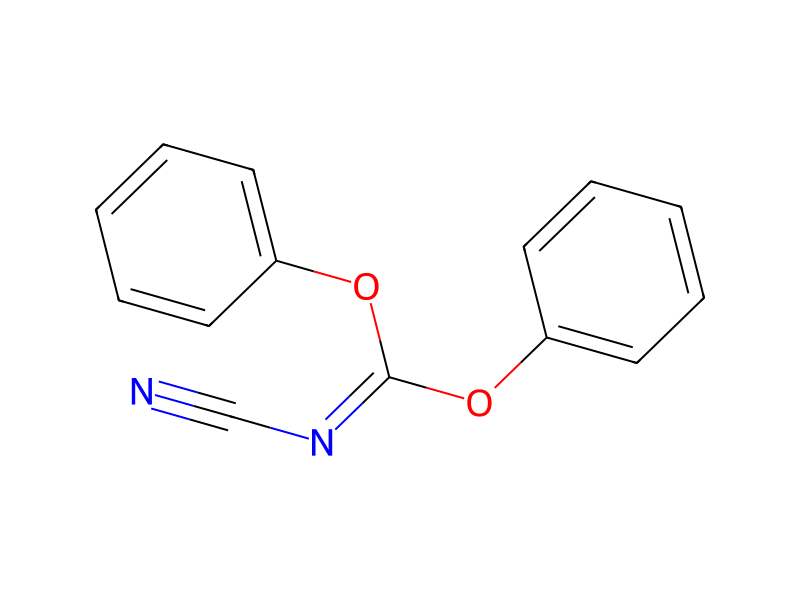
Basic information
- CAS
79463-77-7- Standard SMILES
N#CN=C(Oc1ccccc1)Oc1ccccc1- InChIKey
SLIKWVTWIGHFJE-UHFFFAOYSA-N- Molecular formula
- C14H10N2O2
- Average molar mass
- 238.24 g/mol
- Monoisotopic mass
- 238.07422756
Names & identifiers
- Preferred name
- Diphenyl N-Cyanocarbonimidate
- IUPAC
- diphenoxymethylidenecyanamide
- English name
- Diphenyl N-cyanocarbonimidate
- Molecular formula
- C14H10N2O2
- Molecular weight
- 238.24
Names & synonyms
Diphenyl N-cyanocarbonimidateDiphenyl cyanocarbonimidatediphenoxymethylenecyanamideDTXSID70350786EC 427-300-8RefChem:588833DTXCID10301853427-300-8628-090-279463-77-7diphenoxymethylidenecyanamideMFCD00010380
Show more names
SKL316AURORA KA-4382N-cyanocarbonimidateDiphenylN-CyanocarbonimideN-CYANODIPHENYLIMIDOCARBONATEDiphenylcyanocarbonimidate,97%
Cyanocarbonimidia acid diphenyl aestercyano(diphenoxymethylidene)aminediphenylcyanocarbonimidatediphenyl cyancarbonimidateMaybridge1_007626diphenyl-N-cyanoimidocarbonateN-Cyano-diphenyl imidocarbonateHMS563C14
Database identifiers
- CAS
79463-77-7- PubChem CID
- 688090
- DTXSID
DTXSID70350786- EC Number
- 427-300-8、628-090-2
- Nikkaji
- J995.321C
Properties
Computed structural properties
- XLogP
- 3.6
- Topological polar surface area
- 54.6 Ų
- Hydrogen bond donors
- 0
- Hydrogen bond acceptors
- 4
- Rotatable bonds
- 4
- Heavy atoms
- 18
- Formal charge
- 0
- Complexity
- 298
Physicochemical properties
- Melting point
- 155 · 155-158 °C (lit.)
- Boiling point
- 380.84 °C · 380.84°C (rough estimate)
- Density
- 1.1907 · 1.1907 (rough estimate)
- refractive index
- 1.65 · 1.6500 (estimate)
- storage temp.
- 2 · under inert gas (nitrogen or Argon) at 2-8°C
- solubility
- -2 · sol THF, propan-2-ol.
- form
- Fluffy Powder
- pka
- -6.7 · -6.70±0.50(Predicted)
- color
- White
- Water Solubility
- Insoluble in water.
- Sensitive
- Moisture Sensitive
- BRN
- 4254248 · 4254248
- InChI
- InChI=1S/C14H10N2O2/c15-11-16-14(17-12-7-3-1-4-8-12)18-13-9-5-2-6-10-13/h1-10H
- InChIKey
- SLIKWVTWIGHFJE-UHFFFAOYSA-N
- SMILES
- C(=N/C#N)(/OC1=CC=CC=C1)\OC1=CC=CC=C1
Safety & regulation
GHS classification
GHS Classification
Danger
H318: Causes serious eye damage [Danger Serious eye damage/eye irritation]
P264+P265, P273, P280, P305+P354+P338, P317, and P501 (click each P-code to see the statement)
Danger
H302 (86.7%): Harmful if swallowed [Warning Acute toxicity, oral]
P261, P264, P264+P265, P270, P271, P273, P280, P301+P317, P302+P352, P304+P340, P305+P351+P338, P305+P354+P338, P317, P319, P321, P330, P332+P317, P337+P317, P362+P364, P403+P233, P405, and P501 (click each P-code to see the statement)
Hazard information
Regulatory InformationStatus: Cease Manufacture Update: 10-11-2008 https://echa.europa.eu/registration-dossier/-/registered-dossier/4452
Hazard Classes and Categories
Acute Tox. 4 (86.7%)
Eye Dam. 1 (100%)
Eye damage - category 1
Eye Dam. 1
Safety data
- F
- 10-21
- PPE
- dust mask type N95 (US), Eyeshields, Gloves
- wgk
- 3
- ridadr
- 3439
- hs_code
- 29269090
- risk_code
- 20/21/22-36/37/38
- Signal word
- Danger
- Symbol(GHS)
- GHS05
- hazard_code
- Xn
- safety_code
- 26-36/37
- hazard_class
- 6.1
- Storage Class
- 11 - Combustible Solids
- packing_group
- III
Chemistry & industry
Applications
UsesDiphenyl N-cyanocarbonimidate has been used in the preparation of N-substituted 2-amino-4H-3,1-benzoxazines, cyanoguanidine derivatives, oxadiazoles.
UsesDiphenyl Cyanocarbonimidate (DPCC) is used for preparation of heterocycles, 1,2,4-triazoles, 4-oxa-1,3-diazoles, benzimidazoles, hexahydropyrimidines, and hydroquinazolines; synthesis of O-phenylisoureas, N-cyanoguanidines, and guanidines; modification of peptides; reverse electron demand Diels-Alder heterodieneophile.
Preparation methods
PreparationDiphenyl Cyanocarbonimidate is prepared from diphenyl carbonate by treatment with PCl5 followed by cyanamide.[1]
Upstream & downstream products
Upstream raw materials
Downstream products
Suppliers92 total
梯希爱(上海)化成工业发展有限公司021-67121386 · [email protected]
陕西缔都新材料有限公司81124267 17392282731 · [email protected]
Hebei Chuanghai Biotechnology Co., Ltd+86-17732866630 · [email protected]
Related reactions
91 records


Compound notes
Loading…