

Basic information
- Standard SMILES
COC1=C(OC)C(=O)C(C)=CC1=O- InChIKey
UIXPTCZPFCVOQF-UHFFFAOYSA-N- Molecular formula
- C9H10O4
- Average molar mass
- 182.17 g/mol
- Monoisotopic mass
- 182.0579088
Overview
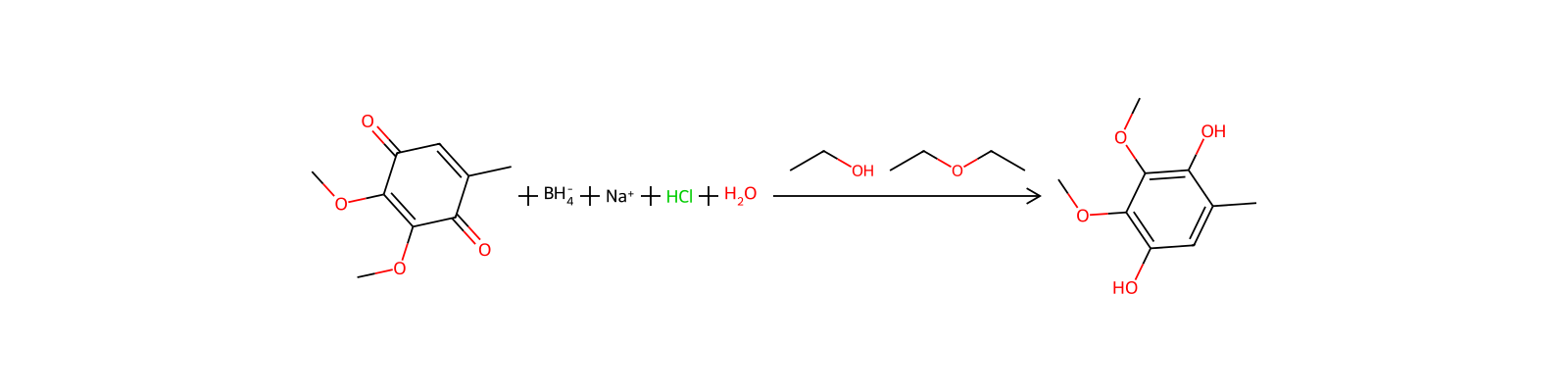
Ubiquinone-0 is a derivative of benzoquinone carrying a 5-methyl substituent; and methoxy substituents at positions 2 and 3. The core structure of the ubiquinone group of compounds. It has a role as an Escherichia coli metabolite and a human metabolite.
Names & identifiers
- Preferred name
- 2,3-Dimethoxy-5-methyl-1,4-benzoquinone
- IUPAC
- 2,3-dimethoxy-5-methylcyclohexa-2,5-diene-1,4-dione
- English name
- 2,3-Dimethoxy-5-methyl-p-benzoquinone
- Molecular formula
- C9H10O4
- Molecular weight
- 182.17
Names & synonyms
605-94-7Coenzyme Q02,3-Dimethoxy-5-methyl-1,4-benzoquinone2,3-dimethoxy-5-methylcyclohexa-2,5-diene-1,4-dioneUbiquinone 0Ubiquinone-0Ubiquinone Q0CoQ0Ubiquinone-OCoenzyme Qo2-Methyl-4,5-dimethoxy-p-quinoneUQ(0) cpd
Show more names
q0COENZYME QUbiquinonl
DTXSID902092422,3-dimethoxy-5-methyl-2,5-cyclohexadiene-1,4-dioneCHEBI:27906RefChem:908653DTXCID10131733210-100-82,3-Dimethoxy-5-methyl-p-benzoquinone2,5-Cyclohexadiene-1,4-dione, 2,3-dimethoxy-5-methyl-
Database identifiers
- CAS
605-94-7- PubChem CID
- 69068
- DTXSID
DTXSID90209242- ChEMBL
CHEMBL1812772- ChEBI
CHEBI:27906- EC Number
- 210-100-8
- Nikkaji
- J24.264K
Properties
Computed structural properties
- XLogP
- 0.8
- Topological polar surface area
- 52.6 Ų
- Hydrogen bond donors
- 0
- Hydrogen bond acceptors
- 4
- Rotatable bonds
- 2
- Heavy atoms
- 13
- Formal charge
- 0
- Complexity
- 323
Experimental & physicochemical properties
SpringerMaterials PropertiesCrystal structure
Physicochemical properties
- Melting point
- 58 · 58-60 °C(lit.)
- Boiling point
- 331.4 · 331.4±42.0 °C(Predicted)
- Density
- 1.19 · 1.19±0.1 g/cm3(Predicted)
- storage temp.
- 2 · 2-8°C
- Water Solubility
- almost transparency in hot Water
- solubility
- 100 mg/ml; · DMF: 100 mg/ml; DMSO: 100 mg/ml; Ethanol: 5 mg/ml; PBS (pH 7.2): 0.2 mg/ml
- form
- Crystalline Powder or Needles
- color
- Red to orange
- Sensitive
- Light Sensitive
- BRN
- 1640422 · 1640422
- Stability
- Stable. Combustible. Incompatible with strong oxidizing agents, reducing agents.
- InChI
- 1S/C9H10O4/c1-5-4-6(10)8(12-2)9(13-3)7(5)11/h4H,1-3H3
- InChIKey
- UIXPTCZPFCVOQF-UHFFFAOYSA-N
- SMILES
- COC1=C(OC)C(=O)C(C)=CC1=O
- CAS DataBase Reference
- 605 · 605-94-7(CAS DataBase Reference)
- NIST Chemistry Reference
- 2 · 2,5-Cyclohexadiene-1,4-dione, 2,3-dimethoxy-5-methyl-(605-94-7)
- UNSPSC Code
- 12352204 · 12352204
- NACRES
- 51 · NA.51
- Symbol(GHS)
- 7 · GHS07
- Signal word
- Warning
- Hazard statements
- 315 · H315-H319-H335
- Precautionary statements
- 261 · P261-P264-P271-P280-P302+P352-P305+P351+P338
- target organs
- Respiratory system
- PPE
- 95 · dust mask type N95 (US), Eyeshields, Gloves
- Hazard Codes
- Xi
- Risk Statements
- 36 · 36/37/38
- Safety Statements
- 26 · 26-36
- WGK Germany
- 2 · 2
- F
- 8 · 8-10-21
- HS Code
- 29146990 · 29146990
- Storage Class
- 11 · 11 - Combustible Solids
- Hazard Classifications
- 2 Skin · Eye Irrit. 2Skin Irrit. 2STOT SE 3
Safety & regulation
GHS classification
GHS Classification
Warning
H315 (100%): Causes skin irritation [Warning Skin corrosion/irritation]
P261, P264, P264+P265, P271, P280, P302+P352, P304+P340, P305+P351+P338, P319, P321, P332+P317, P337+P317, P362+P364, P403+P233, P405, and P501 (click each P-code to see the statement)
Aggregated GHS information provided per 45 reports by companies from 5 notifications to the ECHA C&L Inventory. Each notification may be associated with multiple companies.
Hazard information
Regulatory Information2,5-Cyclohexadiene-1,4-dione, 2,3-dimethoxy-5-methyl-: Does not have an individual approval but may be used under an appropriate group standard
Hazard Classes and CategoriesSkin Irrit. 2 (100%)
Safety data
- F
- 8-10-21
- PPE
- dust mask type N95 (US), Eyeshields, Gloves
- wgk
- 2
- hs_code
- 29146990
- risk_code
- 36/37/38
- Signal word
- Warning
- Symbol(GHS)
- GHS07
- hazard_code
- Xi
- safety_code
- 26-36
- Storage Class
- 11 - Combustible Solids
- target organs
- Respiratory system
- Hazard statements
- H315-H319-H335
- Hazard Classifications
- Eye Irrit. 2Skin Irrit. 2STOT SE 3
- Precautionary statements
- P261-P264-P271-P280-P302+P352-P305+P351+P338
Chemistry & industry
Applications
Uses2,3-Dimethoxy-5-methyl-p-benzoquinone (Ubidecarenone EP Impurity A)
General Description2,3-Dimethoxy-5-methyl-p-benzoquinone (Coenzyme Q0 or DMM) is present in all the cells including neural cells.
Upstream & downstream products
Upstream raw materials
Downstream products
Suppliers50 total
北京华美互利生物化工010-56205725 · [email protected]
梯希爱(上海)化成工业发展有限公司021-67121386 · [email protected]
上海阿拉丁生化科技股份有限公司400-6206333 13167063860 · [email protected]
Hong Kong Tiansheng New Material Trading Co., Ltd+8617320695765 · [email protected]
Baoji Guokang Healthchem co.,ltd+8615604608665 15604608665 · [email protected]
Dayang Chem (Hangzhou) Co.,Ltd.+86-0571-88938639 17705817739 · [email protected]
北京安司莫森技术有限公司010-82954736 13391601435 · [email protected]
上海将来实业股份有限公司400-0066400 13621662912 · [email protected]
上海迈瑞尔生化科技有限公司4006356688 18621169109 · [email protected]
上海晶抗生物工程有限公司021-54721350 13524668266 · [email protected]
阿法埃莎(中国)化学有限公司400-6106006 · [email protected]
安耐吉化学&3A(安徽泽升科技股份有限公司)400-0056266 · [email protected]
孟成科技(上海)有限公司400-820-6829 · [email protected]
上海瀚鸿科技股份有限公司021-54306202 13764082696 · [email protected]
怀化市冰峰化工有限公司0745-2866851 17711757908 · [email protected]
上海景颜化工科技有限公司13817811078 · [email protected]
上海泰坦科技股份有限公司400-6009262 15618770481 · [email protected]
上海隆盛化工有限公司58099637 13585536065 · [email protected]
孝感深远化工有限公司15527621225; 15527621225 · [email protected]
四川库利南科技有限公司400-1166-196 18981987031 · [email protected]
天津希恩思生化科技有限公司400 638 7771 · [email protected]
Xiamen AmoyChem Co., Ltd+86-86-5926051114 · [email protected]
北京泰亚杰科技有限公司021-33690831-8001 13552411790;18616022633 · [email protected]
上海源叶生物科技有限公司13636370518 · [email protected]
艾科试剂4008-755-333 18080918076 · [email protected]
上海思域化工科技有限公司86-21-34053660 · [email protected]
赛默飞世尔科技(中国)有限公司800-810-5118 · [email protected]
TCI AMERICA800-4238616 · [email protected]
TOKYO CHEMICAL INDUSTRY CO., LTD.03-36680489 · [email protected]
TCI Europe320-37350700 · [email protected]
西安奕诺生物科技有限公司18809207782 18809207782 · [email protected]
深圳振强药物研发有限公司0755-66853366 13670046396 · [email protected]
上海睿升化工科技有限公司+86-021-50935922
上海将来实业股份有限公司400-0066400 13621662912 · [email protected]
上海将来实业股份有限公司021-61552785 · [email protected]
安徽科迪达化工有限公司0554-2106669 · [email protected]
HBCChem, Inc.+1-510-219-6317 · [email protected]
日照力德士化工有限公司010-51268198 · [email protected]
郑州鸿晟医药科技有限公司0371-0371-13526885213 15637198702 · [email protected]
美岚实业(上海)有限公司021-58958189 · [email protected]
上海爱蝶实业有限公司021-58957966 18930537195 · [email protected]
成都零六生物科技有限公司400-1166-196 13458535857 · [email protected]
广拓化学(上海)有限公司021-60899189-8001 18918189673 · [email protected]
上海鑫圭生物科技有限公司15121041756 · [email protected]
江苏艾康生物医药研发有限公司025-66028182 17714375163 · [email protected]
Sigma-Aldrich西格玛奥德里奇(上海)贸易有限公司021-61415566 800-8193336 · [email protected]
TargetMol中国(陶术生物)021-021-33632979 15002134094 · [email protected]
九鼎化学(上海)科技有限公司4009209199 · [email protected]
厦门志信化学有限公司+86-5922680277 +86-13806087780 · [email protected]
泰安嘉岳生物化工有限公司15318151873 · [email protected]
Additional notes
DefinitionChEBI: A derivative of benzoquinone carrying a 5-methyl substituent; and methoxy substituents at positions 2 and 3. The core structure of the ubiquinone group of compounds.
Related reactions
7 records



Linked notes
Loading…