
Thiophene-3-carboxylic acid
Completing data — refresh the page later to see the latest
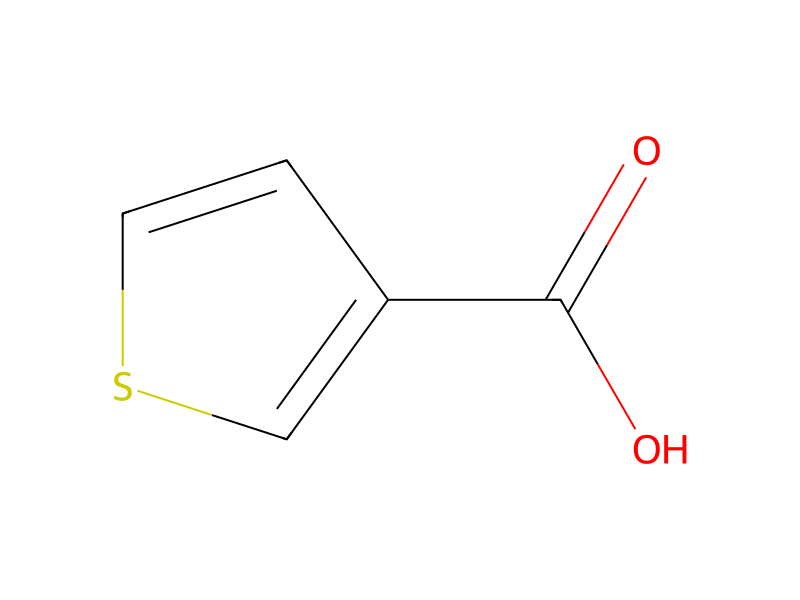
Basic information
- CAS
88-13-1- Standard SMILES
O=C(O)c1ccsc1- InChIKey
YNVOMSDITJMNET-UHFFFAOYSA-N- Molecular formula
- C5H4O2S
- Average molar mass
- 128.15 g/mol
- Monoisotopic mass
- 127.99320037
Overview
structure in first source
Names & identifiers
- Preferred name
- Thiophene-3-carboxylic acid
- IUPAC
- thiophene-3-carboxylic acid
- English name
- 3-Thiophenezoic acid
- Molecular formula
- C5H4O2S
- Molecular weight
- 128.15
Names & synonyms
Thiophene-3-carboxylic acidRefChem:9547988-13-13-Thiophenecarboxylic acid3-Thenoic acid3-thiophenezoic acid3-Thienylcarboxylic acidMFCD00005467.beta.-Thiophenic acid.beta.-Thiophenecarboxylic acidCHEMBL1645856V3012Q6BE
Show more names
3-Thenoylic acid3-ThiophenecarboxylicThiophene-3-carboxylic acid ,99%S0503AKOS 207-06JACS-88-13-1AKOS B013976
NSC-66314beta-Thiophenic acid3-Carboxythiophenebeta-Thiophenecarboxylic acidEINECS 201-802-5NSC 66314thiophene-3-carboxylicacidBRN 0001994
Database identifiers
- CAS
88-13-1- PubChem CID
- 6918
- DTXSID
DTXSID40236745- ChEMBL
CHEMBL164585- UNII
- 6V3012Q6BE
- EC Number
- 201-802-5
- Nikkaji
- J4.287K
Properties
Computed structural propertiesFilling in
- XLogP
- 1.5
- Topological polar surface area
- 65.5 Ų
- Hydrogen bond donors
- 1
- Hydrogen bond acceptors
- 3
- Rotatable bonds
- 1
- Heavy atoms
- 8
- Formal charge
- 0
- Complexity
- 103
Experimental & physicochemical properties
SpringerMaterials PropertiesChemical shift
Physicochemical properties
- Melting point
- 136 · 136-141 °C (lit.)
- Boiling point
- 260 °C · 260°C (estimate)
- Density
- 1.305 · 1.305 (estimate)
- refractive index
- 1.516 · 1.5160 (estimate)
- storage temp.
- Keep in dark place,Sealed in dry,Room Temperature
- solubility
- 0.2 g/10 · water: soluble0.2g/10 mL, clear to almost clear, colorless to slightly brownish-yellow
- form
- Crystalline Powder
- pka
- 4.1 · 4.1(at 25℃)
- color
- White to slightly yellow
- Water Solubility
- 4.3 g/L · 4.3 g/L (25 ºC)
- Merck
- 14 · 14,9279
- BRN
- 1994 · 1994
Safety & regulation
Safety information is for reference only and does not replace the supplier’s Safety Data Sheet (SDS), applicable regulations, or professional assessment.
GHS classification
GHS Classification
Warning
H315 (100%): Causes skin irritation [Warning Skin corrosion/irritation]
P261, P264, P264+P265, P271, P280, P302+P352, P304+P340, P305+P351+P338, P319, P321, P332+P317, P337+P317, P362+P364, P403+P233, P405, and P501 (click each P-code to see the statement)
Aggregated GHS information provided per 9 reports by companies from 6 notifications to the ECHA C&L Inventory. Each notification may be associated with multiple companies.
Hazard information
Hazard Classes and CategoriesSkin Irrit. 2 (100%)
Safety data
- PPE
- Eyeshields, Gloves, type N95 (US)
- wgk
- 3
- rtecs
- XM8330300
- hs_code
- 29349990
- risk_code
- 36/37/38
- Signal word
- Warning
- Symbol(GHS)
- GHS07
- hazard_code
- Xi
- safety_code
- 22-24/25-37/39-26-36
- hazard_class
- IRRITANT
- Storage Class
- 11 - Combustible Solids
- Hazard statements
- H315-H319-H335
- Precautionary statements
- P261-P280a-P304+P340-P305+P351+P338-P405-P501a
Chemistry & industry
Applications
Description3-Thiophenezoic acid is a polymer monomer that can be used to synthesise thiophene derivative polymers, such as the poly(3-thiophene benzoic acid) (PTPA), the copolymer of 3-bromothiophene (BTP) and 3-thiophenezoic acid (TPA). These compounds are an important class of conductive polymers, typically exhibiting favourable electrochemical activity, environmental stability, and ease of processing.
Uses3-Thiophenecarboxylic Acid was used as a lading compound for the development of a clinic useful D-amino acid inhibitor and have the potential to sever as active site proves to elucidate the structure-function relationships of D-amino acids.
General DescriptionMechanism of photopolymerization of 3-thiophenecarboxylic acid catalyzed by potassium dichromate has been reported.
Upstream & downstream products
Downstream products
Related reactions
209 records


Compound notes
Loading…